














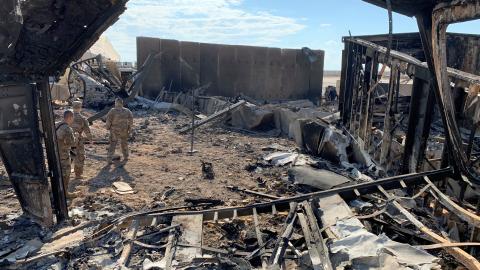
On January 8, 2020, the Islamic Revolutionary Guard Corps (IRGC), Iran’s praetorian guard that the United States has designated as a foreign terrorist organization, conducted a coordinated ballistic missile strike against American forces stationed in Iraq, at Ain al-Asad Air Base and a second military facility. Under direct orders from the Supreme Leader Ali Khamenei, the IRGC launched the attacks in retaliation for the killing of Iranian General Qassem Soleimani, then commander of the IRGC Quds Force, which orchestrates the regime’s infamous proxy warfare network.
Launched in multiple waves between the late night and the early morning, the salvo produced no immediate fatalities. Western media depicted the operation as deliberately restrained—calibrated by the IRGC to inflict harm while staying below thresholds that would compel escalation. But recent open-source intelligence assessments have eroded these claims. Investigative reporting suggests that Iran may have used at least one warhead in the attacks that incorporated radiological or other toxic components.1 These fit a pattern of Iranian strategic actions. Decades before the 2020 strike, senior regime figures had already framed radiological weapons as legitimate instruments of state security, a view articulated publicly in 1987 by President Hashemi Rafsanjani, who argued that such capabilities were essential to the Islamic Republic’s defensive architecture.2
Various US servicemembers serving at Ain al-Asad at the time of the January 2020 attacks have reported symptoms consistent with traumatic brain injury, with the number of diagnosed cases increasing steadily. Concerns of radiation fallout have emerged over time. Personnel stationed at the base were issued dosimeters, and monitoring protocols were introduced to track their potential exposure.3 Further medical assessments of exposed servicemembers—ranging from elevated risks of thyroid cancer to documented neuropsychiatric and personality changes—suggest that Iran may have indeed used a radiological weapon. The United States and its allies therefore need to treat the incident as a potential use of weapons of mass destruction (WMDs), for which Washington should apply a rigorous, zero-tolerance threshold. The absence of immediate fatalities cannot shield the Islamic Republic from accountability.
In a geopolitical context, the Ain al-Asad attack reflects a broader Iranian military policy aimed at transforming American bases in the Middle East into strategic liabilities, or hostages of fortune. To do so, Iran’s plot focuses on altering the threat landscape in the region, raising the cost for America to defend its forward-bases from potential Iranian barrages. Once the cost of sustaining air and missile defense architectures around American bases reaches an unsustainable level, the troops stationed there become extremely vulnerable. In such a pressing scenario, Washington’s most prudent approach is walking away. A prelude to this dynamic played out in the days surrounding America’s June 2025 strikes on Iranian nuclear infrastructure, when Iran launched a limited ballistic missile salvo against the Al-Udeid Air Base in Qatar. While Patriot batteries protected the base, no air and missile defense architecture can indefinitely withstand the offense-dominant characteristics and saturation effects of missile warfare. The next Iranian salvo will likely involve larger volleys and a more prolonged attack duration. Besides, not all American bases in the Middle East enjoy the missile defense protection available at Al-Udeid.
This report provides a detailed open-source intelligence assessment of the January 2020 Ain al-Asad strike, examining claims that Iran used a radiological or dirty bomb within the broader context of Tehran’s regional military strategy. It concludes with policy recommendations for how US decision-makers should address force protection, accountability, and the strategic risks to forward basing in the Middle East.
Exposure, Ambiguity, and Weapons Design in the January 2020 Strike
If Iran has indeed crossed the radiological threshold, this represents a calculated test of Washington’s red lines. Assessing the nature of the attacks at Ain al-Asad requires some understanding of the radiological weapons the IRGC likely used.
Radiological dispersal devices (RDDs) fall within the broader spectrum of chemical, biological, radiological, and nuclear (CBRN) threats. The devices use radioactive material comprised of unstable atoms that decay and emit radiation. This material is often assumed to be dispersed by a conventional explosive, referred to as a dirty bomb.4
The Joint Comprehensive Plan of Action (JCPOA) failed to proscribe various pathways to radiological weapons, and Iran has categorically opposed inspections of its military sites that produce or host ballistic missiles and warheads. Enabled by this permissive environment, Tehran’s radiological weapons programs could have advanced rapidly, without detection, and almost certainly without documentation.5
An RDD generates a limited forensic signature, typically involving a small number of radionuclides with long half-lives. Detecting its effects involves radiological and non-radiological forensic assessments, including the examination of debris, explosive residues, and delivery mechanisms. The Ain al-Asad attack carries all the markers of such an attack: while the strike produced immediate conventional effects, its medical consequences unfolded over time. The medical profiles of those affected by the attack are also consistent with radiological exposure.
A radiological dispersal device’s impact would be local rather than strategic in its scale, and the distribution of its effects would be shaped by contingent variables rather than by rapid and widespread lethality. Radiological weapons, by design, often cause delayed, localized, and complex effects, not immediate mass casualties. With the Ain al-Asad attack, medical attention for post-concussive symptoms did not begin until the day following the attack. Parts of the installation remained without electricity for four to seven days. Within 24 hours of the attack, dozens of servicemembers stationed at the base were diagnosed with traumatic brain injuries. The number continued to rise in the weeks that followed as symptoms emerged and medical staff formally recognized them.6
Medical studies on US servicemembers exposed to missile-blast effects at the air base have examined the neurological consequences of the attack using objective neurocognitive measurement tools. One study focused on a cohort of US personnel medically evacuated to a regional treatment facility in Germany. It employed the Brain Gauge System to quantify effects associated with concussions and traumatic brain injury. Compared to control groups drawn from active-duty servicemembers and explosive-ordnance disposal specialists, the affected personnel demonstrated statistically significant impairments in accuracy, attention, and composite cortical performance weeks after exposure, findings consistent with severe neurological injuries. The findings reinforce the conclusion that the Ain al-Asad attack produced clinically observable brain injuries even in the absence of immediate fatalities, and highlight the enduring diagnostic and treatment challenges posed by modern missile warfare.7
Broader biomedical research examining the interaction between radiation exposure and traumatic brain injury provides important context for understanding complex injury pathways.8 Controlled laboratory studies in animals have shown that prior exposure to significant ionizing radiation can increase the brain’s vulnerability to subsequent mechanical injury, resulting in measurable cognitive impairment in tasks that depend on hippocampal integrity. These results suggest that radiation exposure followed by physical trauma can exacerbate cognitive deficits beyond what either produces in isolation.
While the specific experimental conditions of these models do not map directly to a wartime environment, the underlying principle—that different forms of harm to the central nervous system can interact and compound neurological outcomes—reinforces the necessity of rigorous medical and forensic separation of blast-induced traumatic brain injury from any contemporaneous exposures. In the Ain al-Asad context, where servicemembers suffered documented, blast-related neurocognitive effects, this body of research underscores the complexity of attributing long-term neurological outcomes to a single event. This dynamic highlights the need for multidisciplinary clinical assessments rather than simple binary distinctions of conventional versus radiological injuries.
Investigating the Missile Salvo and the Likelihood of a Radiological Warhead
These medical findings compel a closer examination of the mechanics of the attack itself. Clinically observable neurological injuries indicate that the strike produced levels of blast exposure sufficient to cause lasting harm, but do not explain how such effects were generated across the base. Understanding whether the observed injuries are entirely attributable to conventional blast dynamics or whether additional contributing factors merit consideration requires assessing which weapons were employed—as well as these weapons’ flight profiles, impact geometry, payload characteristics, and patterns of strike execution. In such an analysis, the question shifts from whether harm occurred—which the medical evidence now makes clear—to how the characteristics of the attack translated into the exposure environment that personnel on the ground experienced.
During the January 2020 salvo, some missiles in Iran’s strike package missed their targets. As a result, debris from the attack scattered up to 13 miles from Ain al-Asad Air Base. Careful open-source intelligence analyses suggest that the recovered fragments are consistent with Iranian Qiam-baseline tactical ballistic missiles, a derivative of the North Korean Hwasong-6.9 The Qiam-1 and Qiam-2 employ a bulbous, bottle-shaped warhead that is structurally compatible with nonconventional payloads and optimized for stable reentry, which makes the integration of radiological components technically feasible.10 Iran likely also employed the Fateh-313, a variant of the Fateh-110-baseline quasi-ballistic missiles.11 Notably, Fateh-variants are derived from heavy rockets.
Imagery intelligence reveals two distinct strike signatures across the northern and southern sectors of the air base.12 In the northern impact area, reported crater morphology and steep terminal angles indicate the use of a traditional short-range ballistic missile with a lofted, rounded trajectory. These characteristics are consistent with Iran’s Qiam systems, which prioritize range and payload over precision. By contrast, expert writings suggest that the strike pattern in the base’s southern sector displays shallow impact angles and elongated debris fields. These features correspond to a quasi-ballistic tactical missile derived from heavy artillery rockets, most plausibly the Fateh-313.13 These impact profiles reveal the design of Iran’s strike plan: the IRGC selected two target sets, and one ballistic missile baseline for each. It used Fateh-class missiles, which are more accurate, where control mattered. Where accuracy mattered less, the IRGC used heavier and less precise Qiam missiles. This likely includes the radiological component of the salvo.
An assessment of the attack’s strike patterns further undercuts the initial US assessment that Iran sought to avoid casualties. Missile impact sites included sleeping quarters, aircraft hangars, and operational support facilities. As the first missiles hit, many servicemembers were exposed and had to quickly move themselves and others toward cover. Several bunkers collapsed or caught fire, forcing occupants to abandon them and seek protection elsewhere. The strikes continued for three to four hours, subjecting personnel to multiple blast waves.14
The sequencing of the strikes also raises questions about Iran’s intent.15 Missiles arrived in consecutive volleys, in some cases separated by more than an hour. According to the base commander, these pauses were long enough to create a false sense of safety and appeared intended to inflict casualties.16 Furthermore, Iran provided advance notification to the Iraqi government roughly 90 minutes before the first hit. While this warning may suggest some concern about limiting loss of life, it was also consistent with Tehran’s interest in preserving relations with Baghdad. Additionally, Iraqi authorities had given no assurance that they would relay Tehran’s warning in time—or at all—to its targets.17 Finally, while ballistic missiles are best suited to be employed against hardened targets and runways, Iran deliberately targeted servicemembers’ comparatively unfortified housing units.18
A Radiological Dispersal Below the Nuclear Threshold?
The JCPOA left Iran unconstrained to develop radiological weapons,19 a category of armament that the Soviet Union developed in the early 1950s as a transitional step toward fission-based weapons. The development of longer-range missiles amplified the perceived threat posed by radiological weapons, transforming them from improvised tools of terror into deep-strike instruments—political weapons as much as military ones, and sources of intimidation as much as battlefield lethality.
The physiological impact of radiation exposure depends on several factors, including the affected individual’s biological resistance; the intensity, duration, and type of radiation exposure; and the chemical properties of the radioactive material involved. Iodine concentrates in the thyroid gland, making the organ particularly vulnerable to radiation.20 Additionally, strontium and plutonium affect bone surfaces; plutonium, ruthenium, and cerium carry pronounced pulmonary effects; and ruthenium and cerium can damage the gastrointestinal tract. Health outcomes to radiation exposure are further shaped by the type of radiation emitted. Alpha particles can cause severe localized damage—for example, to the skin or gastrointestinal tract if ingested—but do not penetrate beyond that range. Beta radiation can penetrate into tissue, while gamma and X-ray radiation can traverse the entire body, depending on the dose. Subject to these considerations, high-dose radiation exposure would be expected to produce a characteristic set of early signs and symptoms.
Roughly one-third of thyroid tumors that develop following radiation exposure are malignant, with most presenting as papillary thyroid carcinoma (PTC). This cancer typically emerges five to ten years after exposure.21 Press reporting has documented thyroid cancers appearing at meaningful rates among servicemembers affected by the Ain al-Asad attack, and these observations are in line with established medical literature on radiation exposure.22
A Preventable Strike
Long before missiles struck Ain al-Asad, analysts had warned of the possibility of such a strike. Five years prior to the attack, an academic publication from the US Air Force had flagged the threat and deemed it worth monitoring. Writings published by Air University warned that Iran’s expanding ballistic missile force was evolving into a direct danger to US forward bases across the Middle East.23 This assessment emphasized that Iranian missiles had the potential to hold air bases, logistics hubs, command nodes, and ports of debarkation at risk.
The assessment also underscored that Iran possessed the largest ballistic missile inventory in the region and was steadily improving its range and accuracy, eroding the long-standing assumption that US forces deployed in the Middle East were protected. The analysis further noted that the sheer volume of Iran’s arsenal could compensate for its relative lack of precision, enabling the Islamic Republic to overwhelm defenses through repeated attacks on fixed infrastructure.
In the same year, US Director of National Intelligence James Clapper warned that Iran’s advancing ballistic missile capabilities were becoming central to its military posture, concluding that in any scenario involving the use of WMDs, Tehran would rely primarily on its missile forces as the backbone of its deterrence and retaliation strategy.24
In 2019, the US Defense Intelligence Agency’s report on Iranian military power stated that Iran’s ballistic missile proliferation efforts had become sophisticated enough that its missile forces could launch successful salvos against targets throughout the region—including large military bases.25
In light of these warnings, Iran’s strike on the Ain al-Asad Air Base marked the execution of a threat that US defense institutions had identified, analyzed, and publicly documented years in advance.
Conclusion
For decades, the Western strategic community assumed that Iran’s missile proliferation was primarily for regime survival and to compensate for conventional military weakness. This assumption eroded after 2017, when Iranian missile forces employed ballistic missiles to hit various targets in Syria. Subsequent threshold-crossing actions included proxy attacks on Gulf energy infrastructure in 2019, the January 2020 strike on U.S. forces at Ain al-Asad, and, beginning in 2024 and culminating in the 12-Day War in 2025, direct attacks against Israel from Iranian territory.
Iran’s January 2020 attack clarified the Islamic Republic’s intent and narrowed the margin for future analytical complacency. The strike was designed to inflict mass casualties, and directly targeted US servicemembers. That no US personnel were killed in the attack owed more to dispersal measures and prior warnings than to any intrinsic restraint in Iranian planning. From an intelligence perspective, the incident underscored a reality that can no longer be discounted: Iranian ballistic missiles are not merely tools of signaling, but usable instruments of war that can become means of delivering WMDs.
If Iran did employ a radiological device against a US base, it would have committed an act that deserves a response. Such a precedent would embolden the Islamic Republic, inviting further radiological attacks and strengthening its hand against the United States and its allies. Iran’s willingness to exploit ambiguity and escalate through unconventional means—whether via proxies or covert delivery—demands a policy of clear red lines and rapid, forceful response. Failure to impose consequences now will only expand the threat envelope and erode Washington’s credibility.
Policy Recommendations
Although the harm to US servicemembers has already been done, it is not too late for Washington to investigate the strikes, understand their effects, and respond appropriately to deter future attacks of the same kind. US policymakers should pursue the following steps.
1. Establish Accountability Through a WMD-Grade Investigation
The US should establish a time-bound investigative commission with full interagency authority to examine whether Iran used WMDs at Ain al-Asad Air Base. The inquiry should apply the investigative standards used to investigate WMD uses rather than conventional battle damage assessments. The commission should integrate defense intelligence, medical science, radiological forensics, and legal frameworks to reconstruct exposure conditions, assess Iranian intent, and determine accountability. Declassification should be pursued where possible to support transparency, allied coordination, and legal proceedings on behalf of affected servicemembers.
2. Run Medical and Exposure Assessments
A credible assessment needs to begin with the human terrain. Medical records—particularly patterns of traumatic brain injury, thyroid dysfunction, rare cancers, neurological decline, and long-term neuropsychiatric effects—should be examined through longitudinal analysis, with pre-deployment baselines reconstructed to distinguish service-related harm from preexisting conditions.
That human-based inquiry should be paired with a disciplined reconstruction of the exposure environment. Ain al-Asad was a complex operational installation, requiring integrated reviews of missile impact sites, debris fields, blast overpressure, and infrastructure using archived imagery and engineering models. All radiation surveys, dosimeter data, and hazard reports are relevant. While direct radiological forensics are time-limited, indirect indicators endure, including contamination records, disposal logs, laboratory notes, and early test results; where biological samples exist, modern analysis may still detect signatures of past exposure.
The objective of such an assessment is not to reestablish the precise conditions of a single night in January 2020, but rather to determine whether current medical outcomes align with established radiological injury pathways. In this sense, Ain al-Asad may reveal whether Iran and its Revolutionary Guard Corps can expect to evade accountability for a potential WMD attack on US forces, or whether it should expect the United States to respond with the rigor such a case demands. Washington should ensure that these attribution mechanisms can take place rapidly to prevent Iran from exploiting any delay caused by ambiguity.
3. Restore Deterrence and Strategic Credibility
To protect forward deployed troops in the region going forward, the US should:
- Upgrade force protection at forward bases to account for ballistic missile overmatch and potential radiological scenarios. This includes modernizing shelter standards, improving dispersion and warning protocols, expanding CBRN detection and decontamination capacities, and conducting recurring exercises built around ambiguous, delayed-effect attacks. Protective shelters at Ain al-Asad were designed to withstand small munitions such as rockets and mortars, not ballistic missile payloads. The shelters were unlikely to survive a direct ballistic missile impact.
- Direct the intelligence community to produce a formal, urgent assessment of Iran’s radiological warfare potential. This should include doctrine, procurement networks, and risks of proxy transfer.
- Establish a credible framework of consequences for any use of radiological weapons. This should be done publicly if necessary.
- Coordinate closely with the North Atlantic Treaty Organization and regional allies to reinforce deterrence. In doing so, the US and its allies should make clear that any further radiological attacks will trigger a decisive and overwhelming response.