












Decline in US-Georgia Relations
After the 2003 Rose Revolution, Georgia was one of the United States’ most dependable strategic partners in the Black Sea region. Its commitment to Euro-Atlantic integration, substantial contributions to US-led missions in Iraq and Afghanistan, cooperation on counterterrorism and energy transit made Georgia central to Washington’s regional strategy. That alignment extended to working together on sensitive Iran-related security matters, including through intelligence sharing and law-enforcement support.
Today, however, Georgia is moving in a different direction. Led by the party Georgian Dream, the government has become more authoritarian while aligning closer with US adversaries—in particular, Russia and the Islamic Republic of Iran. This shift culminated in December 2024 when the US suspended the US-Georgia Strategic Partnership Charter and sanctioned Georgian Dream founder Bidzina Ivanishvili. At the same time, Iranian political, religious, economic, and cultural influence in Georgia has risen sharply and is now systematic and deeply embedded in segments of Georgian society.
This report documents Iran’s expanding influence in Georgia and demonstrates that Tbilisi is facilitating Iranian penetration while allowing Tehran to build an extensive network of influence infrastructure. This activity directly threatens US national security interests in the South Caucasus, undermines Western influence, and strengthens a regime that is committed to exporting the ideology of the 1979 Islamic Revolution.
A Strategic Realignment Toward Tehran
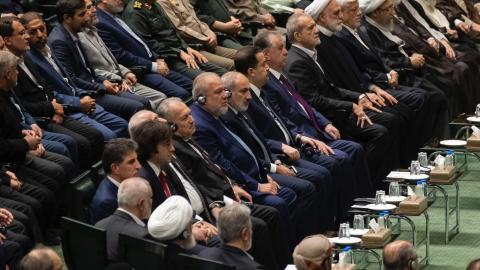
Georgia’s pivot toward Iran has been visible at the highest levels of government. Georgian Prime Minister Irakli Kobakhidze traveled twice to Iran in 2024—once for the funeral of former President Ebrahim Raisi, alongside leaders of Hamas and Hezbollah, and later for the inauguration of President Masoud Pezeshkian. In 2025, Georgia’s deputy foreign minister signaled solidarity with Tehran by visiting the Iranian embassy and signing a condolence book that honored those killed in US-Israel strikes.
These decisions reflect a broader pattern. Georgia permits Russian strategic airlifters to transit its airspace en route to Iran, even though Russia occupies 20 percent of Georgia’s territory. Analysts believe these flights have carried supplies that bolstered the Iranian regime during periods of internal unrest. Meanwhile, Tbilisi has allowed Tehran to expand its presence in Georgia’s religious, educational, cultural, economic, and media sectors.
Georgia and Iran’s growing alignment directly undermines US policy in the region. By breaking with its Western orientation, Tbilisi weakens the North Atlantic Treaty Organization’s position in the Black Sea region, provides Iran a new strategic platform in Eurasia, and complicates US efforts to establish peace between Armenia and Azerbaijan.
Iran’s Influence Infrastructure in Georgia
The Islamic Republic’s penetration of Georgia is deliberate, organized, and comprehensive. It focuses particularly on the country’s ethnic Azerbaijani Shia minority, who mostly live in the region Kvemo Kartli. Iran has long seen this community as a strategic target and uses the following mechanisms to influence them:
- Religious and educational institutions, such as branches of the Ahl al-Bayt World Assembly and the US-sanctioned Al-Mustafa International University, operate openly in Georgia and promote Tehran-aligned religious doctrine. They also cultivate loyal clerical networks and provide ideological training framed as religious education.
- Madrasas and youth-mobilization networks groom the next generation of Georgian Shia leaders, foster loyalty to Iran’s political theology, and normalize anti-American narratives.
- During pilgrimages, Georgian Shia believers move through Iran and Iraq for the Arbaeen commemorations. The Islamic Revolutionary Guard Corps (IRGC) uses these trips for recruitment, indoctrination, and intelligence spotting.
- Iran-linked charitable foundations not only provide social welfare but also help Iran enhance its influence, transfer resources, and expand its soft power.
- Pro-Iranian media platforms amplify Tehran’s narratives, lionize its leaders, and systematically promote anti-Western messaging to the Azerbaijani-speaking population of Georgia.
- Through economic penetration and sanctions-evasion networks, Iran is working to turn Georgia into a sanctions-evasion hub. These efforts include a surge in Iranian-affiliated company registrations in Georgia and a sharp increase in Iranian imports after 2022.
Georgian state institutions—such as the State Agency for Religious Issues—quietly accept this infrastructure’s expansion, and in many cases cooperate with Iran. For example, Georgia has received senior Iranian regime figures on an official level, including Ayatollah Reza Ramezani of the Ahl al-Bayt World Assembly, while they were directly engaging with pro-Iran networks in the country.
The Ideological Dimension: Exporting the Revolution
Iran’s activities in Georgia are part of its efforts to export the 1979 revolution, as mandated by the Islamic Republic’s constitution. For decades, Tehran has used clerical networks, educational programs, charities, pilgrimage structures, and aligned media to build ideological ecosystems across the Middle East, Africa, Europe, and Latin America. Tehran is now incorporating Georgia into that system.
Events once unimaginable in Georgia—such as rallies displaying portraits of Ayatollah Ali Khamenei and Hezbollah’s Hassan Nasrallah, or public commemorations of the late IRGC commander Qassem Soleimani—now take place openly. Members of youth networks wear T-shirts bearing the image of terrorist leaders. Tasua religious processions in Marneuli have carried explicitly anti-American banners attacking the US president.
This campaign is not simply religious outreach. It is political indoctrination. And because Georgia occupies a strategic transit corridor between Europe, Turkey, Iran, and the Caspian Basin, the stakes extend well beyond its borders.
A Threat to the US and Its Allies
and Iran’s growing presence in the country further undermines US interests by:
- Strengthening Tehran’s ability to project power into the South Caucasus and Black Sea region
- Undermining US and NATO strategic depth in Eurasia
- Enabling possible Iranian sanctions evasion, financial flows, and covert logistics
- Normalizing anti-US ideology among a key regional population
- Creating fertile ground for intelligence recruitment and paramilitary mobilization
- Threatening US energy security interests by placing Iranian influence near major pipeline routes
Furthermore, Georgia’s drift toward Iran is part of a broader geopolitical realignment that includes closer ties with Moscow. This shift also weakens democratic institutions, places legal pressure on pro-Western nongovernmental organizations and media, and erodes traditional Western partnerships.
Policymakers in the West have not noticed the expansion of Iranian-linked networks in Georgia, once a staunch US ally. Tehran can therefore entrench its influence with limited scrutiny or resistance, and the West will have great difficulty reversing this trend.
Conclusion
Georgia was once a model partner of the United States in the Black Sea region: Tbilisi was democratic, pro-Western, and cooperative on security matters, especially in regard to Iran. But now US-Georgia relations are at their lowest point in decades.
Iran’s growing influence in Georgia has driven this shift. Tehran has constructed sophisticated influence infrastructure that merges religious indoctrination, political alignment, cultural outreach, economic penetration, and media propaganda. This campaign helps the Iranian regime export the Islamic Revolution and weakens US influence across Eurasia.
Left unaddressed, Iranian penetration of Georgia will deepen and further erode Western leverage, empower US adversaries, and increase the risk that Iranian-driven instability will spread across the South Caucasus. Therefore, US policymakers should treat Georgia’s Iranian turn as a pressing strategic challenge rather than as a peripheral concern.