Caption
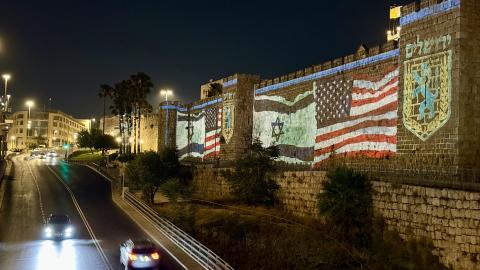
A photo shows US and Israeli flags projected on the historic walls of the Old City near Hebron Gate in Jerusalem on June 22, 2025. (Getty Images)
The end of Nicolás Maduro’s rule marked a historic turning point for Venezuela. But transitions do not secure themselves. Authoritarian systems often attempt to survive through controlled reform and partial concessions.
Venezuela’s interim authorities have introduced initial measures, including an amnesty law and economic adjustments. Yet a genuine democratic transition requires structural guarantees: the full release of political prisoners, the dismantling of repression, the reopening of civic space, the safe return of political exiles, and the establishment of a new, independent electoral authority capable of organizing free and fair general elections.
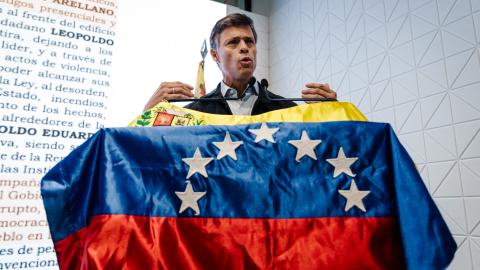
Please join Leopoldo López, who will outline the strategic roadmap for consolidating democratic change and explain why sustained clarity, leverage, and principled leadership from the United States remain essential to preventing backsliding and securing a stable, sovereign, and democratic Venezuela.
Listen on Spotify and Apple Podcasts.
Joel Frushone:
Well, good morning everyone, and welcome to Hudson Institute. I’m Joel Frushone, director of External Affairs here. Today marks two months since Operation Absolute Resolve in the removal of President Maduro, Nicolas Maduro from power. That operation changed the political equation in Venezuela literally overnight.
What follows will determine whether this becomes a durable democratic transition or merely a recalibration of power under new management. Few people understand both the architecture of repression and the demands of democratic reconstruction as personally as our guest this morning. It’s an honor to welcome back to Hudson my friend, an extraordinary person and central figure in Venezuela’s Democratic movement, Mr. Leopoldo Lopez.
During the past six weeks, Leopoldo has been speaking internationally about what he calls the difference between economic adjustment and structural democratization. A distinction that he has emphasized is critical to the next phase of Venezuela’s transition. So, this morning’s conversation is about that distinction, what that means for policymakers here in Washington, DC.
Leopoldo needs no introduction, so I’ll be brief. He’s the founder of Voluntad Popular, a Venezuelan Democratic Opposition Movement, a party that he launched in 2009. He’s a two-term mayor of Chacao, one of Caracas’s most politically and economically significant municipalities. He was arrested on February 18, 2014, after then President Maduro publicly called for his detention, and was sentenced to 14 years in prison following a trial internationally condemned as politically motivated for sure.
He spent seven years in detention, including in a military prison, under house arrest, and in solitary confinement. His house arrest was at the Spanish Embassy in Caracas before escaping Venezuela in October of 2020. Those years required survival under relentless threat for both him and his family. His experience is singular, yet he’ll be the first to tell you that it’s shared in different forms by thousands of Venezuelans.
Since leaving Venezuela, he’s lived in Spain with his family in exile. He’s the co-founder with Masih Alinejad and Garry Kasparov of the World Liberty Congress, which is the world’s largest network of pro-democracy leaders and advocates. Excuse me.
Leopoldo, welcome back. Let’s begin with where things stand today. Over the past few weeks, you’ve been speaking internationally about this as a phase of transition that still must be anchored in democratic institutions and not reduced to purely economic change. So, what’s structurally different in Venezuela today and what remains unchanged beneath the surface?
Leopoldo López:
Well, thank you. Thank you very much all. Thanks to all of you. It’s great to be here at Hudson again. Well, I think that the best thing is to summarize. Where are we after January 3? I want to start by saying that we are much better off than what we were on January 2. So, I think that’s very important to set that very clearly, that we are at a much better opportunity and window for a prosperous and democratic Venezuela. It had to be that way, not because the Venezuelan people didn’t try everything in order to make a peaceful transition through elections, through protests, through the recognition and the opening of the constitution. But Maduro stole elections, Maduro went after the people that were peacefully protesting, not once, but thousands of times, incarcerated. Thousands of people tortured. Thousands of people killed, tens of thousands of people according to the UN and the ICC.
We went to 16 rounds of negotiation, 16 rounds, with all of the mediators from the Vatican, to the OAS, to ex-presidents, to the Norwegians. It all failed. There were sanctions imposed on Maduro, all sorts of sanctions since 2019. And Maduro was able to evade the sanctions with the support, among others, of Iran because Venezuela became part of the kleptocratic network, criminal network of primarily Iran and Russia. And because nothing happened, the use of force in a law enforcement, military-backed operation by the United States, that was a perfect operation to remove Maduro. It put Venezuela at a very different moment than what we were on January 2.
So, I want to start by saying that I am optimistic about this new phase that Venezuela is beginning. I’m optimistic. And of course, it’s a moment of a lot of challenges. And President Trump, who we thank him as Venezuelans, and the administration, and Secretary Rubio, have laid out that there are three phases to this process; the stabilization, the economic recovery, and then the transition to democracy.
The economic transition has started. It’s very clear what has happened in terms of the engagement of the US administration. The Secretary of Energy has been to Venezuela. I understand the Secretary of Interior will go to Venezuela. There is interest in the support for the economic recovery in Venezuela. There are better expectations for sure in Venezuela.
There are also very important signals of the security approach of the United States. The director of the CIA was in Caracas, and went to the President’s palace three weeks after the capture of Maduro. Some days after he was there, generals were removed or were substituted within the military. And I think that this is a pattern that we will continue to see.
Then, the commander of the Southern Command last week was in Venezuela, and he met with Padrino Lopez. The Minister of Events openly defeated by the United States in what happened on January 3, because obviously, Padrino Lopez, as Secretary of Defense, and Diosdado Cabello, Minister of Interior, are the generals of the defeat, of what happened on January 3. They were the ones that were supposedly going to defend Maduro and Venezuela, both of them. They were responsible for the security of Nicolas Maduro, both of them, and they failed. And they met in a way that was very telling with the commander of the Southern Command.
So that’s all going, and it’s, I believe, positive. However, what is in our terms, in our view, those of us, millions of Venezuelans, that we have been dreaming, fighting, protesting, voting to have democracy in Venezuela, is this enough? This is where we want to be? No. It’s not where we hope to be because we believe that we need to go to a transition to a total democracy, to democracy.
And how will that happen? It will happen through elections. That’s the only way. When will that election take place? It will take place when the conditions are met. And I hope that they are the sooner, the better. But it starts right now to have that as a priority.
Maria Corina Machao, just two days ago, stated very clearly that that was the path forward, to have elections. Secretary Rubio, last week at the CARICOM event it out very well. He said that Venezuela, in order to have a legitimate government, there needed to be an election in order to have a transition for democracy.
So that’s where we are. It’s not going to be without obstacles. There will be obstacles, but I believe that if we put our sight in transitioning to democracy, and I’m talking about the Venezuelan democratic leadership, the Venezuelan people that we understand that we are in these two phases, but we need to start looking at this process of finally transitioning to democracy through elections.
Joel Frushone:
I could let you talk all day and just sit here and listen to you as you do, but I do have a few questions. I’m going to dig a little deeper into that.
When you were here in January, you outlined several benchmarks for credible transitions. Elections was one of them. For today’s audience, I want to revisit a few others, not just as moral imperatives, but as policy indicators. And the first one is the mass release of political prisoners.
You’ve been calling for this since January 3. You’ve called for that for most of your life since leaving Venezuela, but what would meaningful progress look like here? And did the amnesty law go far enough?
Leopoldo López:
Well, the regime approved an amnesty law that is not an amnesty law. It’s actually just an excuse for them to free political prisoners. However, hundreds of political prisoners have been released. And I believe that that is also very positive. I believe that that’s a consequence of what happened on January the 3, and we’re happy for that, very happy for that. Hundreds of political prisoners have been released. However, not all the political prisoners have been released.
My understanding is that there are at least 500 political prisoners, most of them military, that have not been released. And we need to call for the total release of all the political prisoners, military, and civilians that need to be released. In our view, that’s the most short-term commitment that needs to happen in this phase of transition. And it’s happening already. And I think that it’s because of the pressure, but then it’s not enough because there needs to be the dismantling of the repressive state.
What does that mean? Well, there has been the buildup of a repressive state in Venezuela that I could explain it around three clear pillars that this repressive state has. One is the legal framework. There are laws in Venezuela called like the hate law, a law that can criminalize you and send you to prison just because you say a phrase that the regime doesn’t like, and that’s in a law. Then there are laws that criminalize NGOs, humanitarian NGOs, educational NGOs, human rights NGOs. Those are laws that are proven that have not been dismantled or removed.
Then there is the second pillar of the repressive state that are the judges and the attorney general. There is not a single judge. And I can tell you from experience, I was sentenced to 14 years of prison because a judge concluded that I was capable of sending subliminal messages to the Venezuelan people. And that’s just an example. And those are the lucky cases that go in front of a judge, but there is not a single independent judge in Venezuela, so that needs to change.
And then I think that the most pressing one, the operative repressive state. What does that mean? Well, especially means a person, a named Diosdado Cabello, who is the Minister of Interior. And he’s responsible for the persecution. He’s responsible for the tortures. He’s responsible for most of the police and parapolice structure of the repressive state. And we believe that it’s very important that Diosdado Cabello is removed from the Ministry of Interior. So those three things around the dismantling of the repressive state.
Joel Frushone:
So, when you talk about repression, I mean, there may be pauses in there like you just described, but what’s the genuine dismantling to signal to Washington or elsewhere that this is really happening? Is it Cabello leaving? And what else needs to happen there that-
Leopoldo López:
Well, I mean, I think one, the release of the political prisoners. Two, I would say the laws. I don’t know how to say, when you take a law out of record, dismantling those laws that I mentioned before. And then yes, Diosdado Cabello, there is another person, Alexander Granko, that people know these names in Venezuela. And I can go on and on with. . . These are people that are known to them-
Leopoldo López:
These are people that are known to the Venezuelan people to be responsible for torturing and killing thousands of people. And there are, and I’m not saying this in theory, there are over 800 victims with names, cases, place, time when the crimes occurred that are in the accusation against Nicolás Maduro at the International Criminal Court.
There are tens of thousands of killings that have been recorded at the UN Human Rights Council and its reports. So, what I am saying is not a theory. It’s not hearsay. This is real. These people are responsible for this, and they cannot continue to be part of the structure in this phase, especially after the removal of Nicolás Maduro.
Joel Frushone:
Another of your benchmarks was the return of political exiles, yourself included. And what must change for you and the thousands of other exiles, not the millions of refugees that are out of the country, so they can return safely? And is the return an early test of the transition? What’s that look like?
Leopoldo López:
Well, I think it’s part of it. And we just heard from María Corina two days ago, and I think it was a very important statement that she said she’s going back to Venezuela, and she will be back in Venezuela within weeks. I mean, I don’t know the exact moment, but I believe that all of the political exiles, we should return. And this is part of what’s happening already in Venezuela with the release of political prisoners. Some of them were in house arrest. They were recently released.
There is a spark of the opening of the civic space. People can go to church together and have a common celebration in church that was not able to happen only two months ago. There are some voices from the student movement, from the nurses, from the workers. That’s already starting to happen. And I believe that that is very positive.
And I think that the leadership of María Corina Machado, it’s important that she is in Venezuela. The legitimacy and the leadership of Edmundo González Urrutia, who was elected in the elections of July 24 also has to be in Venezuela, and all of us. And that means that anyone who wants to contribute to push for that transition should be allowed to be in Venezuela.
Joel Frushone:
In their home. You talked about elections and a clear time-bound path for free and fair elections. What needs to be in place for that to happen systematically? And we saw what happened in the last round of elections, so . . .
Leopoldo López:
Well, it’s very concrete what needs to happen in terms of the infrastructure. There needs to be a new electoral board. A new national electoral council. Second, once you have a new electoral board, that could be decided and implemented in the short-term. And it could be in the same way that the regime approved a hydrocarbons law in less than two weeks. They could push forward. I’m not saying that it would be only that mechanism approved by the assembly of the regime, whatever mechanism, but a new electoral board very soon.
Once there is a new CNA, they will have to present the timetable for that election, six months, eight months, 12 months, whatever period it is. But if we don’t start now, the period will be longer. And then there needs to be a lot of things that could happen, like the registration of the political parties, the registration of the voters.
So, I think that in terms of the timeline, I will tell you when the conditions are met. And I wouldn’t put a time, but I would put a sequence of conditions. And I think that this is very important to happen in parallel and in support with the other two phases that Secretary Rubio has stated, which are the stabilization and economic growth. And I see that there is no contradiction by putting a clear horizon towards a democratic transition and continue to strengthen the stabilization path and the economic recovery path in the case of Venezuela.
Joel Frushone:
So, right into my next question. The administration, they also emphasize that calibrated economic re-engagement. So, sanctions begin to shift, how do we avoid getting ahead of political reform if that happens and all of those releases come in there? What are your thoughts on that?
Leopoldo López:
Well, I think economic reform is already happening. I think it’s going to have an impact, but I think particularly it’s going to benefit the oil companies that are already in Venezuela. I think the new hydrocarbons law, it’s good news for, especially for Chevron, for Repsol, and for a couple of others that are in Venezuela. However, I don’t think that that law is enough to bring new capital and the level of capital that is needed. Let me just share some numbers about the oil industry in Venezuela.
Joel Frushone:
Yes, please.
Leopoldo López:
When Chavez came to power, Venezuela was producing 3.6 million barrels of oil. Today, Venezuela is producing around 800,000 barrels of oil, which it’s an absolute collapse of the oil industry. Another number, when Chavez went to power, the debt of PDVSA was around $3 billion. The debt of PDVSA today is over $60 billion. Again, it went from 3.6 to 800,000. The debt went from $3 to $60. I mean, that is just the framing of the huge mismanagement and corruption. So, I think that in order for taking Venezuela from 800,000 barrels of oil to where we should be, two, three, four million barrels of oil-
Joel Frushone:
A day?
Leopoldo López:
Yeah. There will need to be a huge investment around between 50 and 70, if not more, thousand billion dollars. So, that level of investment, it’s not going to come to Venezuela without clear rules of engagement that could be predicted to be stable for decades because this level of investment requires that level of certainty. And that’s not going to happen with Delcy Rodriguez. It’s not going to happen with the current condition. That can only happen when there is a legitimate and a democratic and a rule of law based with clear rules of engagement, including constitutional reforms, new laws, new institutional framework that will give credibility to this level of investment.
So, I think it’s going to be phase one. Then if there is no change, there’s going to plateau. But if there is democratic change, there is going to be a huge attraction, a huge increase in the economic interest to invest, not just in oil and gas, but in many other industries. But until that happens, the level of investment I think is going to remain limited.
Joel Frushone:
And heads of US oil firms have said that, right, to the president a few weeks ago, exactly that. I want to switch a minute to authoritarian regimes working together. It’s part of why you, Masih and Gary created the World Liberty Congress. So, with the upheaval in Iran’s leadership, does that materially change the strategic picture in Caracas? And is Russia still involved, funding things? Is China still involved, funding things just because Iran’s out of the picture? And please describe, because you know this inside and out, that network and the playbook that they run.
Leopoldo López:
Listen, this is something that is very well known to Venezuelans. It’s so well known to the Venezuelans that there is an autocratic network that has been supporting the regime that the most famous song over the past eight weeks in Venezuela has been a song that goes like this, “Where are they, where are they, the communists that were going to save us? Dónde están los comunistas? Que decían que iban a salvarnos.”
And people have been dancing this song all over Venezuela and all over the world. It’s Dónde están los comunistas? Que decían que iban a salvarnos. Los rusos, los chinos, los cubanos y” (Translation: Where are they, where are they, the communists that were going to save us? The Russians, the Chinese, the Cubans) . . . All of them. So, I say this because it’s absolutely common knowledge to the Venezuelan people that there was an architecture, that there was a network of autocratic countries that were the patrons and the controllers of Venezuela. So, that’s of course now being changed. I think that what’s happening in Iran is going to have a tremendous impact also in Latin America because Venezuela was the bridge to the old South America for Iran.
Recently, I would say not recently, almost even 10 years ago, there was a case where the Venezuelan embassy was giving tens of thousands of Venezuelan passports to members of Hezbollah and Hamas. You can look for all of this information. All of this has happened. And it’s known also that the way which Venezuela evaded the sanctions that were imposed in 2019 was with the support of Iran, with the ways of using crypto and other means of using oil shipments and fleets to evade sanctions—
Joel Frushone:
Security apparatuses.
Leopoldo López:
. . . and to end up selling the oil to China. It is known to the Venezuelan people, the presence of the Russians. Well, it’s so well-known that all of the military equipment in Venezuela, it completely shifted from NATO-oriented military equipment to Russian military equipment since 2007, the Sukhoi airplanes, the assault rifle AK-103, the SS-300 anti-missile system. Venezuela spent billions of dollars to have the support of Russia.
And again, January the 3rd was a moment of defeat of the Russians in that realm, too. And now what’s happening with Iran will also be an important impact to this level of coordination that Venezuela had. And I think it’s very good news, very good news that the United States has a decisive interest in the security and the integrity of the Western hemisphere. That is very good news for all of the Western hemisphere because it has not been a priority for the US for many, many years. And I think that having a hemisphere that doesn’t have the level of dependency and influence of Russia, China, and Iran is very good news for the entire hemisphere. So, we are very happy that that is also a consequence of January the 3.
Joel Frushone:
Let’s talk about the neighborhood and stay there for a minute. Our shared neighbor, Cuba, your shared neighbor as well in Venezuela. Can you talk about the domino effect in everyone. . . Eyes on Cuba now, what’s going to happen there? Is the economy going to fail? What are your thoughts on how this impacts that neighbor?
Leopoldo López:
Well, I hope the regime falls. I hope it happens soon. Most Cubans hope that this happens soon. And I think that in Cuba, people saw what happened in Venezuela. People also saw what’s happening in Iran. And there is this, I think this widely spread hope and almost conviction that there is going to be change happening in Cuba very soon.
In what way it’s going to unfold? I cannot tell you what’s going to happen right afterward. I cannot tell you. But what I can tell you is that I am sure that the Cubans, the huge majority of Cubans, support this. Like the huge majority of the Venezuelans actually support what happened on January 3. More than 70 percent of the Venezuelan people support the capture of Nicolás Maduro, more than 70 ,percent . And I also saw that more than 60 percent of Latin Americans support the capture of Nicolás Maduro. And I think that’s very important for people to see and to-
Leopoldo López:
I think that’s very important for people to see and to really try to understand what happens because I have seen a lot of people in Washington, in Brussels, in Geneva saying that the capture of Nicolas Maduro violated international law. Really? Violated international law. What about the international law around the victims of the tens of thousands of people that have been killed, torture? The international law for the political prisoners? The international law for the millions of people that have been forced to flee our country, where has been that international law? Other people say sovereignty. Really? Sovereignty? The sovereignty of whom? Of the dictator? So you’re talking, we hear from the UN, oh, the sovereignty, the international law, the precedent we hear those phrases from the UN. Really? And what about the sovereignty, the most sacred sovereignty of all of the people? Because that’s the most sacred sovereignty.
Not the legal sovereignty, not even the sovereignty of the territory, is as sacred as the sovereignty of the people, and that’s the entire concept around which a republic is built. And democracy is precisely giving the people to give that sovereignty of the people to the republic through the vote. And that we did and we won. 70 percent of the vote, and Maduro stole the election. So, there are, in my view, no arguments to dispute with what happened on January 3 around international law or around sovereignty or around legitimacy. And I hope that this opens at this a different way for the US public to see the way in which we are seeing this from the perspective of Venezuela. And I am sure I’m talking on behalf of the huge majority of Venezuelans that are very, very happy that Maduro was captured.
Joel Frushone:
That same exact conversation is playing out now because of Iran and the legitimacy of that. You know all the players described that in Karacas so well. So, what should Washington watch for to suggest that they’re just managing the moment? I mean, there’s always this conversation that Delcy, her brother, Cabello, everyone can just wait out President Trump. Your thoughts on that, that they need those signals that you know what? They’re placating you now.
Leopoldo López:
Well, I think that it’s a contrary. I think Delcy’s doing what the US is telling her to do. Does she want to play it out? Of course. Does she want to remain in power and the regime? Of course. Is the US going to allow that in the medium and long term? Absolutely not. Secretary Rubio said it and I believe him. I believe that what he’s saying is a commitment of him and a commitment of the administration that he represents. And what’s the alternative? What’s the clear way? What do we need to do? What do we need to be laser focused on is to build the path to an election. Again, I am not talking about the timeframe because it will be given through the conditions.
But even just putting the date, just putting the date of the election and that could just start to build that entire path to what we think is not just an election for president. We need an election also for the National Assembly, for governors, for mayors, for local council, for the [foreign language 00:29:40] for the unions, for the universities. All of that needs to go to an election because Venezuela has been suffocated without being able to openly participate for years. And at least I believe, we believe, I’m sure that this is a shared sentiment that the Venezuelan people want to participate. They want to be part of this rebuild up. And what’s the only way? Total democracy. Open up democracy and open up the participation of the people. And I think, again, that should be the milestone. That should be the goal. And that should be also a wide tent of support to that. I mean, I don’t see why Democrats or Republicans would have a different opinion around supporting this agenda that I’m laying out to have elections in Venezuela when the circumstances are given.
I don’t see why any European government would be against this claim that we’re doing or any government in the region saying that they support the possibility of the Venezuelan people to go to an election. Because the contrary is just leaving the same regime and not opening for what has been the hopes of decades of fights and struggle and suffering and hope of millions of people.
Joel Frushone:
Let’s bring others into the conversation. Any questions from the audience? We’ll give you a microphone. Please just state your name and your affiliation. Tali right here, please.
Audience Member Dr. Gonzalez:
Hello. I’m Dr. Gonzalez from CIFAI, private sector. I have just some quick things. You mentioned Maduro stole the elections. So why didn’t put back the winner? Because what is right now is the same apparatus of Maduro. In Venezuela, Maduro is not just one person, it’s the entire [foreign language 00:31:40] military, the people, the politics, the government. That’s one. And the other one, you said that Russia. . . was a blow for Russia, the fact that Maduro was taken away. But what was the actual blow? What were the interactions of Russia, Venezuela, and what was getting Russia from Venezuela and vice versa?
Leopoldo López:
Yeah. So, you’re right. The elections of 2024 were a huge victory and Edmundo Gonzalez was elected, is the legitimate president elect of Venezuela. However, there is a reality. There was a US led law enforcement military backed operation that removed Maduro and captured Maduro. And it was a decision by the US to do a transition from within. And I believe that this has to do with the understanding that there could have been chaos given the experience of Iraq. It’s been said by President Trump himself and others. But the reality is that that’s the decision that was made. And given that reality that today, Delcy Rodriguez is the interim dictator that is empowering Venezuela, given that reality, what do we do? So what we can do is to look forward and to look forward for a window that will take us to democracy, and that’s elections, and that’s elections. And I think that there is a wide consensus, wide, huge in Venezuela that this is the way to go forward.
Your second question was about the Russian influence. It’s wide and spread in Venezuela, and it’s been going on for years. Started around 2006, 2007 when the US was not. . . There was a change in the planes that were used by Venezuela from the F-16s to the Sukhois. But even before that, Venezuela started to buy the assault rifle, the AK-103. And then a couple years later, there was a huge investment in the anti-missile equipment, the SS-300 and others. And this of course led for an engagement of the military in Venezuela with the Russians. The Wagner Group was in Venezuela. They had different fields of activity in Venezuela before they were dismantled. Russia also has influence in the kleptocratic network around Maduro and Delcy Rodriguez. These are the enablers, the “Business people,” that are around all of the kleptocratic network, they also have a base and connections with Russia.
We have seen the diplomatic connection with Russia. I mean, Maduro has been to Russia. There’s always been this backing. There was even threats by Russia before January 3, saying that if the United States goes into Venezuela, there will be consequences. Russia said this. Putin said this. Lavrov said this. And the United States captured Maduro. And what did Russia do? Nothing. Nothing. And I think that’s good news. And I think it’s good news that also Iran is being neutralized for their foreign influence in places like Venezuela. And I also think it’s good news that China doesn’t have the level of influence in Venezuela that it had before January 3.
Joel Frushone:
Pedro, please. Next.
Audience Member Jose:
Hello, good morning. My name is Jose from Valvula Politica E News from Venezuela. I make the question in English, but it’s possible respond in Spanish for my news. Why is the removal of the Diosdado Cabello important, and why is it crucial to the justice in this moment? If you can respond in Spanish.
Leopoldo López:
*Leopoldo responds to the question in Spanish. Below is an English translation with light edits for readability. Please excuse any small inaccuracies.*
Well, the dismantling of the repressive state. It has three pillars. The first pillar is that all the laws of repression must be dismantled: the hate speech laws, the laws against non-governmental organizations, and the entire legal structure. Then there's the judicial structure—the judges, the prosecutors—there's a need for them to be removed and for there to be a change in that part of the legal structure.
And then there's the operational repressive state, and the operational repressive state is headed by Diosdado Cabello and includes people like Alexander Granco. These are people who are identified as being the hierarchical, operational, and politically responsible for tens of thousands of crimes that are registered with the International Criminal Court and the United Nations. And of course, for there to be a sign that there is a change in the state of repression in Venezuela, Diosdado Cabello has to be removed from the Ministry of the Interior, and people like Alexander Granco and others who are the face of the execution of the torture and death of tens of thousands of people and that has to happen as soon as possible, that is to say neither Diosdado nor these characters can remain in power so that there can be a transition. *end of Spanish translation*
Audience Member Jose:
Thank you.
Joel Frushone:
Mr. Laura.
Audience Member Francisco:
Hi, my name is Francisco, and I work at the Inter-American Development Bank. My question is particularly related to what role you think that regional actors such as Colombia, Brazil, and others will play in a possible transition taking place in the future. And whether in their bilateral talks with the United States, they might dissuade or try to persuade the administration to help set a date for possible elections in the future. Thank you.
Leopoldo López:
Well, I think it should be in their best interest to push also for a democratic transition. And I think that that should be also a point of encounter for the region. I don’t see a problem that Milei, Petro, Lula, Sheinbaum, and Noboa all agree that there needs to be elections in Venezuela. And I hope that happens. And I hope that that becomes also a priority for the US just to have everyone on board in pushing for this transition. And I would be very suspicious to see if they would be against that agenda.
Joel Frushone:
Right here, please.
Audience Member:
Hello, Leopoldo. My name is Monmolin Herrera. It’s great to see you again. I’m affiliated with the Victims of Communism Memorial Foundation. I used to work with them. My main question is that there is a huge extreme concern that President Trump could be oriented or persuaded by external actors of the regime to stop the support of the rightful leaders. I mean, we see it before with the interim presidency of Juan Guaidó. Apparently, the President of Russia persuaded to stop the support of Trump to Guaidó. So there is that extreme concern. I mean, we see it at the state of the union that he did not mention María Corina Machado, and always was pretty much cozying up in a certain way with Delcy Rodríguez. So that’s extreme concern, that he could just kick out the right leadership. So, I just want to know what would be your thoughts in that concern, that Trump could be persuaded away?
Leopoldo López:
Well, I tell you something, I think that is primarily the responsibility of the democratic leadership. We cannot outsource what is not outsourceable. I mean, the future of democracy in Venezuela is a responsibility that the democratic leadership and the Venezuelan people have to assume. So that needs to be our agenda and our priority.
And the second thought is that I think that there is a huge difference between the circumstances now and before January 3. In both scenarios, there was external influence. There is a huge external influence from Washington to what happens in Caracas. It’s obvious. But before that, it was from Moscow, Beijing, and Tehran. We can come here to Washington DC, many voices that have different opinions can come here, can talk openly the way we are talking. We can even have conversations with the administration, with people at the Hill, with think tanks, what we are doing here. This is something that cannot be done in Beijing, in Tehran, or in Moscow.
So, the responsibility of the Democratic leadership is to work towards having that common agenda for democratic transition in Venezuela and talking and coordinating in the US and beyond with other democratic nations and with the region around this agenda. That’s what I think needs to be the priority.
Joel Frushone:
Excellent question and excellent answer. We have one more question here, and then we’ll go there, and then we’ll give Leopoldo the final word.
Audience Member Antonio Tintoré:
Thank you, Leopoldo, for your presence and also your efforts over the years. My name is Antonio Tintoré, and I’m an analyst at the Center for Strategic and International Studies, CSIS. My question is about Europe. You’ve briefly touched upon this, but I’m more interested and curious about your assessment of Europe’s response to January 3. Some countries expressed doubts about the international legality of the actions, but overall, a pretty muted response, I think. So yes, indeed, a question about your assessment of our response, I myself am Spanish, and also a question about the future, and what role do you think Europe should play in this ongoing process?
Leopoldo López:
I’ve had the opportunity to meet with several European officials, high ranking European officials. And in private, they have told me that they made public statements about the concerns around international law or about the president. But then in a private conversation, they recognized that the operation was perfect, timely, seamless, effective, that there was nothing else that could have been done. That Maduro was a thug, that Maduro was impossible to have in an equation that made any possible progress towards democratization, stability, or economic recovery. And it’s interesting, I had at least three conversations with high level officials that in private they recognize this.
So, I think that there is a shift, very clear, in what will it take in order to make these changes happen. And I think it’s a change of moment, a change of doctrine that will have many consequences. And again, our responsibility is to make sure that what start in January 3 continues to go in the right direction towards a legitimate and democratic government that provides prosperity, justice, and stability for the Venezuelan people.
Joel Frushone:
Last question here, please.
Audience Member Pedro Pizano:
Thank you. Hola Leopoldo. I’m Pedro Pizano, I’m the director of the John McCain Freedom for Political Presidents Initiative at the McCain Institute. It’s always so good to see you. You sacrificed six years of your liberty so that we could have ours in Venezuela and the world. And I just have enormous admiration for you and all your family.
Leopoldo López:
Thank you.
Audience Member Pedro Pizano:
Two quick questions. Can you talk about the democratic tradition and how the opposition has united, all the way back to Rómulo Betancourt? But also, have you taken lessons from each of your iterations? And the second, we say that freedom starts with a name, and you mentioned the political prisoners. So, can you talk or give us some names about who is most at risk right now? Is it [inaudible 00:44:20]? Is it the Police Metropolitanos? Who are the people that we need to fight for the most right now?
Leopoldo López:
Well, there are plenty, I’ll tell you. Antonio Sequea, for example, is a Venezuelan, he’s a member of the National Guard. He’s been a prisoner for over six years now. He has many of the members from his promotion that also are in prison. I will tell you another name. Louis Molina. Louis Molina is a police officer that was arrested and imprisoned in the year 2002. 2002. Do the math. 25 years ago. Luis Molina. And he has three other members of the Metropolitan Police that are also in the same situation. Erasmus Bolivar. And I know these people, they’re my friends because we were in prison together. Now they are in another prison. 25 years they’ve been in prison.
And just last week, one of the members of the regime, Jorge Riaza, who used to be vice president . . . Who is a guy that, by the way, when I was doing a hunger strike in 2015, my wife spoke with him and he told my wife, he said, “You better just tell him to leave the hunger strike because we’re just going to let him die there.” And this guy said last week, he said, “No, we cannot give the amnesty law to the Metropolitan Police officers.” 25 years. So that gives you an idea.
And that was your first question. And the second?
Audience Member Pedro Pizano:
[Pedro Pizano asks his second question without a microphone]
Leopoldo López:
Well, I mean, just very quickly on this, because you asked from Rómulo Betancourt . . . One idea that I think is important, it’s very common to hear people say, “Oh, the problem in Venezuela is the division within the opposition.” I think that’s a false statement, and I think that has nothing to do with the facts and with the history of the struggle that we’ve had. There are differences, yes, of course, like in any family. Has the performance of the democratic movement been united or fractured? Mostly united. I’ll give you some examples. 2012, we did a primary. We elected presidential candidate, 25 governor candidates, 335 candidates for the municipality. We went to an election united. 2013, Chavez died, we went to that election United. 2014, we went to the protest, we called for the protest. Then people got united.
2015, we went to the election of the National Assembly. We built a coalition of 27 parties, and we won with two thirds the vote and the seats of the National Assembly. 2016, we performed in the National Assembly in a unified way. 2017, we went to protest, massive protest, six months, united. 2019, we did the interim government also with the support of the National Assembly, united. Then COVID. Then 2023, we did a primary in unity. We elected María Corina Machado. She was not able to run. Again, in unity, we decided that Edmundo González was going to be the candidate. And in unity, we went to the election for the 28 of July in ‘24 and we won. So those are the facts.
And it’s bewildering to hear so many analysts saying, “Oh, the problem in Venezuela is that the opposition is not united.” There are problems, yes, of course. Differences. There has even been people in the opposition that have sold their soul to the regime, but that’s another story. Those are concrete cases. But the experience has been of unity. And I think that’s what you will continue to see. You will continue to see unity. You will continue to see commitment to what we’ve been fighting for, which is democracy. And for us, democracy, simple, is free and fair elections, is rule of law and is the respect for human rights.
Joel Frushone:
Leopoldo, you can leave it there, or you can—
Leopoldo López:
No, I can leave it.
Joel Frushone:
If you want to leave it there. Well, yeah, thank you very much for your leadership. Thank you very much for your leadership, for coming back to Hudson, and for continuing the fight for Venezuela.
Leopoldo López:
No, thank you very much.
Joel Frushone:
I thank you very much.
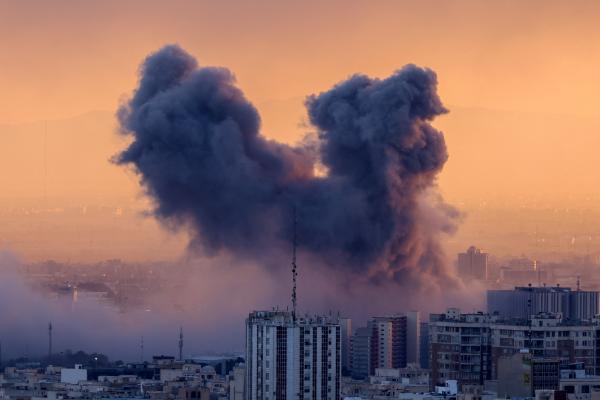
This conference convenes leading experts and policymakers to examine why the conflict began, assess the current state of play, and explore competing theories of victory.
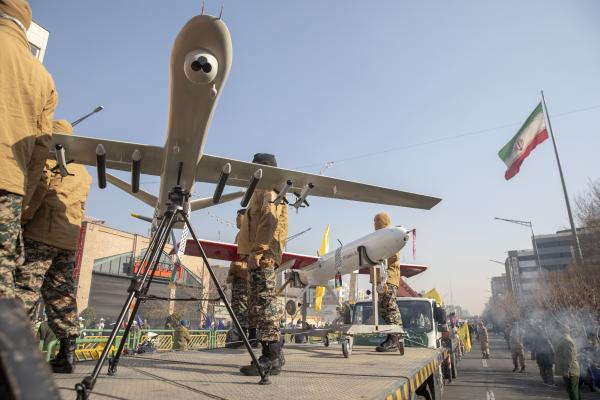
Please Join Senator Joni Ernst (R-IA), a member of the Senate Homeland Security and Armed Services Committees, for a discussion with Senior Fellow and Director of the Center on Europe and Eurasia Peter Rough on Operation Epic Fury, the future of American foreign policy in the Middle East, and how the conflict is shaping the future of warfare and strategy.
Please Join Congressman Jimmy Panetta (D-CA) and Senior Fellow Michael Doran for a discussion on the region’s significance and why updating US trade policy is key to unlocking its potential in an era of renewed great power competition.
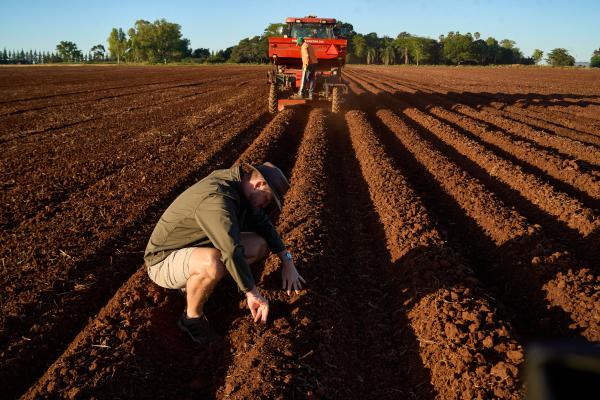
Join Senior Fellow Joshua Meservey as he hosts a panel of experts to discuss the history of land expropriation in Zimbabwe, the status of the land compensation agenda, and how policymakers can rectify an issue that bedevils US-Zimbabwe relations.