







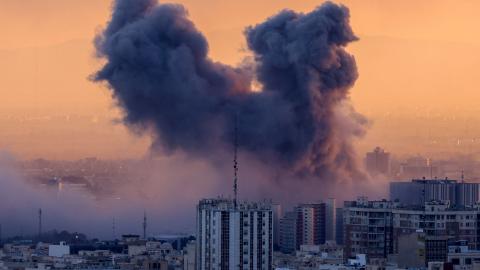








The military strikes against Iran by America and Israel illustrate a stark strategic truth: the post-Cold War globalist model is no longer the operating system guiding US policy. The stand-off with Tehran is more than a nuclear dispute. It is a live test of a deeper divide over how international order should function. It reveals a contest between two competing approaches to international order: one rooted in global institutions, the other grounded in sovereign authority and state capacity.
The global architecture meant to restrain proliferation did not deliver. Years of multilateral agreements, inspection regimes and diplomatic choreography failed to prevent Tehran from advancing its nuclear capabilities. When deterrence faltered, it was not a global institution that mobilised forces. It was a nation-state.
Many of America’s European allies argue that major global challenges require solutions rooted in international institutions, shared rules and collective governance. By contrast, the view now dominant in Washington holds that the nation state remains the core source of authority and effective action, and that outcomes ultimately depend on state capacity and decision-making.
It’s a clash of operating systems.
If policymakers on both sides of the Atlantic hope to move the transatlantic relationship forward, this divide warrants closer examination. These competing approaches have strained relations between Washington and Europe. What if European leaders were to give the state-centric argument a serious hearing? Here is why they should.
Since the end of the Cold War, a globalist framework has largely prevailed. Governments, international organisations and non-governmental actors assumed that challenges – from security and economic disruption to migration, pandemics and climate change – required collective global solutions. As former UN Secretary-General Kofi Annan described them, these were ‘problems without passports’.
Nowhere has this model been embraced more fully than in Europe. The European Union represents the most ambitious effort to pool sovereignty and manage interdependence through supranational governance, and European policymakers have been among the strongest advocates of global frameworks.
This prevailing global framework often treats cross-border problems (carbon floats, for example) as evidence that global solutions are superior. But it’s states that generate problems, experience their consequences, and provide the resources to address them. Industries operate within national systems, citizens bear costs, and governments supply the regulation, infrastructure and enforcement required to respond. Treating ‘global’ as an operational approach obscures where authority and responsibility truly reside.
The global framework resembles the passive voice in English: it diffuses responsibility, masks root causes and produces complex processes that impede progress. International negotiations often trap officials in webs of meetings and rules that delay or prevent action.
Not surprisingly, results have been uneven. European governments have pursued ambitious climate policies and global climate diplomacy, yet global emissions reached record levels in 2025 and major economies remain off-track to meet agreed targets. Large-scale migration has destabilised politics across Europe and beyond, straining asylum systems, while calls for expanded UN humanitarian administration fail to address the drivers of displacement.
European governments have been among the leading supporters of global development frameworks and multilateral targets, yet the gap between ambition and outcomes remains wide. Progress toward the 2015 UN Sustainable Development Goals has fallen far short of expectations. Hundreds of millions still lack reliable access to electricity, food insecurity has worsened, and water stress is intensifying across many regions. The World Bank likewise reports that poverty reduction has stalled and that, at current rates, lifting everyone above roughly six dollars per day would take more than a century.
When global approaches fall short, their defenders often call for more of the same rather than confronting the model’s limits. Recognising those limits points back to the nation state. It is governments that are accountable to citizens and who face the political consequences when they fail, especially in democracies. That chain of accountability weakens as authority shifts to international bodies. Moreover, a state-centred approach also recognises that time matters: prolonged negotiations delay action while problems intensify, whereas states can respond more quickly and flexibly.
Such an approach does not reject cooperation. Rather, it emphasises practical collaboration among partners based on shared interests and capabilities. It also reflects how progress actually occurs. Climate policy, for example, turns on national decisions about energy, growth and technology, with governments providing the regulatory and financial support for emerging sources. As the economic historian Daniel Yergin has noted, the energy transition will unfold unevenly across regions, shaped by national choices.
Similarly, research on development highlights the importance of domestic policy and state capacity. Economists such as William Easterly and David Dollar argue that foreign aid is no substitute for domestic reform and that national choices largely shape growth outcomes.
NATO offers an effective state-based model. Although Article Five commits allies to collective defence, it preserves national sovereignty: each member controls its own forces and decides how they are used. The alliance does not replace national militaries but relies on them. Deterrence ultimately rests on the capacity, readiness and political will of individual states, with the alliance aligning these capabilities toward a shared purpose.
A state-centred approach does not abandon multilateral institutions. Rather, it urges a clearer recognition of their limits and a focus on their strengths: convening actors, sharing information and facilitating coordination. Enduring results stem from domestic capacity, while implementation rests ultimately with sovereign governments.
European scepticism toward this approach is understandable. After nationalism fuelled devastating 20th-century conflicts, leaders sought to constrain state power through integration. Yet the cracks in today’s global order – well noted at the Munich Security Conference – suggest an opportunity to reconsider how cooperation can produce results.
The challenge facing Washington and its European allies is not whether to cooperate, but how. A state-anchored framework offers a path to renewing the transatlantic partnership by grounding cooperation in national capacity, democratic accountability, and practical action. By placing states back at the centre of international politics, democratic nations can demonstrate that they remain capable of shaping outcomes in a contested world. Delivering concrete results will restore confidence that democracies can get things done, making everyone stronger.