














Executive Summary
- Battlefield assessment: The Russian military increased its combat activity in the Kostiantynivka sector. Ukrainian forces increased the range of their first-person view (FPV) drones in the Kherson sector, threatening Russian forces there.
- German-Ukrainian cooperation: Ukraine and Germany inked a series of comprehensive defense deals, boldly committing Berlin to supporting Ukraine’s deep-strike deterrent.
- Ukrainian combat innovations: Ukrainian President Volodymyr Zelenskyy announced that the Ukrainian military used only robotic systems to capture a Russian position, marking a milestone in warfare if confirmed by independent assessments.
1. Battlefield Assessment
Last week again saw heightened military activity, with Russia and Ukraine at times engaging in more than 160 tactical engagements in a single day. The heat map across the battle space changed little, with Pokrovsk, Kostiantynivka, and Huliaipole accounting for the bulk of combat operations.
While the battlefield geometry showed no drastic shifts, several telltale indicators suggested that the Armed Forces of the Russian Federation are positioning themselves for a renewed push in the coming weeks. Dovha Balka, west of Kostiantynivka, has emerged as a heavily contested front under growing Russian pressure. Likewise, Ukrainian sources reported that Kyiv’s forces conducted tactical withdrawals from multiple villages in Sumy Oblast in response to Russian offensives.
On the Kherson front, Ukrainian FPV drone operations have expanded their effective range to roughly 40 miles. This extension, along with a corresponding increase in successful kills, has placed Russia’s tactical rear areas under mounting pressure.
2. From Aid to Integration: Germany Moves to Industrialize the Ukrainian War Machine
Germany and Ukraine finalized a set of defense cooperation agreements on Tuesday, including a drone-production deal that Zelenskyy described as potentially one of the largest of its kind in Europe.
Germany remains Europe’s leading military supporter of Kyiv. Since Russia’s 2022 invasion, Berlin has delivered roughly €55 billion ($64 billion) in assistance to Ukraine and has earmarked an additional €11.5 billion ($13.4 billion) in its current budget. A significant portion of this support has financed the procurement of weapons from the United States.
On April 14, Germany’s Ministry of Defense further expanded its commitments, announcing it would fund Ukraine’s acquisition of GEM-T Patriot interceptor missiles and IRIS-T mid-tier air-defense systems. Supply constraints on Patriot systems have intensified due to sustained Ukrainian demand in response to Russian strikes and have been further compounded by the operational requirements of US, Israeli, and Gulf Arab forces involved in the conflict with Iran.
The agreements between Berlin and Kyiv, signed by Zelenskyy and Ukrainian defense minister Mykhailo Fedorov during a recent visit to the German capital, underscore the growing significance of Ukraine’s defense-industrial base after more than four years of war and rapid innovation in drone warfare. The agreed-upon package, valued at €4 billion ($4.7 billion), covers drone manufacturing, joint development of long-range strike weapons, and defensive weapon systems.
German chancellor Friedrich Merz signaled plans in late 2025 to support Ukraine’s production of long-range weapons. Senior German military officials have also conveyed an interest in funding Kyiv’s domestic strike capabilities. Several of the new initiatives are being run under the “Build with Ukraine” concept, including the joint production of artificial-intelligence-enabled mid-range strike drones. The initial phase of this project aims to deliver 5,000 such drones to Ukrainian forces.
Ahead of last week’s bilateral talks in Berlin, Zelenskyy and Merz reviewed seven Ukrainian-designed unmanned systems slated for potential joint production, including one ground-based system and six aerial systems. According to Ukraine’s Office of the President, the German firm Helsing and Ukraine’s Culver Aviation have already committed to joint drone manufacturing. Diehl of German and the Ukrainian firms Fire Point and Luch have concluded also recent technology-cooperation agreements. Notably, Fire Point produces Ukraine’s principal deep-strike systems, including the FP-1 drone and the Flamingo cruise missile baseline.
The Ukraine-Germany agreement has the potential to play a critical role not only to the Ukrainian military but also in shaping the future of European security. Integrating Kyiv’s combat-proven systems into Europe’s defense technological and industrial base (DTIB) could provide capabilities that Europe currently lacks.
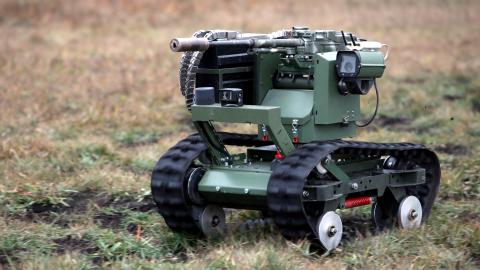
Ukrainian forces have regularly showcased these capabilities in combat. In a recent engagement, Ukrainian units used only unmanned aerial systems and unmanned ground vehicles to seize a Russian position, an operation that may mark a notable inflection point in the conduct of modern warfare. Zelenskyy announced the successful operation on April 13. Although he did not disclose the location, he framed the operation as an early indicator of a shifting battlefield paradigm. Though details of the achievement remain limited, open-source indicators suggest the attacked was executed without deploying infantry, resulted in no Ukrainian losses, and led to the eventual surrender of the Russian personnel holding the position.
Germany has thus far exercised strategic restraint in declining to provide Ukraine with Taurus KEPD 350 cruise missiles, which would likely have proved highly effective against the Crimean Bridge, a central logistics artery sustaining Russian forces on the occupied peninsula. Berlin’s increasing willingness to support Ukraine’s indigenous deep-strike capabilities represents a meaningful and positive shift in the bilateral relations.
3. What to Monitor in the Coming Weeks
1. With diplomatic talks between the United States and Iran concluding without agreement in Pakistan, combat operations have resumed in the Middle East, as US Central Command executes a naval blockade of Iranian ports. Iran is likely to intensify its drone strikes against soft targets across the Gulf in an effort to inflict greater costs on the global economy.
2. Against this backdrop, Zelenskyy recently confirmed the transfer of Ukrainian counter-drone systems, including drone-hunting drones, to the Gulf Arab states. In the coming weeks, Ukrainian weapons deliveries to Arab allies of the United States—and increasingly of Ukraine—are expected to grow.
Subscribe to Hudson’s Re: Ukraine Newsletter Here