












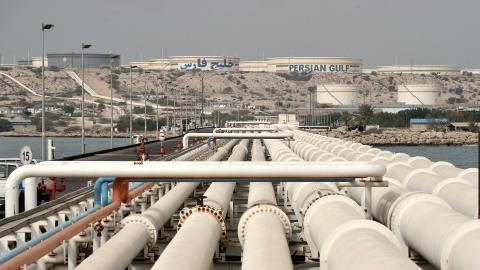
As United States forces aboard the USS Tripoli arrive in the Middle East, Hudson Institute Senior Fellow Can Kasapoglu analyzes Washington’s options for striking Iran’s coercive island network in the Gulf, including Tehran’s main export hub, Kharg Island.
The Military and Geopolitical Perspective on Iran’s Coercive Island Network
The ongoing American–Israeli campaign against Iran has been operationally effective in degrading the Islamic Republic’s destructive military capabilities. Yet Washington will face difficulty compelling Iran’s Islamic Revolutionary Guard Corps (IRGC) to stand down so long as Tehran retains the ability to disrupt maritime economic activity through the Strait of Hormuz.
The strait, while still susceptible to Iranian threats, remains the central vulnerability in the global economy. Prior to Operation Epic Fury, a substantial share of global shipping transited this narrow maritime corridor—including roughly one-quarter of global seaborne trade, one-fifth of the world’s oil supply, one-fifth of the world’s liquid natural gas (LNG), and a wide range of other critical goods such as fertilizers. This concentration of maritime traffic along predictable sea lanes has created a structural exposure: a disruptive and hostile actor with continued access to the strait can impose disproportionate effects on a global scale. Iran’s military and strategic approach to the current conflict rests squarely on this stark geopolitical reality.
In any potential effort to disrupt Iran’s control over the strait, Kharg Island looms large. Located deep in the Persian Gulf, some sixteen miles off the coast of Iran and roughly four hundred miles northwest of the Strait of Hormuz, the island spans only about eight square miles. Despite its small size, Kharg functions as the primary hub for Iran’s oil exports and serves as an economic center of gravity underpinning the IRGC’s coercive power.
Any serious effort to dismantle Iran’s leverage over global energy flows must address the broader network of Iranian-controlled islands in the Gulf rather than focus on a single node. Qeshm Island, positioned closer to the entrance of the strait, extends Iran’s surveillance reach and supports naval drone operations and anti-ship missile coverage. The islands of Abu Musa, Larak, Greater Tunb, and Lesser Tunb sit astride the strait’s entrance, providing Tehran additional reach along this sensitive maritime corridor. Together, these positions allow Iran to maintain persistent surveillance, deploy missile systems, and conduct interdiction efforts against passing vessels.
Even as US Marines were en route to the Gulf aboard the USS Tripoli, Washington was already shaping the battlespace and setting conditions for the opening phase of a potential campaign. US strikes have targeted high-value Iranian military defense infrastructure on offshore islands. Additionally, US Central Command (CENTCOM) has announced the killing of Admiral Ali Reza Tangsiri, commander of the IRGC navy. Although decapitation strikes have inherent limitations, Tangsiri’s death could have a detrimental effect on Iran’s island defense plans.
A coordinated campaign against multiple Iranian positions could further alter the geometry of the war by compressing Iran’s operational space and complicating its ability to sustain maritime pressure. Seizing and holding Kharg Island for a sustained period could even serve as a catalyst for internal political instability or regime change within the Islamic Republic.
Yet the seizure of terrain, whether inside mainland Iran or on its offshore islands, would be only an initial step. Holding that ground amid persistent missile and drone salvos and a barrage of asymmetric threats would likely require a prolonged campaign. Absent robust force protection, layered air and missile defenses, counter-drone capabilities, and continuous resupply operations, any initial gains could erode quickly, leaving US forces dangerously exposed.
The Military Buildup
The USS Tripoli arrived in the Middle East on March 27 carrying thousands of Marines from the 31st Marine Expeditionary Unit (MEU). This force package is configured for rapid-response contingencies across littoral environments and is designed for insertion, limited-objective operations, and crisis response.
The Tripoli’s design shapes how it is likely to be employed. The ship is configured without a well deck, a choice that maximizes its naval aviation capacity and allows it to operate as a high-density platform for F-35B aircraft. As a result, the vessel functions as a light carrier, prioritizing sortie generation and sustained air pressure over surface insertion capacity. The USS Boxer, a Wasp-class amphibious assault ship with the 11th MEU, has also departed San Diego for the Middle East. The two formations appear to be moving toward the region on a staggered timeline.
An MEU provides a modular, multidomain force designed for rapid combat operations. In a strike-forward configuration, embarked F-35B Lightning II aircraft can extend the force’s reach inland while supporting maritime control, including engagements against fast-attack craft. Attack helicopters can deliver persistent coverage in littoral areas, reinforcing interdiction and close-in protection. In an assault posture, an MEU can insert Marines across extended distances using MV-22 Osprey and CH-53E Super Stallion platforms, enabling distributed entry options beyond the immediate shoreline.
This maritime posture is unfolding alongside signs of parallel land-force readiness. Elements associated with rapid-response formations, including detachments from the 82nd Airborne Division, have been described in open-source reporting as part of a broader contingency posture in the region. Taken together, these developments reinforce the idea that Washington is positioning scalable and deployable forces into the Gulf for crisis response rather than preparing for immediate large-scale war. These movements expand the menu of options available to US planners.
A Dangerous Naval Threat Landscape
To date, CENTCOM’s sustained campaign has hampered Iran’s naval, missile, and drone capabilities, degrading Tehran’s ability to mass fires and coordinate effects at scale. Nonetheless, the Islamic Republic retains serious residual threats. Even in a weakened state, Iran’s layered denial architecture—mines, missiles, and drones—continues to impose real operational risks on any force operating in the Gulf.
Easy to deploy and highly effective in the narrow approaches to the Strait of Hormuz that amphibious units must traverse, naval mines represent the least expensive means of threatening a moving amphibious force. The Islamic Republic has a variety of these mines in its inventories. While none are state of the art, they remain dangerous.
Mines do not need to win the fight to be effective—they need only complicate an adversary’s efforts sufficiently to deter action. This principle has been demonstrated repeatedly in modern warfare. During the Korean War, dense minefields delayed US amphibious operations at Wonsan in 1950 and stripped the landing of its operational value. After that operation, US Admiral Allan E. Smith identified the disproportionate impact mines can have with characteristic acerbity: “We have lost control of the seas to a nation without a Navy, using a pre–World War I weapon, laid by vessels that were utilized at the time of the birth of Christ.”
Beyond naval mines, Iran’s anti-ship cruise missiles (ASCM) and anti-ship ballistic missiles (ASBM) pose critical threats in the theater. Satellite imagery suggests that Iran has installed a significant portion of its ASCM capabilities in subterranean launch positions on Qeshm Island.
The Islamic Republic’s ASCM baseline has long borne evidence of Chinese DNA. The Quds Force, a branch of the IRGC specializing in unconventional warfare and subversive military intelligence operations, has transferred some of these systems to Iran’s proxies across the region, including the Houthis in Yemen and Hezbollah in Lebanon. In 2006, Hezbollah successfully struck an Israeli Navy platform, the INS Hanit, with a Noor missile, a derivative of the Chinese C-802 ASCM.
While Iranian anti-ship cruise missiles have historically been limited to subsonic categories, expert assessments suggest that the IRGC has recently explored supersonic options, including variants equipped with ramjet power packs—air-breathing propulsion systems that compress incoming air at high velocity before combustion. More alarmingly, reporting indicates that China may have transferred YJ-12 supersonic anti-ship cruise missiles to Iran before Operation Epic Fury began. While no open-source intelligence confirms Iranian forces have used such weapons to date, this would mark a true capability leap for Tehran.
Anti-ship missiles, however, are only effective as the kill chains that enable them. In 2025, the US Department of State publicly accused Chinese satellite companies of providing the Houthis with targeting data. Moreover, ongoing monitoring suggests that the IRGC has long sought access to military-grade data flow from companies linked to the Chinese Communist Party (CCP).
Additionally, reports that Russia has provided Tehran with targeting data to support its operations against US forces have already made headlines. In any potential marine assault scenario, it would be naïve to assume that China and Russia would remain idle or decline to provide Tehran with real-time actionable intelligence.
ASBMs present an additional challenge for US forces in any effort to seize Kharg Island. Unlike high-end ASCMs, ballistic missiles do not hug the sea or maneuver extensively. Instead, they rely on speed. Some exit the atmosphere and reenter on a steep terminal trajectory, compressing reaction times and striking a target at extreme velocity.
Interception windows against such projectiles are narrow, and the effects of ASBM warheads are correspondingly severe. Yet physics cuts both ways. Ships are moving targets by nature, and a ballistic missile lacking terminal sensors or real-time updates can easily miss a maneuvering vessel.
Once again, the decisive variable in such operations is the kill chain, a systematic, sequential process for identifying, tracking, targeting, engaging, and destroying an enemy. Persistent drone coverage fused with disciplined signals intelligence can convert speed into accuracy. In confined waters, volume can accomplish what imprecise weapons cannot. A coordinated salvo layering ASBMs with loitering munitions and ASCMs increases the probability of a successful strike and taxes defensive magazines.
Iran’s proxy network has demonstrated a willingness to employ ASBMs. In 2023, the Houthis fired ASBMs at the vessel Maersk Hangzhou. The US Navy destroyers USS Gravely and USS Laboon intercepted the inbound missiles, whereupon the engagement shifted to close quarters. Houthi boats closed to within meters of the merchant vessel, prompting US naval helicopters to counterattack, destroying multiple platforms and killing ten enemy fighters.
In 2024, the Houthis also struck the Greek-owned bulk carrier Zografia. Open-source intelligence suggests that the weapon the Iranian proxy employed was an ASBM—probably a Khalij Fars, the anti-ship derivative of the Fateh-110 short-range ballistic missile.
Finally, Iran retains naval drones, or unmanned surface vessels (USVs). These robotic platforms have scored kills on commercial vessels during Operation Epic Fury, and have also constituted a key part of the Houthis’ campaign in the Red Sea. Visual evidence suggests that Iran has deployed naval drones in underground sites along its coastal areas and islands. Open-source battle damage assessments show that repeated attacks on these hardened underground ASCM and USV facilities have failed to destroy them entirely, in part due to limited penetration into the core architecture protecting these installations.
Air Assault Options and Likely Concepts of Operations
At present, the Pentagon is weighing the deployment of up to 10,000 additional ground troops to the Middle East. Such a move would expand the range of military options available to US President Donald Trump. In the meantime, open-source tracking suggests that strategic US drones have conducted frequent surveillance flights above Kharg Island.
While Iran’s coastal islands offer suitable shores for amphibious landings, US forces could likely insert Marines more effectively by air. In any operation targeting Kharg or Iran’s other islands, US forces would likely approach at low altitudes using tilt-rotor aircraft such as the MV-22, the Marine Corps variant of the V-22 Osprey. Elements from the 82nd Airborne Division and select Special Forces detachments would likely join these raids.
Almost certainly, any such campaign would be preceded or accompanied by a strategic-scale shock elsewhere in Iran—perhaps including a massive attack on the country’s electrical grid that could cause widespread blackouts. In addition, while high-command decapitation strikes would not paralyze the IRGC, targeting sector commanders in the Hormuz area and senior leaders of Tehran’s naval forces could open a window for US forces to strike Kharg.
Although US strikes have largely degraded Iran’s strategic air-defense network, residual elements of Tehran’s asymmetric systems remain active and could strike with little warning. High-end Man-Portable Air-Defense Systems (MANPADS) would continue to pose a persistent threat to low-flying aircraft, while more unconventional systems—such as the 358 loitering “air-defense” drone—introduce an added layer of unpredictability to any US air-assault effort.
Together, these threats would complicate US air-assault operations, particularly during the most vulnerable phases of insertion and resupply. Notably, by the end of 2025, Iran had officially made a move to acquire Russian Verba high-end MANPADS, systems capable of imposing serious risks on air assault platforms operating at low altitude.
Once on the ground, any forcible-entry formations would disperse to secure critical infrastructure on Kharg Island or other target locales. This move would force Revolutionary Guard units into a stark choice: strike Iran’s own key economic infrastructure to dislodge invading forces, or hold fire and risk losing control of the regime’s primary export nodes.
If an expeditionary force successfully completes forcible-entry operations on Kharg and secures the island’s export infrastructure, the campaign will transition from seizure to consolidation. The principal task in this phase would be to hold the island and prepare it for follow-on forces. This effort would prioritize force protection under sustained Iranian interdiction. At that stage, the IRGC would likely initiate layered fires, including drones and ballistic missiles, to degrade the US foothold on the island.
The IRGC could then attempt to shift its ground-warfare efforts to irregular operations, using residents and oil workers as human shields. Recent operations in Iraq have demonstrated this approach, with Iranian paramilitary groups there using first-person view (FPV) drones, mirroring a key trend in the war between Russia and Ukraine. A similar concept of employment (CONEMPS) should be anticipated in the Revolutionary Guards’ island-defense efforts, alongside the use of tactical weapons such as anti-tank guided missiles (ATGMs) that could produce asymmetric effects.
Sustainment Under Fire: From Seizure to Vulnerability
If US forces are successful in seizing Kharg Island or other similar objectives, their operation would shift into the sustainment phase. During this period, three Iranian capabilities could threaten US marines and airborne troops.
The first is Iran’s supply of short-range ballistic missiles: road-mobile, solid-fueled, and relatively precise Fateh-110 derivatives, including the Fateh-313, the Zulfiqar, and other variants optimized to strike fixed positions, logistics hubs, and airfields with minimal warning. Iran also possesses an anti-ship variant of this ballistic missile family, a capability which should not be underestimated.
The second threat comes from Iran’s Shahed family of drones. Russian combat experience in Ukraine has demonstrated how these munitions can be effective as expandable strike systems. Ongoing Russian–Iranian adaptation of Shahed drones likely points to the emergence of variants that can carry expanded payloads, including heavier and thermobaric warheads, in innovative concepts of operations (CONOPS).
Third, US forces attempting to hold Iran’s offshore islands could be threatened by heavy ballistic missile warheads equipped with submunitions. These weapons are designed for saturation rather than precision. In an island battle space, these systems could blanket critical areas, stress US naval air defenses, and degrade operational tempo.
Against these threats, the energy infrastructure on Iran’s islands remains both the key objective and the most acute vulnerability. Any Iranian strike against this infrastructure on Kharg Island would not only shape the tactical fight locally, but also transmit immediate shocks to global energy markets.
Access Under Fire: Pathways and Strategic Tradeoffs in the Strait of Hormuz
Any operation targeting Iran’s island oil infrastructure would begin with a shaping phase—cyber and electronic warfare efforts to disrupt sensors and networks, followed by precision strikes to degrade air defenses and isolate the objective. Without these preparations, US forces would enter a contested battle space with high exposure. Any US campaign in the region would likely center on two decisive islands: Kharg and Qeshm.
Kharg is Iran’s economic center of gravity. Seizing it would place Tehran’s oil exports under direct pressure, generating coercive leverage rather than territorial gains. The approach to taking Kharg would likely rely on vertical insertion from regional bases, minimizing the exposure of large amphibious platforms in the Strait of Hormuz.
The potential payoff to capturing Kharg is significant, but so too is the risk of escalation. Even if US forces secured the island, the IRGC would retain the capacity to retaliate across the Gulf by striking the region’s energy, water desalination, and civilian infrastructure. This could expand the conflict into a broader economic war.
Qeshm, by contrast, is the IRGC’s primary denial hub. It anchors Iran’s ability to threaten maritime traffic with missiles, drones, mines, and fast-attack craft supported by hardened and often underground infrastructure. Taking Qeshm is also most likely the harder fight. The island’s size, terrain, and proximity to the mainland favor the defender. Iranian reinforcement efforts there would likely be continuous. Even if seized, holding Qeshm would impose a heavy burden for a relatively limited strategic return.
Ultimately, the decisive challenge in taking either island is one of sustainment. Seizing ground is feasible, but holding it is more difficult. Continuous resupply, medical evacuation, and air- and missile-defense efforts would strain US capacity, while US bases in the region would remain vulnerable to Iranian strikes. Distributed Iranian operations, including decentralized missile and drone units, would enable Tehran to exert persistent, multi-directional pressure on any opposing forces.
Yet, while Iran retains control of the Strait of Hormuz, it retains the strategic leverage necessary to help it forestall geopolitical defeat. Washington’s path to victory runs through the strait, in one form or another.