















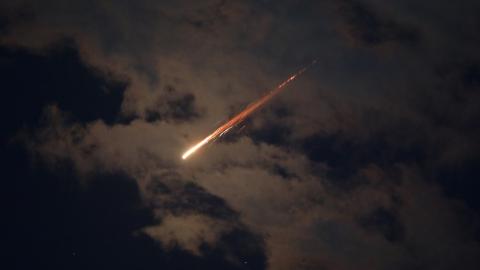
On March 20, the Islamic Republic of Iran carried out a limited long-range ballistic missile attack against Diego Garcia, a base in the Indian Ocean operated jointly by the United States and the United Kingdom. Hudson Institute Senior Fellow Can Kasapoglu analyzes the attempted attack and its implications for the United States and its allies.
Iran’s Deliberate Shift Toward Intercontinental Capabilities
Iran’s decision to target Diego Garcia with two missiles represents a calculated expansion of Tehran’s operational strike geometry beyond the Middle East theater. That neither missile reached its intended target—one suffered an in-flight failure, while the other was intercepted—does not diminish the operational significance of the attempt.
Instead, the launches demonstrate that Iran’s Islamic Revolutionary Guard Corps (IRGC) intends to stress-test its extended-range delivery systems under live operational conditions, and target locations previously considered beyond Tehran’s reach. The attempt aligns with Iran’s geopolitical objective of delivering strategic effects on a global scale to pressure the administration of US President Donald Trump into ending the war.
Israeli military assessments characterize the weapon systems Iran employed in the strike as a two-stage ballistic missile with an estimated operational range of approximately 2,500 miles. That characterization carries considerable analytical weight for any attempt to determine the system Iran may have used.
The two-stage configuration likely means that the missile does not belong to the Khorramshahr family, one of Iran’s legacy medium-range ballistic missiles. The Khorramshahr-4 is a platform optimized for delivering heavy payloads within an operational radius of approximately 1,240 to 1,250 miles. The North Korean baseline variant of the missile achieves ranges in excess of 1,860 miles, but only with a substantially lighter warhead.
Despite its occasional mischaracterization as a two-stage missile, the Khorramshahr is assessed with high confidence to be a single-stage, liquid-fueled projectile rooted in the North Korean Musudan lineage. References to this projectile possessing a second stage frequently reflect an analytical conflation between true propulsion stages—discrete engine phases that generate thrust during ascent—and post-boost or reentry-vehicle configurations, which are the terminal-guidance and payload-delivery components activated after the boost phase concludes.
The Israeli assessment of Iran’s attempted strikes on Diego Garcia indicates that Tehran likely used space-launched-vehicle (SLV)–derived architectures, rather than the Khorramshahr, in those attacks. The combination of a verified two-stage propulsion profile and a demonstrated range envelope of roughly 2,500 miles shifts the analytical weight decisively away from Iran’s legacy medium-range ballistic missiles (MRBM) and toward its SLV ecosystem—the suite of multistage orbital-insertion rockets that Tehran has developed under the guise of its civilian space programs.
Systems such as the Zoljanah, the Qased, and—likeliest of all—the Ghaem-100 provide a closer design philosophy analogy than the Khorramshahr to the strike parameters observed in last week’s attack. These projectiles combine verified multistage architectures with demonstrated advances in solid-propellant technology and staging sequencing, and exhibit range characteristics consistent with the reported Diego Garcia strike profile.
This strike profile also suggests that Iran may have addressed any remaining technical barriers preventing it from striking targets as distant as Diego Garcia. These barriers, chief among them reentry-vehicle survivability under the elevated thermal and mechanical stresses of a high-velocity descent, may have been partially or fully mitigated through suborbital testing, undisclosed experimentation, or external technical assistance, likely from North Korea.
A Long-Standing Strategic Weapons Pathway
Open-source defense intelligence assessments converge on three principal development pathways through which Iran could credibly advance toward an intercontinental ballistic missile (ICBM) capability.
1. Evolving the Khorramshahr lineage.
Tehran could reduce payload mass and reconfigure the system into intermediate-range ballistic missile (IRBM) variants with progressively longer ranges. This effort could ultimately produce ICBM-class derivatives that leverage existing propulsion infrastructure while eliminating the range of penalties imposed by super-heavy warhead configurations.
2. Integrating external Propulsion units.
Iran could incorporate critical foreign engine designs, most notably the Soviet-origin RD-250 family, to bypass indigenous development constraints and shorten the timeline to true intercontinental performance. The RD-250 design lineage was central to the development of the North Korean Hwasong-15 program.
3. Exploiting the SLV program
Tehran could continue using platforms such as the Qased and Ghaem-100 to refine multistage solid-propulsion systems, precision guidance architectures, and staging dynamics. This pathway offers a structured, politically plausible route for advancing toward intercontinental capabilities under the cover of a nominally civilian space program.
Of these three options, the SLV track is likely the most viable, sustainable, and politically plausible route available to Tehran. In April 2020, the IRGC Aerospace Force executed its first successful launch of a military satellite when it placed the Noor into a low-Earth orbit at approximately 273 miles.
That operation represented a significant institutional departure. It was conducted exclusively by the Revolutionary Guards, not by Iran’s civilian space agency, and it employed the Qased launch vehicle—a three-stage system integrating both liquid- and solid-propulsion elements. The launch drew directly and deliberately on Iran’s existing ballistic-missile and space-launch infrastructure, blurring the institutional line between the two programs in a manner that was almost certainly intentional.
The Qased’s architectural profile already closely parallels that of an ICBM. Its first stage is assessed with high confidence to rely on a Ghadr-class medium-range ballistic-missile engine, a configuration that confirms the deliberate cross-pollination between Iran’s military-use missile inventory and its space-launch program.
In July 2025, following the conclusion of the Twelve-Day War, Iran resumed space-launch testing using the Qased. Officially characterized as satellite-related technical exercises, these launches unambiguously advanced Iranian propulsion, guidance, and staging capabilities with direct relevance to long-range ballistic-missile development. The dual-use character of Iran’s space program is not a matter of analytical inference—it is a structural feature of the program’s design.
The structural convergence in Iran between SLV technology and long-range ballistic-missile development has been a persistent and well-documented concern in Western intelligence and defense assessments. The United Kingdom, France, and Germany—the E3—issued a coordinated statement following Iran’s January 2024 launch of the Soraya satellite aboard a Ghaem-100 SLV. The three nations explicitly assessed the launch not as a civilian milestone, but as a component of a broader and deliberate pattern of long-range missile development.
Since Trump’s first term, successive US intelligence community evaluations have also consistently assessed that Tehran’s nominally civilian space program has credibly and deliberately pursued the possession of intercontinental ballistic-missile capabilities. Iran’s attempted strike on Diego Garcia may vindicate this judgment as more details of the attack become known.
Iran’s Expanding Threat Envelope: Implications for the Continental United States and NATO
The attempted strike on Diego Garcia marks a decisive inflection point in Iran’s strategic-missile posture—one that demands a fundamental reassessment of existing threat frameworks.
For years, Tehran maintained the convenient fiction that its missiles possessed a self-imposed range ceiling of 1,240 miles. This posture served Iran’s diplomatic interests while masking the true pace of its development program.
That fiction is now operationally obsolete. A strike profile extending into the Indian Ocean demonstrates not merely extended range, but Iran’s deliberate abandonment of strategic ambiguity. Iran is no longer signaling restraint. It is signaling reach, and doing so under live warfighting conditions.
The implications for the North Atlantic Treaty Organization (NATO) are immediate and structural. With the limited exception of the Iberian Peninsula, the alliance’s territory now falls within Iran’s evolving missile engagement envelope, including systems derived from its SLV program.
Moreover, the Iranian threat is no longer theoretical. Over the course of Operation Epic Fury, Iran has executed multiple strike attempts against Türkiye, the sole NATO member state that shares a land border with the Islamic Republic. Deployed alliance air- and missile-defense assets, including systems that protect critical infrastructure nodes such as the Kürecik X-band early warning radar, intercepted those attempts.
At the strategic level, Iran’s reach now extends well beyond Europe. Tehran’s long-range missile-development program has always carried an implicit terminal objective: placing the continental United States within credible strike range. For the Islamic Republic, a demonstrated range of 2,500 miles is not an endpoint, but a developmental midpoint. For the West, Iran’s attempted strike on Diego Garcia serves as a marker that Tehran is moving deliberately toward intercontinental capabilities.