











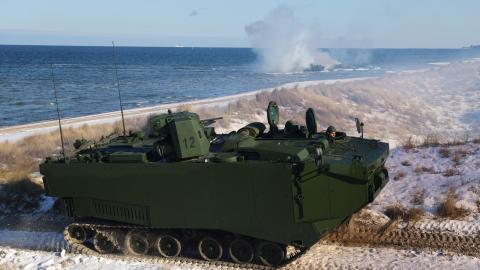
The main phase of a large-scale NATO exercise called Steadfast Dart 2026 began last week. This exercise, billed as the alliance’s largest for the year, involves more than 10,000 troops from 11 NATO nations. The focus of the military exercise is Northern Europe and the Baltic Sea region, an area that has become more contentious since Russia’s invasion of Ukraine and the subsequent accession of Finland and Sweden to the alliance.
The exercise also comes at a time when transatlantic relations have been strained over issues such as trade disputes and American calls to annex Greenland. In light of the geopolitical circumstances, there are three notable observations about this exercise that set it apart from other NATO exercises in recent years.
The first is the limited US participation in the training event. This is the first large-scale NATO training event in which there is no sizable or significant US military presence since President Barack Obama’s decision to withhold full American participation in the 2013 Steadfast Jazz exercise. At the time, this was thought to be because Obama was shifting US focus away from Europe as part of the so-called pivot to Asia, meaning he showed little interest in bolstering America’s role inside NATO.
Officials say the lack of US participation in this month’s exercise is because policymakers want to test Europe’s ability to respond to a crisis without the help of Washington. While there is probably some truth in that, it is likely that the lack of an American military role in this year’s exercise is part of what has become a repeated pattern by the second Trump administration of reducing America’s role in the alliance.
For example, at the last NATO defense ministerial meeting, the US defense secretary, who normally attends, did not show up and instead delegated a more junior official. There is even talk of the US relinquishing the role of Supreme Allied Commander Europe, a position it has held exclusively since the beginning of the Cold War.
The second observation is the outsized role played by Turkiye. It is the second-largest troop-contributing country after Germany, having sent more than 2,000 to the exercise. Notably, the Turkish navy’s amphibious assault ship TCG Anadolu is playing a leading role in the maritime component of the exercise and has even sailed into the Baltic Sea, operating off the coast of Latvia. This marks the first time the Turkish navy has operated in the Baltic Sea at this scale.
What is most interesting is how Turkiye’s participation is being framed. While Turkiye was an early member of NATO, having joined the organization in 1952, it has often been cautious about highly public participation in major training events during times of geopolitical tension. Ankara prides itself on balancing its relations between both Ukraine and Russia within the framework of its NATO obligations. While it participates in NATO operations and exercises, it often does so quietly. This time, however, even President Recep Tayyip Erdogan publicly commented on Turkiye’s role in the exercise on social media, signaling a willingness to highlight Ankara’s contribution.
The third observation concerns geography and logistics. Many might think that the distances across Europe may not be very far compared to traveling within other continents. However, this is a misconception. Because the focus is on the Baltic Sea, countries such as Turkiye and Spain have had to travel significant distances to participate, serving as a useful test of different European countries’ ability to project power in the transatlantic region.
The Turkish navy’s deployment to the Baltic represents a power projection of roughly 8,000 km from its home ports, underscoring the scale of the logistical and operational effort required to sustain such a mission. The distances between Spain and the Baltic states are also vast. Going from the Iberian Peninsula to Estonia means flying troops more than 3,300 km. This also requires a significant logistical effort.
NATO’s training exercises serve as an important component of the alliance’s overall readiness. They offer opportunities to learn lessons and identify shortfalls so that the alliance can be better prepared in the case of war.
For example, NATO this month conducted another training event in Estonia that included a small team of Ukrainian drone operators. In a simulation, in just a matter of hours, 10 Ukrainian drone operators were able to “destroy” so many armored vehicles and troops that two battalions-worth of British and Estonian soldiers were left combat ineffective. The lesson was clear: the character of warfare is evolving rapidly and NATO must adapt. Regular training exercises give the alliance an opportunity to do just that.
Many Americans are frustrated that some European allies have not invested enough in defense. At the same time, the US needs NATO just as much as Europe needs the US. Europe is vital to the US economy, serving as America’s largest source of foreign investment and its largest export market. NATO provides the security foundation that makes this economic relationship possible.
So far, the exercise has been successful and it shows that, even if the US chooses not to participate in a major way, the European members of NATO understand that they have obligations, duties and commitments to fulfill.
While the Trump administration’s calls for Europe to do more without the US may have been one of the drivers behind the lack of American participation in Steadfast Dart 2026, America’s absence also sends political signals, whether intended or not. In the current geopolitical environment, the optics of nonparticipation matter. And at a time when transatlantic unity is needed, the optics of America’s absence do not look good.