







In The Closing of the American Mind Allan Bloom famously remarked that his incoming students believed that
“The true believer is the real danger. The study of history and of culture teaches that all the world was mad in the past; men always thought they were right, and that led to wars, persecutions, slavery, xenophobia, racism, and chauvinism. The point is not to correct the mistakes and really be right; rather it is not to think you are right at all.”
Many still hold to this and assert that a majority of past wars, persecutions, and cruelties were peculiarly religious matters. There is certainly some measure of truth in this since religion comes in all shapes and sizes.
But the treaties ending wars were also usually religious matters, as were instances of political opening and reform. Families, economics, education, media, health, and poverty relief were also religious. In short, historical activities of all kinds were religious, as were societies as a whole. Human beings, for good and ill, have always been religious in their practices.
Hence, asserting the role of religion in conflict merely illustrates two obvious things: first, that religion has suffused humankind throughout history, and second that human beings have done terrible things to each other throughout history. These realities reflect the Christian doctrine of original sin, something Christian theologians and as well as others have been aware of for several millennia.
The key issues are not whether religion has justified evil things, which it certainly has, but whether religions, or at least some religions, have been particularly disposed to violence and repression. And, in particular, how historic religions compare with those comparative newcomers in world history, secular ideologies and regimes.
In his excellent and comprehensive Broken Altars: Secularist Violence in Modern History, Thomas Albert Howard writes that his purpose is to “bring needed nuance and perspective to a complex, often fraught topic.” While his discussion is indeed nuanced and complex, he makes a very strong case that violence and cruelty are in fact more typical of secular states and movements than religious ones.
Howard is careful to note that ‘secular,’ a term derived from Christian theology, has several meanings, some of which can have a positive view of religion. He distinguishes three kinds: passive secularism, combative secularism, and eliminationist secularism. His “passive secularism” refers to open regimes that emphasize freedom of religion, of conscience, and of the press. These being more-or-less unequivocally positive attributes, he concentrates his critique of secularism on its combative and eliminationist forms.
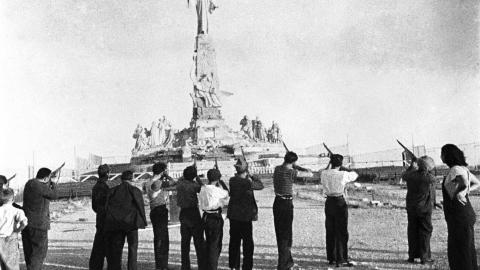
He provides three case studies of early twentieth-century “combative secularism”: Mexico, Spain, and Turkey. This section surveys the often overlooked brutal, violent repression and assaults on the Catholic Church in Spain and Mexico in the 1920s and 1930s. In Turkey, public Islam was controlled by a repressive state while non-Muslims were, and are, driven from the country.
Howard’s principal focus is on “eliminationist” secular regimes, headed by communist parties professedly adhering to Marxist-Leninism. His examples are the USSR, Romania, Czechoslovakia, Albania, and what he calls “Red Asia,” comprising Mongolia, China, Tibet, and Cambodia.
For all their differences, the litanies of repression Howard describes show striking similarities: anti-religious propaganda and desecration of religious sites, control of education and the press, compulsory registration of religious institutions, imprisonment, exile, torture, murder, and genocide. Similar patterns exist in the regimes he does not analyze, such as one of the worst, North Korea. His descriptions of their depravities make for harrowing reading.
Two striking features are not the violence per se, but their glorification of it and sadistic reveling in the humiliation, torture, and elimination of their purported foes. The opponent must not only be defeated but must also suffer. Howard’s description recalls Solzhenitsyn’s contrasting of the brutality of the Soviet prisons and camps with the relative lenience of Tsarist confinement.
Some of this reveling in violence is to maintain terror as a means of control over the population. Lenin maintained, “To promise the end of terror would be self-deception.” It was to be a permanent policy. Whether the victim was innocent did not itself matter; indeed, the fact that innocence was no defense reinforced the power of terror.
But there are perhaps deeper, more religious motives. As Eric Voegelin argued in the 1930s in The Political Religions, ideologies such as Nazism, Fascism, and Communism were best understood as ersatz religions. He expanded this in The New Science of Politics (1952) and Science, Politics and Gnosticism (1959). His theme was not so much that ideologies are like religions, but that they are religions, albeit of a particularly debased kind.
This is usually implicit from the overall structure of ideologies, with prophets, messiahs, sacred texts, and eschatology, but can sometimes be quite overt. In much Eastern Orthodox tradition, the bodies of holy saints are believed to be immune to corruption. The bodies of monks who died centuries ago may be observed in Kiev’s Pechersk Lavra, the Monastery of the Caves. Lenin’s body, embalmed in Red Square, is a secular pilgrimage site that sought to illustrate that communism could match Orthodoxy. It has established a “Lenin cult,” something that Putin has defended. Mao Tse-Tung’s embalmed body in Tiananmen Square functions in the same way for the Chinese Communist Party.
Even more stark is North Korea’s secular theocracy. The Democratic People’s Republic of Korea (DPRK) does not consider its ideology of Kim-Il-Sung-ism–Kim-Jong-il-ism as a religion. It is officially referred to as a sasang (ideology), and it is considered treacherous for a North Korean to refer to it as a chonggyo (religion). But it certainly mirrors what most would call a religion.
Former Soviet army officer Kim Il-Sung founded the North Korean state. From early childhood, North Koreans have been taught to look on the “Great Leader” Kim Il-Sung and, later, his son Kim Jong-Il as infallible, godlike beings and the veritable progenitors of the Korean race. The constitution refers to Kim Il-Sung as the “eternal President” so that, while dead, he still rules North Korea. The constitution also explicitly states that the party and revolution must be carried out “eternally” by theKim family bloodline. This is confirmed by recent reports that current leader Kim Jong Un has selected his 13-year-old daughter Kim Ju Ae as his heir, thus carrying the eternal bloodline into its fourth generation.
Such regimes have a god that is immanent, what the Bible calls an idol. But, without a real God, they have no external standard to guide or restrict them. They have an inner-worldly absolute. In this sense, eliminationist secularism is the closest in the modern age we have to a theocracy. It is the standard beyond which there can be no appeal.