






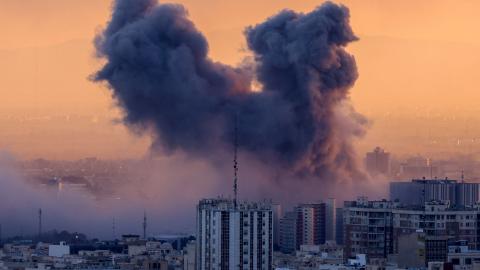





Below Hudson Institute Senior Fellow Can Kasapoğlu assesses the military situation in Iran and across the Middle East as the United States and Israel continue to conduct air strikes against the regime and as Tehran attempts to widen the conflict. He also pinpoints the key variables that will determine its course over the coming critical days.
1. Iran’s Missile Salvos Have Declined, but Tehran’s Kill Chain Remains Intact
Operations Epic Fury and Roaring Lion, the joint US-Israeli campaign against the Islamic Republic of Iran, have begun to reduce Iran’s long-range strike tempo. Tehran’s missile and drone salvos have declined by roughly 70 to 85 percent since the first day of strikes, largely thanks to an aggressive hunt for Iranian missile launchers and drone launch positions. Because the US controls the skies over Iran and has unprecedented information superiority, it can now strike Iranian Shahed loitering munitions on the ground.
Yet no credible reports have thus far emerged of major defections within Iran’s Islamic Revolutionary Guard Corps (IRGC) or among the Islamic Republic of Iran Army, commonly known as Artesh. As a result, the war so far has produced mixed outcomes: Iran’s launch capacity appears to be declining under sustained US and Israeli strikes, yet Tehran’s remaining missile and drone-combat formations continue to fight and still pose a serious threat, especially to the Gulf Arab states.
Open-source intelligence tracking suggests that by March 5, the Islamic Republic had already launched roughly 585 ballistic missiles and 1,522 drones. In the opening stages of the conflict, which began on February 28, Tehran directed some 40 percent of its missile launches at Israel. As of March 4, however, that figure has declined to slightly more than 20 percent.
This shift suggests that Iran is changing its targeting priorities under mounting pressure. While Israel remains a central theater of the war, Tehran now focuses a larger share of its missile attacks on US military infrastructure in the region and other targets in the Gulf Arab states.
Tehran has already fired more ballistic missiles than it fired during the entire 12-Day War in June 2025. Iran’s drone usage also reflects an increased operational tempo: Tehran is on pace to fire between 4,000 and 5,000 Shahed loitering munitions over the course of a month, a pace similar to what Russia sustains in its campaign against Ukraine.
The geographic distribution of Tehran’s strikes against the Gulf Arab states further illuminates Iran’s operational planning and strategic priorities. Thus far, the United Arab Emirates and Kuwait have absorbed the heaviest salvos. Open-source data indicates that, as of March 4, Iran had directed 189 ballistic missiles and roughly 941 drones toward the UAE. Visual evidence also indicates that the UAE has sustained heavy barrages of Shahed drones. This pattern underscores Tehran’s reliance on massed loitering munitions to saturate its targets’ air defenses and impose constant defensive pressure.
Geography compounds the challenge the Gulf Arab states face. The UAE’s proximity to the Islamic Republic allows Tehran’s missile forces to employ short-range ballistic missiles, including solid-fueled systems with short launch preparation cycles. These weapons can be fired rapidly and with little warning, compressing any defender’s reaction time. When combined with large drone swarms, Iran can attack its neighbors with persistent low-cost aerial threats paired with high-speed ballistic strikes.
Despite these pressures, the UAE’s air and missile-defense networks have performed effectively thus far. Available indicators suggest that Abu Dhabi has been able to sustain interception rates consistently exceeding 90 percent in many engagements, reflecting a layered defensive architecture and a sustained operational readiness for high-tempo attacks.
Yet while the Gulf Arab states’ air and missile defenses are performing well and maintaining high interception rates, magazine depth may become a constraint if long-range exchanges continue at the current tempo. The UAE, like many of its neighbors, possesses limited supplies of interceptors. The rules of ballistic-missile defense dictate that a force requires two or three interceptors per incoming hostile missile to ensure a high probability of success. Applying this calculus to the current salvo patterns suggests that the UAE may have already exhausted roughly 20 to 40 percent of its missile-defense magazine depth in its fight to maintain interception rates above 90 percent.
Other Gulf Arab states have also been under fire, though not as intensely as the UAE. As of March 3, Iran had targeted Kuwait with 178 ballistic missiles and 384 drones. Saudi Arabia, Qatar, and Bahrain have also faced attacks, reflecting an expanded battle space across the Gulf.
Tehran has hit multiple targets in these countries. In Saudi Arabia, Tehran struck Aramco’s Ras Tanura refinery, a facility essential for the kingdom’s refining and export of oil products. Bahrain is in a particularly difficult position. According to official numbers, the island kingdom intercepted 70 missiles and 59 drones as of March 3. Of the Gulf Arab states, Bahrain’s air- and missile-defense inventory is the smallest and remains under significant stress. In its attacks against Qatar, Iran has employed more ballistic missiles than drones.
Taken together, the early strike data suggests that Tehran is waging a campaign designed not merely to punish individual states but to reshape the regional threat landscape. By attacking its neighbors, Iran hopes to pressure Washington via its Gulf Arab partners.
Iran is demonstrating that it can conduct high-tempo missile and drone warfare across the region. The central strategic issue, however, is not how many missiles and drones the Islamic Republic launches in the first week of the war, but whether the US-led coalition can destroy the IRGC’s long-range strike deterrent before Tehran can inflict undue damage on the Gulf Arab states.
These states possess significant offensive capabilities. Saudi Arabia, for one, employs a robust ballistic missile arsenal that the kingdom has developed in cooperation with China. Yet it remains to be seen if the Gulf Arab states will fight back and conduct offensive combat operations at scale.
2. Targeting Iran’s Long-Range Strike Deterrent: Launcher Attrition and Pre-Launch Drone Strikes
The IRGC’s doctrinal order of battle and operational kill chains remain intact, and it has been able to continue conducting long-range salvos, albeit at a suppressed pace. To reach its political and military objectives, Operation Epic Fury needs to break these junctures of Iranian resistance.
The pace of Tehran’s strikes has declined markedly since the outset of the conflict. Estimates from the US Department of War suggest an 86 percent drop in Iran’s missile salvos and a 73 percent decrease in its drone-warfare activity since the beginning of the war. In the opening days of the operation, Iran launched roughly 350 missiles per day, and is now launching around 50.
The diligent US and Israeli campaign to prey on Iranian transporter-erector-launchers (TELs) has been the primary driver of this trend. Visuals from the battle space illustrate that allied forces have hit a growing number of Iranian launchers as they prepare to conduct salvos. Destroying TELs reduces the Islamic Republic’s ability to generate large waves of strikes, even if Tehran retains missiles in storage.
Recent developments also indicate that Israeli military planners are the targeting priorities. In addition to Iran’s nuclear and missile infrastructure, Israel focuses its strikes on the IRGC’s internal security, intelligence, and protest-suppression units. This shift is notable. Regime protection—monitoring dissent, controlling unrest, and maintaining internal coercive power—is the core mission of many IRGC formations. Israel hopes to weaken Iran’s ability to both project power externally and maintain control internally.
For its part, the United States has intensified its hunt for Iranian Shahed drones on the ground. Washington’s forces have struck these loitering munitions often as they are being prepared for launch. This too marks a significant operational development. In the Russia-Ukraine War, such strikes are rare, as Kyiv lacks the air superiority required to systematically hunt drone-launch sites deep inside Russian-held territory. In contrast, the United States now operates over Iran with both air and information supremacy. Social media visuals have even shown US-operated MQ-9 Reapers over the Iranian city of Shiraz.
Yet Shahed drones are relatively cheap to produce in mass quantities, and defending against them often requires interceptors that are far more expensive to manufacture than the drones themselves. Moreover, the Gulf Arab states do not have Ukraine’s experience conducting counter-drone concepts of operations. Since allowing large drone swarms to launch imposes an unfavorable cost exchange on any defender, eliminating Iran’s launch positions altogether is the most sustainable way to win the drone war.
Finally, the naval warfare theater has been highly active in the early stages of the conflict. The US military has sunk or put out of action more than 20 Iranian warships across the region. Notably, a reported US torpedo attack against the IRIS Dena frigate off the coast of Sri Lanka marked the first confirmed American torpedo kill of a warship since the Second World War.
3. Iran’s Emerging Strategy: Degrading the Sensor Layer and Widening the Battle Space
Iran is increasingly targeting US radar and sensor infrastructure stationed across the Gulf Arab states, as Tehran appears intent on regionalizing the conflict in hopes of raising the diplomatic costs for Washington. To this end, Tehran reportedly launched a ballistic missile toward Türkiye, a host to key allied assets and the only member of the North Atlantic Treaty Organization (NATO) that borders Iran. This highlights how the conflict may expand beyond the US Central Command’s area of responsibility.
In addition to Israel and the Gulf Arab states, Tehran has hit multiple US bases across the region, targeting the sensor network and radar infrastructure that sustains American forces throughout the Middle East. Open-source imagery suggests that Iran has targeted several high-value sites. These include the AN/TPY-2 radar at Muwaffaq Salti Air Base in Jordan, the AN/FPS-132 radar in Umm Dahal, Qatar, the AN/TPY-2 and THAAD radars at Al-Ruwai Air Base in the UAE, and the AN/TPY-2 radar at Prince Sultan Air Base in Saudi Arabia.
The Qatar strike is particularly notable. Satellite imagery released by Planet Labs now appears to confirm the earlier claims of several Tehran-affiliated channels that an Iranian one-way attack drone or another projectile successfully struck and significantly damaged the US Space Force’s AN/FPS-132 (Block 5) ballistic missile early warning radar stationed there. The system is not a minor asset: valued at roughly $1.1 billion, the AN/FPS-132 is the largest US radar installation in the Middle East and a critical node in the region’s missile-warning architecture.
At this stage, drawing firm conclusions about the extent of battle damage would be premature. Available imagery and reporting remain incomplete and require careful verification. Moreover, the highly contested information environment complicates any open-source intelligence battle-damage assessments. For example, IRGC cyber-information operatives appear to be circulating fabricated satellite imagery to exaggerate US losses and shape perceptions in Tehran’s favor.
Nonetheless, Iran’s targeting pattern suggests that the Islamic Republic is focusing on the sensor layer that underpins the US-led air- and missile-defense architecture in the region. Tehran is likely trying to degrade American radar cueing and early-warning data that support the Gulf Arab states’ missile defense operations.
Blinding this sensor layer may be one element of a broader Iranian strategy to regionalize the conflict and expand its geographic scope in hopes of raising the diplomatic and strategic costs for the Trump administration. As mentioned earlier, on March 4 indications emerged that Iran had launched a ballistic missile at Türkiye, though it remains unclear whether this projectile had been intentionally aimed at Turkish territory or had deviated from its trajectory. While the details of this incident remain limited, NATO defenses ultimately intercepted the missile.
Any decision by Tehran to extend its missile campaign toward Türkiye would raise escalation risks significantly. Ankara hosts several critical NATO assets, including an airborne warning and control system operational node, a forward-deployed X-band radar installation, the headquarters of NATO’s Allied Land Command, and the strategically vital Incirlik Air Base. Strikes near these facilities would not only widen the battlefield but also risk triggering greater NATO involvement.
Tehran made another significant attempt to widen the war on March 5, when drones originating from Iran struck the passenger terminal of Azerbaijan’s Nakhchivan International Airport, injuring two people, and a school near the village of Shakarabad, close to the Iran-Azerbaijan border. While Iranian officials denied involvement in these incidents, the strikes could ignite an additional conflict in the Caucasus. More important, any exchange between Tehran and Baku could also exacerbate instability inside Iran, given the large ethnic-Azerbaijani population living in the Islamic Republic.
4. The Wildcard: Hezbollah Enters the War
In a dangerous move, the Lebanon-based Iran-backed militia Hezbollah has entered the war and opened a northern front against Israel. In an unprecedented step, the Lebanese government declared Hezbollah’s military wing illegal and demanded that it surrender its weapons. This decision reflects growing anger within Beirut’s political circles, which for decades have tolerated Hezbollah or been constrained by its ability to conduct armed activities in Lebanon.
Operationally, Hezbollah’s attacks appear designed to complement Iran’s missile campaign. While Israel intercepts longer-range Iranian missiles, Hezbollah hopes to launch shorter-range rockets and drones from Lebanon to increase pressure on Israel’s layered air-defense system at lower altitudes. Hezbollah may also wish to provoke Israel into a large-scale ground incursion to deepen the regional crisis.
While Hezbollah’s involvement will not dramatically alter the military balance of power, such a stratagem would no doubt align with Iran’s efforts to put diplomatic pressure on the United States by widening the fight.
5. What to Monitor in the Second Week of the Campaign
As the war enters its second week, policymakers should monitor the following possible developments:
- A further decline in the pace of Iran’s missile and drone salvos could indicate a significant degradation of the Islamic Republic’s strike capacity, especially if Tehran stages fewer than 30 launches per day.
- Any friction within Iran’s security apparatus, especially between the Islamic Revolutionary Guard Corps and Artesh, could indicate growing dissension within the regime’s ranks. Defections, desertions, or the erosion of discipline within the IRGC could accelerate this instability, while any further shift in Israel’s target set inside Iran—particularly toward the regime’s security infrastructure—could hasten domestic trouble for Iran's clerical leadership and ruling IRGC elites.
- Iran’s attempts to widen the war geographically, including by targeting Türkiye or Azerbaijan or ramping up attacks on the Gulf Arab states, could spell trouble for allied efforts to contain the diplomatic costs of the conflict.
- If the depth of the Gulf Arab states’ air and missile defenses runs low, those nations may be forced to ration interceptors or prioritize the protection of specific areas, just as Ukraine has in its war with Russia.