







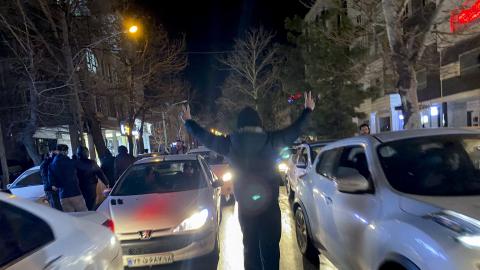
Iran is at a crossroads. The largest and most sustained wave of nationwide protests since the “Woman, Life, Freedom” uprising in 2022 and 2023 is now sweeping the country. The current marches may soon eclipse them. What began in late December 2025 as demonstrations over a collapsing currency and rising living costs has spread rapidly across cities and regions. As repression has intensified and casualties have mounted, the protests have hardened into open demands for regime change.
No matter what happens next, there is no scenario in which the Islamic Republic survives 2026 with its power intact. Too much has happened; too many uncontrollable yet intersecting factors are conspiring to erode the regime’s power. But that does not mean that revolution is inevitable and Iran will blossom into a free open society once more.
The Islamic Republic has faced mass unrest before. Over the past 15 years, it has weathered repeated nationwide protest cycles. Each time, the pattern held: Demonstrations surged, the security services cracked down violently, and opposition networks fragmented. The regime survived intact.
That history matters—but it no longer governs the present moment.
The Islamic Republic is dying. It may suppress this round of protests. The leadership may survive this year. But it will not emerge from 2026 with its authority, cohesion, or capacity preserved.
A complete overthrow of the Islamic Republic is only one of three plausible outcomes.
The first scenario is regime collapse. Sustained unrest fractures the elite, leading to defections within the security services and the breakdown of centralized control.
The second is partial transformation. Supreme Leader Ali Khamenei, now 86 years old and visibly frail, may die—or be removed—clearing the way for a strongman from the Revolutionary Guard to take power. Such a figure would adjust policy at home and abroad to buy time. The state might endure, but the regime as we now recognize it would not: Ideological authority would erode, and institutional cohesion would weaken.
The third scenario is muddling through. The leadership represses the protests until they dissipate. The system survives without formal change. But it emerges even weaker than before: more paralyzed, more isolated, and more reliant on force to function at all.
These outcomes are distinct, but none preserves the regime as it now exists. Collapse is possible. Severe decline is inevitable.
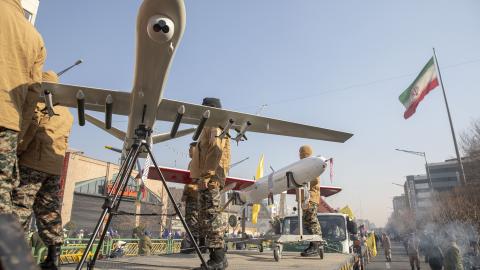
None of this renders the Islamic Republic harmless. Like a rabid dog, it is dying—but still extraordinarily dangerous. Iran retains a substantial ballistic missile force, a residual nuclear capability, and an ideological commitment to destroying Israel and driving the United States from the Middle East. A dying regime does not become cautious by default.
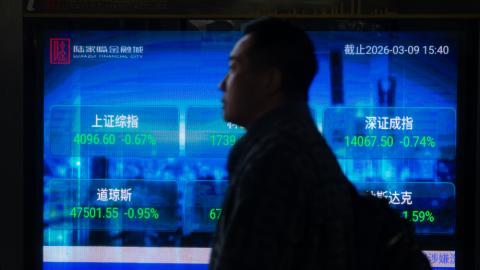
Why is this time different? Because the regime has lost the most basic attribute of a functioning state: control over its currency. When the gap between the official and market exchange rates reaches 35 to 1, the rial no longer adequately functions as money. Savings become meaningless, contracts lose credibility, and economic planning collapses.
The regime now presides over two separate economies. One operates in depreciating rials and sustains the formal bureaucracy. The other conducts real transactions through oil barter and hard currency, accessible only to a narrow circle of regime insiders. When the Iranian defense ministry must sell crude directly to foreign customers to finance operations—because the central budget can no longer transfer funds through normal channels—the state has lost its capacity to allocate resources. Public finance, in any meaningful sense, has ceased to function.
With foreign currency reserves frozen or inaccessible, the central bank can no longer defend the currency or manage liquidity. Monetary policy has become a series of levers attached to nothing. A government that cannot stabilize its money or credibly tax and redistribute revenue has lost one of the basic arms of the state—and it will not recover it.
The reason is structural. In practice, the Central Bank no longer controls Iran’s foreign currency at all. Sanctions have forced the regime to rely on a shadow banking system in which foreign exchange is held outside Iran, parked in shell companies and intermediaries beyond the reach of normal state institutions. The money exists, but it is not available for macroeconomic stabilization or public welfare. Instead, it is channeled through extraterritorial networks to sustain the regime’s confrontation with the West and Israel. For ordinary Iranians, this collapse is experienced in daily shortages of everything. Water is intermittent even in major cities. Electricity and fuel are rationed. Food prices outpace wages, forcing households to cut consumption and exhaust savings.
Iran’s socialized economy compounds the damage. Fuel is sold domestically at heavily subsidized prices. Regime-connected middlemen buy it cheaply, export it illegally, and pocket the difference. The public absorbs the shortage; insiders capture the rest. What appears on paper as social protection functions in reality as a corruption machine.
Iran’s president, Masoud Pezeshkian, has broken with decades of regime orthodoxy by openly acknowledging the depth of Iran’s systemic failure. He has attributed the crisis largely to American economic sanctions and expressed sympathy for the protesters. “I have tasked the Minister of the Interior to hear the legitimate demands of the protesters through dialogue with their representatives, so that the government can act with all its might to resolve problems and respond responsibly,” he posted on X on December 29. Rather than denying the scale of the problem or immediately calling for repression, he publicly conceded that the national economic collapse lies at the center of the unrest.
Yet Pezeshkian, 71, has also been explicit about his own powerlessness. In a speech last March, he said that he favored negotiations with Washington but was overruled. On the central question of sanctions relief—the only plausible path to economic stabilization—the Iranian president openly acknowledges that he has no agency. Ali Khamenei retains a veto that freezes policy, blocks recovery, and leaves the regime without a viable exit from the crisis it has wrought.
That exit does exist—at least in theory. The Trump administration has put a clear offer on the table: Dismantle both the nuclear program and the ballistic missile program, and end the financing of regional proxies. In return, Iran would regain access to foreign currency, stabilize its economy, and unwind the sanction-induced shadow system that now sustains corruption and scarcity. Khamenei has rejected the offer outright. Ideology and regime identity take precedence over survival.
This paralysis—economic, political, and strategic—now follows a series of reversals that stripped the regime of its aura of invincibility. After October 7, 2023, Israel dismantled Iran’s regional strategy piece by piece. It destroyed Hamas in Gaza, massively degraded Hezbollah in Lebanon, and collapsed Iran’s Syrian support, culminating in the fall of Bashar al-Assad. Only after that regional structure was broken did the conflict widen into the 12-day war of June 2025, which struck Iran directly, destroying key elements of its air defenses, missile forces, and nuclear infrastructure. The nuclear program had long functioned as the regime’s central symbol of defiance against the West. Its destruction ended that claim.
The damage to Iran’s nuclear infrastructure was real, but it was not the same as strategic disarmament. Tehran still possesses technical knowledge, remaining assets, and—above all—the intent to rebuild. The same is true of its missile program. These capabilities no longer guarantee leverage or immunity, but they ensure that the regime remains a lethal actor even as its position deteriorates.
Taken together, these shocks have pushed the system into a new phase. Iran now displays many of the classic preconditions for revolution—economic collapse, military humiliation, legitimacy erosion, and external isolation. But it lacks a decisive catalyst: an organized revolutionary leadership. The regime has been systematic and ruthless in eliminating potential leaders. What remains is an angry public that can take to the streets but cannot take control.
Sustained protest does not by itself topple regimes in Iran, but it increases the probability that elite fracture, security defection, or external intervention will do so.
Iran’s ethnic diversity compounds the problem of translating mass protest into unified political action. Persians constitute only about half of the population, alongside large Azerbaijani, Kurdish, Arab, Baloch, and Turkmen minorities concentrated in distinct regions. These groups hold different grievances and respond to different pressures. The protest dynamics in Tehran do not automatically translate to Kurdistan or Baluchistan. The regime has long exploited this fragmentation, suppressing unrest region by region rather than confronting a unified national movement.
Despite visible tensions within the elite, there have been no confirmed defections within the security services. No senior commanders have changed sides. The coercive core of the regime—centered on the Islamic Revolutionary Guard Corps—remains intact, cohesive, and more than willing to use force to preserve its power.
In the absence of a unified national movement, this repressive apparatus still has room to operate. Internet shutdowns, mass arrests, and calibrated violence can fragment protest networks and exhaust participants. The security services remain disciplined and willing to act. This capacity does not resolve the regime’s underlying failures, but it can delay their most severe political consequences.
Donald Trump has warned that mass killings of Iranian protesters would trigger intervention. His recent actions in Venezuela and Operation Midnight Hammer give the warning some punch. Nevertheless, recent reporting suggests that the regime has entered a more openly repressive phase, indicating that Tehran is prepared to test Trump’s redlines.
The immediate test will come this weekend, when the protests are set to intensify. If repression fragments and disperses them, the regime may yet muddle through. If, however, violence triggers an American or Israeli response, or if it broadens participation and spreads unrest nationwide, then even survival through paralysis may no longer be possible.
No matter what, the trajectory is clear. The Islamic Republic may kill protesters and try to outlast the demonstrations, but the regime can no longer restore its authority. It enters 2026 weaker than at any time since its founding, and if it manages to last out the year, it will be even weaker still.