









Book Review: Le fantôme de Munich: L’Europe face aux défis du monde contemporain by Isabelle Lasserre, 2025 (172 pages)
Isabelle Lasserre’s The Ghosts of Munich is both a warning and a diagnosis. More than a historical analogy, the “Munich” reference functions as a strategic prism through which Europe’s contemporary failures, hesitations, and moral ambiguities are exposed. Drawing on history, field reporting, interviews with diplomats and military officials, and a close reading of European political behavior since 2007 — and especially since 2022 — Lasserre advances a clear thesis: Europe is not repeating Munich mechanically, but it is reproducing its logic.
At its core, the book interrogates Europe’s capacity to confront revisionist powers — Russia foremost among them — without relying indefinitely on American protection. The return of high-intensity war to the European continent, combined with the possibility of U.S. disengagement, has transformed what was once a theoretical debate into a strategic emergency. In this context, the “ghosts of Munich” refer to recurring reflexes: instinctual appeasement, fear of escalation, reluctance to name the enemy, and deep discomfort with the exercise of power.
Lasserre’s work belongs neither to academic theory nor to polemical commentary. It is a rigorously documented journalistic endeavor, grounded in empirical observation and animated by a strong normative stance. Its ambition is not merely to criticize European weakness, but to explain its roots — historical, psychological, ideological, and political — and to show why these patterns now threaten Europe’s security and moral coherence.
From 1938 to 2007: The Persistence of Strategic Blindness
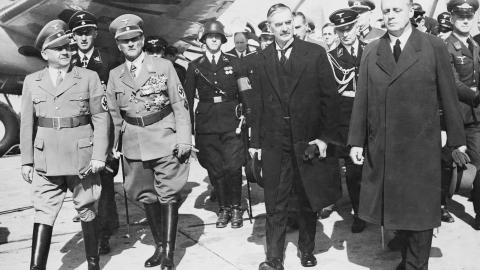
The book opens with a return to Munich in September 1938, when France and the United Kingdom chose to sacrifice Czechoslovakia in the hope of preserving peace through concession. Lasserre does not invoke Munich as a simplistic analogy, but as a foundational trauma that continues to shape European strategic culture. Munich has become a ritualized warning — invoked rhetorically yet rarely internalized in practice.
The paradox is central to Lasserre’s argument: Europe remembers Munich as a moral failure, yet continues to act according to its logic. The fear of war, the prioritization of stability and prosperity, and the belief that concessions can moderate aggressive powers remain deeply embedded in European decision-making. Drawing on thinkers such as Solzhenitsyn, Lasserre highlights a long-term “decline of courage” among Western elites, who often prefer moral ambiguity to strategic clarity.
A second, decisive moment structures the narrative: Vladimir Putin’s speech at the Munich Security Conference in 2007. In that speech, Putin explicitly rejected the post-Cold War order, denounced Western dominance, and signaled Russia’s willingness to revise the European security architecture by force, if necessary. For Lasserre, this was the true moment of rupture. Russia declared its intentions openly, and Europe chose not to listen.
The conflicts that followed — Georgia in 2008, Crimea in 2014, the war in Donbas, and ultimately the full-scale invasion of Ukraine in 2022 — did not fundamentally alter this pattern. Each shock produced condemnation and limited action, but rarely a strategic reassessment. Europe continued to deepen energy dependencies, expand economic ties, and cling to the illusion of a cooperative security architecture that included Russia. The 2014 violation of the Budapest Memorandum, under which Ukraine had surrendered its nuclear arsenal in exchange for security guarantees, should have been decisive. Instead, it reinforced Moscow’s perception that international commitments could be broken without serious consequences.
Ukraine as a Strategic Revealer
The war in Ukraine occupies the central place in Lasserre’s analysis. February 2022 undeniably marked a shock. Europe responded with unprecedented sanctions, military assistance, and political support for Kyiv. NATO enlarged. Defense budgets increased. Yet, for Lasserre, this awakening remains incomplete and structurally constrained.
Three limits dominate Europe’s response.
First, incrementalism. Military aid has been delivered slowly, in fragmented packages, and often only after prolonged internal debates. Tanks, aircraft, long-range missiles — each category required months of hesitation. Support has been sufficient to prevent Ukraine’s collapse, but rarely to enable decisive victory.
Second, fear of escalation. European leaders have consistently framed their policies around what Russia might tolerate, rather than around what Ukraine requires to win. Restrictions on the use of Western weapons, anxiety over nuclear rhetoric, and a persistent desire to avoid “humiliating” Russia all reflect a deep-seated reluctance to assume responsibility for escalation dynamics.
Third, dependence on the United States. Despite repeated declarations of “strategic autonomy,” Europe’s posture remains anchored in American leadership. Lasserre devotes particular attention to the scenario of U.S. disengagement — whether through political choice, domestic division, or shifting priorities. In such a scenario, Europe would face a brutal choice: accept a Russian-imposed settlement, or undertake a level of military, industrial, and political mobilization long postponed.
Ukraine thus functions as a merciless revealer. It exposes Europe’s material weaknesses, but above all its deficit of will. Unlike Czechoslovakia in 1938, Ukraine chose resistance. President Zelensky’s refusal to flee, and Ukraine’s capacity to fight, forced Western governments to adjust.
Dependencies, Illusions, and the Crisis of Will
One of the book’s major contributions lies in its ability to connect strategic abstraction with concrete structures.
Economic dependencies play a central role. Germany’s reliance on Russian gas, France’s belief in a strategic partnership with Moscow, and the United Kingdom’s openness to Russian capital all contributed to European hesitation after 2014.
Industrial weakness is another recurring theme. Europe’s defense industrial base, fragmented and under-invested, has struggled to meet the demands of high-intensity warfare. Promises — such as the delivery of one million artillery shells — remain only partially fulfilled. Governments hesitate to provide long-term contracts, and industry hesitates to invest without political clarity.
Lasserre is particularly incisive in her critique of sanctions as a substitute for strategy. While acknowledging their utility, she argues that sanctions have become a performative instrument — highly symbolic, morally reassuring, but strategically insufficient when disconnected from a coherent theory of victory. By elevating sanctions to the center of its response, Europe often avoids the harder questions of force posture, deterrence, and war sustainability.
Ultimately, Lasserre concludes that Europe’s problem is less a lack of resources than a loss of confidence in its own agency. Citing Eastern European voices, she captures a deeper malaise: Europe no longer believes it can shape events. It prefers management to decision, process to power, and moral posturing to responsibility.
Beyond Russia: Munich as a Broader European Reflex
One of the book’s most original aspects is its extension of the Munich framework beyond Ukraine. Lasserre applies the same logic to Europe’s approach to China. Here again, she identifies a search for balance, moderation, and “middle ground,” driven by economic interests and the desire to avoid alignment with the United States.1 This posture rests on the assumption that China is fundamentally rational, pragmatic, and restrainable through engagement.
For Lasserre, this underestimates both the ideological nature of the Chinese regime and the depth of the Sino-Russian strategic alignment. The belief that Europe can decouple selectively, or use China as a moderating influence on Russia, reflects another iteration of Munich thinking: the hope that engagement can substitute for clarity about power and long-term confrontation.
The most controversial — and arguably most powerful — extension of the Munich paradigm concerns the Middle East.
Lasserre argues that Europe’s response to Islamist terrorism and to the Israeli–Palestinian conflict reveals a form of “moral Munich.2 Faced with Hamas terrorism and jihadist ideology, Europe hesitates to name the enemy clearly. In the name of balance, it equates democratic states with genocidal organizations, blurs moral responsibility, and retreats into procedural neutrality.
She highlights the spread, within universities and activist networks, of Islamist-inflected decolonial discourse that reframes jihadism and radical anti-Zionism as “resistance.”3 This phenomenon, far from marginal, fuels a new antisemitism disguised as political critique and weakens Europe’s capacity to defend its own principles. Fear of internal conflict, accusations of racism, or charges of “Islamophobia” lead to deliberate moral ambiguity.4
For Lasserre, this is Munich logic transposed to values: in order to preserve social peace, Europe sacrifices clarity, truth, and ultimately its own security.
Strengths and Limits
The book’s strengths are substantial. It combines strategic pedagogy with empirical depth, making complex issues accessible without simplification. Its European perspective avoids both American moralism and Franco-centric bias. Above all, it displays intellectual courage in naming responsibilities and failures.
Its principal limitation lies in the very power of its central metaphor. The Munich analogy, while illuminating, risks overextension. Nuclear deterrence, institutional integration, and the specificities of contemporary Russia differentiate the current European strategic situation from the 1930s. Lasserre acknowledges these differences, but a more systematic treatment could have strengthened the argument. Similarly, other dimensions — such as technological competition or Europe’s southern flank — receive less attention.
These complaints, however, stem less from analytical weakness than from the frustration of a reader who wishes the analysis went even further.
The Ghosts of Munich stands as an important contribution to contemporary thinking on European defense and the future of the Western order. It is ultimately a call to responsibility. Europe, Lasserre argues, is not condemned to repeat history — but only if it draws the right lessons. Munich is not a warning against firmness; it is a warning against delay, illusion, and self-deception. The core problem identified is Europe’s persistent strategic blindness: a tendency among its leaders to replace rigorous assessments of power, interests, and adversaries’ intentions with self-referential political and moral projections. Rather than confronting geostrategic realities, Europe too often interprets external threats through its own fears, constraints, and normative assumptions.
The central message is clear: Europe possesses the resources to defend itself and its values. What it lacks is the willingness to accept the costs of doing so. History does not disappear; it returns as a ghost, shaping perceptions and decisions.
On a more personal note, this blindness is the most acute in the Middle East, where European policy is shaped less by strategic clarity than by moral confusion, postcolonial ideology, and analytical error, exemplified by the refusal to acknowledge the geopolitical dimension of antisemitism and its contemporary expression in anti-Zionism.
Whether Europe exorcises these ghosts — or allows them to govern its future — will determine not only the outcome of the war in Ukraine, but the very meaning of European power in the 21st century.