










The first few hours on the run are exhilarating; everything seems to happen at once. The noise and the danger are so present that the drills kick in and for a while, time seems to slow down. Later, as the adrenaline wears off, exhaustion and fear take over. That’s when resilience and courage are needed.
Alone, without a team, the US F-15 airman who crashed in Iran would have needed every ounce of his training and strength to continue to hide, move, communicate and pray for rescue. He wasn’t on the run for a night with his team, as I was 20 years ago, but for two days with no one. That’s tough.
Though the details are sparse, what is becoming clear is that the US combat search and rescue team have achieved a remarkable success. Across hostile ground, with a local population aware of the prize within their grasp, and with capable units tracking and searching for him, the airman was brought out.
That speaks to a military team of huge power and resourcefulness. There’s no other nation that could have done it. Fifty years ago, even the US wouldn’t have been able to do it.
One of the defining moments in recent Iranian-US relations was the attempted rescue of the so-called Iran hostages. In those first days after the 1979 Islamic Revolution, it wasn’t clear that the regime would be so hostile to Washington. The cries of “Death to America” were yet to be heard on every street. Many in the Iranian military, which had switched allegiance from the Shah to the ayatollah, had trained alongside US troops or at US bases.
The first few hours on the run are exhilarating; everything seems to happen at once. The noise and the danger are so present that the drills kick in and for a while, time seems to slow down. Later, as the adrenaline wears off, exhaustion and fear take over. That’s when resilience and courage are needed.
Alone, without a team, the US F-15 airman who crashed in Iran would have needed every ounce of his training and strength to continue to hide, move, communicate and pray for rescue. He wasn’t on the run for a night with his team, as I was 20 years ago, but for two days with no one. That’s tough.
Though the details are sparse, what is becoming clear is that the US combat search and rescue team have achieved a remarkable success. Across hostile ground, with a local population aware of the prize within their grasp, and with capable units tracking and searching for him, the airman was brought out.
That speaks to a military team of huge power and resourcefulness. There’s no other nation that could have done it. Fifty years ago, even the US wouldn’t have been able to do it.
One of the defining moments in recent Iranian-US relations was the attempted rescue of the so-called Iran hostages. In those first days after the 1979 Islamic Revolution, it wasn’t clear that the regime would be so hostile to Washington. The cries of “Death to America” were yet to be heard on every street. Many in the Iranian military, which had switched allegiance from the Shah to the ayatollah, had trained alongside US troops or at US bases.
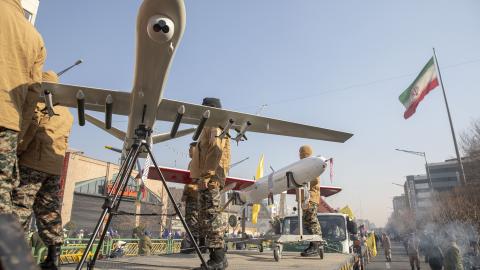
With a history like that, in hunting for the missing airman, Iran’s forces were looking for a prize to remind the US of the price of failure. While Americans were desperate not just to find their comrade, but also to ensure they could avoid a repetition of Iran’s capture of British Royal Navy personnel in 2004, and again in 2007.
No one was in any doubt that the stakes were as high as they could be from the moment the airman ejected. Every element of the US military machine would have been devoted to his recovery. The US has always seen the protection of its own forces as a key moral element of its fighting capability. Since the Second World War, pilots and special forces operators have been issued with silk maps that can be folded up and sewn into uniforms, and gold coins that can be taped to belts or hidden in boots, to help them orientate themselves and bribe their way out of trouble. No doubt, this airman had them too.
Maps were not only good for directions. They contained words written in all the languages that were likely to be useful, including requests for help and promises of reward. And the maps themselves would have their own value. Some armies promise their troops that should the serial number on the map be matched with a name, it can be turned into thousands of dollars at any embassy in the world. Again, a way of making it easier for them to hide or escape.
But the key is to remain hidden. In the desert, where few people are around and any outsider would be noticed, that’s not easy. After 24 hours, he would have been looking for water, not food. And while it wouldn’t have been too cold, he would have needed to hide from watchful eyes.
Still, technology would have made that easier. The airman would almost certainly have been carrying a personnel recovery device capable of sending encrypted bursts to satellites overhead, allowing rescue teams to track his position without him needing to break cover or risk a voice transmission. And drones would have been redirected to watch over him, marking threats and mapping routes in the area.
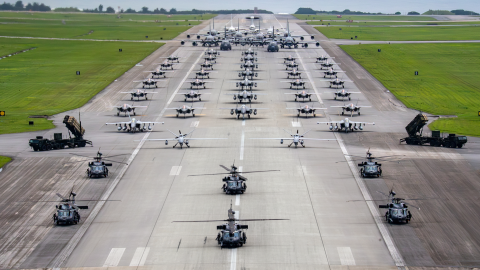
When the opportunity finally came, the combat search and rescue team, which was likely to be a mix of air force pararescuemen and special operations helicopters who had rehearsed this scenario hundreds of times, would have been sent in.
That’s why this succeeded while Operation Eagle Claw failed. In 1980, the teams hadn’t trained together, the helicopters broke down. Most fundamentally of all, the command chain was confused, leading to conflicting assumptions and orders. The disaster at their forward base, Desert One, was a system failure that the US military has corrected.
This rescue is proof that the years of integration and leadership that SOCOM offers have prepared the American military better than any other. That deep understanding of joint operations and relentless rehearsals has made US special operations the most capable in the world. Losing a C-130 and a helicopter won’t matter, so long as everyone is brought home.
For Britain, there is a harder lesson. We couldn’t have done it. We do not have the platforms, the satellites, the reach or the mass. Our rescue plan, if the airman were British, would be to call the US. Our only choice would have been reaching out to Washington or capitulating to Tehran.
The Americans got their man out because they decided, decades ago, that they would never accept the alternative. That’s given them a power that demands respect. Britain once had it. Like America, we could decide to have it again.