







Written Testimony
Chairman Self, Ranking Member Keeting, and distinguished members of the Committee. I am honored to speak before this esteemed Committee on the topic: “Flashpoint: A Path Toward Stability in the Western Balkans.”
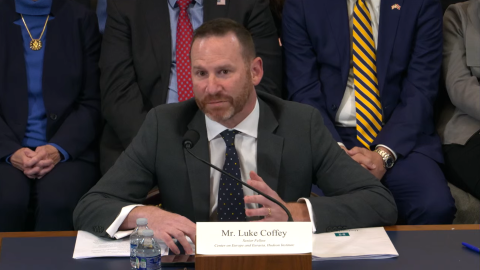
My name is Luke Coffey. I am a senior fellow at Hudson Institute. The views I express in this testimony are my own and should not be construed as representing any official position of Hudson Institute.
Regional Overview and U.S. Interests in the Balkans
In the broader context of transatlantic security, much of the focus remains—understandably—on the war in Ukraine and what NATO should do to deter further Russian aggression. Especially in recent years, U.S. policymakers have often overlooked an important European region: the Balkans. The fragile peace in the Balkans is under considerable pressure for two main reasons. First, sectarian and religious divisions, which are easily exploited by regional and international actors. And second, a lackluster economic situation, which is exacerbated by poor governance.
To understand why the United States should care about the Balkans, it is important to understand why Europe matters. The Balkans have been central to Europe’s security for decades. The Balkan Wars of 1912 and 1913 set the stage for the First World War. During the Second World War the Balkans were geographically vital to both the Axis and the Allies alike. And in 1995, NATO’s first major test on the battlefield after the Cold War took place in the region when the alliance dispatched forces to Bosnia to stop the ethnic cleansing of Bosnian Muslims—now referred to as Bosniaks—by ethnic Serbs. A few years later, NATO began another operation to stop a similar Serbian campaign targeting ethnic Albanians in Kosovo. The European Union and NATO maintain peacekeeping forces in Bosnia and Herzegovina and Kosovo to this day. History shows clearly: instability in the Balkans creates issues the rest of Europe cannot ignore.
There are three main reasons why U.S. policymakers should renew their focus on the Western Balkans:
- The Balkans matter because Europe matters. Half of global gross domestic product comes from North America and Europe. Europe is America’s largest single export market, with 46 out of 50 states exporting more to Europe than to China. (When an American builds a product to export, that is an American job.) Europe is also the source of almost two-thirds of all foreign direct investment entering the United States—totaling some $4 trillion each year. This economic prosperity depends on the continent’s stability. Today, the two top threats to this stability are Russia’s invasion of Ukraine and the risk of renewed instability in the Balkans. Both have direct implications for U.S. economic well-being and, by extension, for the American worker.
- The United States has already contributed greatly to regional stability, with modest investments delivering huge returns. In the case of Bosnia and Herzegovina, the United States has generously provided about $2 billion in aid since 1995. By comparison, America’s total expenditures in Bosnia—a mission that is 11,286 days old at the time of this writing—are roughly similar to what the U.S. military spent every six days in Afghanistan at the height of our engagement there. With a relatively small military intervention in the 1990s, U.S. leadership helped end a genocide and halt ethnic cleansing in the region and paved a path that has brought some countries into the Euro-Atlantic community, with others close behind. Now is not the time for the U.S. to turn its back.
- The situation in the Balkans affects other interests, including Ukraine. The top U.S. priority in the transatlantic community should be maintaining unity, cohesion, and stability among European allies in the face of Russia’s continued aggression against Ukraine. The Balkans, specifically Serbia and the Republika Srpska (an ethnic Serb entity inside Bosnia and Herzegovina), offer Moscow a platform to sow further instability. Therefore all U.S. actions in the Balkans should be understood as part of America’s Ukraine policy, which includes denying Moscow the ability to open second fronts in the continent’s southeast. Unconventional policy prescriptions—like scrapping the Dayton Agreement—could have unpredictable results. In particular, creating a power vacuum in the Balkans could give Russia an opportunity to draw Europe’s focus away from Ukraine and further divide the transatlantic alliance.
Opportunities in the Balkans
Increased American engagement in the Balkans would help promote numerous U.S. policy goals:
- Advancing Euro-Atlantic integration. After the Cold War, NATO and the EU enlarged rapidly in Eastern Europe—but the Balkans lagged behind. Slovenia and Croatia are the only Balkan countries that are members of both institutions. Albania, North Macedonia, and Montenegro are in NATO and aspire to EU membership. Bosnia and Herzegovina is an EU candidate and is following a membership action plan (MAP) for accession to NATO. Serbia is a candidate for EU membership only. Meanwhile Kosovo—recognized by most but not all EU members—remains the furthest from joining either. Membership in these international bodies has historically encouraged improvements in governance, rule of law, security, and prosperity. Fully integrating the Balkans into the Euro-Atlantic community will make the Balkans, and by extension Europe, safer and more stable.
- Securing a major transit route for irregular migration. The Balkans are a key corridor for migrants moving from the Eastern Mediterranean and the Middle East into Europe. Weak governance, entrenched organized crime, and political corruption enable human trafficking that spills into European cities, economies, and politics, shaping debates from Brussels to Westminster. The political aftershocks of the 2015 Syria-related migration crisis are still being felt more than a decade later.
- Fighting entrenched organized crime and drug trafficking. The region’s weak governance also enables drug traffickers. The Balkans serve as a major entry point for cocaine and other narcotics from South America into Europe. The September 2023 Serbian paramilitary attacks in Kosovo showed that areas with poor governance can easily become renewed flashpoints for inter- and intrastate conflicts.
- Combating Russian and Chinese meddling. Moscow uses the Balkans as a conduit for its destabilizing operations against Europe. Russia fuels ethnic discontent, provides political, economic, and diplomatic support to Serbia and secessionists in Republika Srpska, and openly threatens Bosnia and Herzegovina regarding its pursuit of NATO accession. China, meanwhile, is expanding its footprint through questionable infrastructure investments. The region is so important to China that Serbia was one of only three stops during President Xi Jinping’s trip to Europe last year.
- Increasing European energy security. The region lacks sufficient infrastructure, reception terminals, and interconnectors to integrate with a regional energy grid without Russian consent. Although much of Europe has made progress, Russia remains a major energy supplier—especially to Serbia and Bosnia and Herzegovina. In particular, the Southern Interconnection gas pipeline, which will connect Croatia’s Krk liquefied natural gas (LNG) terminal to Bosnia and Herzegovina, was stalled due to obstruction by local nationalist leaders until only this week.
Bosnia and Herzegovina: Dayton at 30
The situation in Bosnia and Herzegovina deserves particular attention from U.S. policymakers.
The nation’s recent history—and America’s role in its recent stability—is perhaps well known to my fellow witnesses and members of this Committee. But it is worth briefly recapping some of the fundamentals.
Bosnia and Herzegovina emerged from the breakup of Yugoslavia in the 1990s, which began a bloody interreligious and interethnic sectarian war. Ethnic Serbian factions’ targeting of the Bosniak community accounted for the vast majority of the 100,000 people killed during the Bosnian War. The best known example of this was the Srebrenica Genocide in July of 1995, in which Serb fighters murdered more than 8,000 Bosniak men and boys. An estimated 30,000 women and girls were displaced and, in some cases, sexually abused. In November of that year, a historic peace deal was agreed to in Dayton, Ohio, known now as the Dayton Peace Agreement. This reorganized Bosnia and Herzegovina as a single state composed of two substate entities: the Federation of Bosnia and Herzegovina (largely Bosniak and Croat) and Republika Srpska (largely Serb).
Milorad Dodik, the longtime Republika Srpska leader recently removed from office by the Bosnian courts, remains influential and continues to advocate for the entity’s secession from the rest of Bosnia, reanimating Serb nationalist goals from the Bosnian War. During his two decades in power, Dodik pursued this goal both rhetorically and materially. In recent years, he took steps to undermine Bosnia and Herzegovina’s legitimate state-level structures and institutions and create parallel institutions inside Republika Srpska. These efforts reached a new level when Dodik refused to recognize Christian Schmidt as Bosnia and Herzegovina’s international high representative, a position created under the Dayton Agreement to oversee the implementation of the deal’s terms. Dodik led Republika Srpska’s National Assembly to stop publishing the high representative’s decisions and suspend implementation of rulings from the Constitutional Court of Bosnia and Herzegovina.
On February 26, 2025, a Bosnian state court sentenced Dodik to one year in prison and banned him from holding public office for six years for this refusal, which it judged to be a violation of both Bosnia’s constitution and the Dayton Agreement. The next day, in direct response to that verdict, Republika Srpska lawmakers adopted separatist legislation that barred Bosnia and Herzegovina’s state-level court, prosecutor’s office, and central police agency from operating on the territory of Republika Srpska, while setting up parallel judicial and prosecutorial structures. These laws were an attack on Bosnia’s constitutional order and on the Dayton framework itself, contributing to the most serious institutional and sovereignty crisis since the end of the war.
Throughout this period, Dodik had been politically and diplomatically supported by Serbia and Russia,888 which view Republika Srpska as a useful lever against Bosnia’s Euro-Atlantic aspirations and the West’s role in the region. For many years, Washington correctly recognized Dodik as a threat to the Dayton order and to regional stability. In January 2017, the U.S. sanctioned Dodik for obstructing the Dayton Peace Agreement and destabilizing Bosnia and Herzegovina—sanctions that lasted the duration of the first Trump administration. Later designations followed in 2022 for corruption and obstructing the peace process.
However, on October 29, 2025, the U.S. Treasury unexpectedly removed Dodik and his network from its sanctions list—an action that appeared to emerge out of the blue, unanchored in any broader U.S. strategy for the Balkans region, and without clarity on what, if anything, the United States obtained in return.
From the standpoint of U.S. interests, this matters because political stability in Bosnia and Herzegovina has a major effect on the stability of the Balkans, and thus on Europe’s overall security architecture. Lifting sanctions on Dodik, one of the region’s most prominent secessionists and a strong partner of Moscow, sends a confusing signal to allies and adversaries alike and risks emboldening those who seek to hollow out the Dayton system from within.
Although still a fringe view in policy circles, the idea of scrapping Dayton altogether is gaining traction. Surely, the Dayton Agreement is not perfect. But it has been one of the greatest diplomatic achievements by the United States in the post–Cold War era. And while Bosnia still must undergo significant constitutional reform in line with the decisions of the European Court of Human Rights and the opinions of the Venice Commission if it is to become an EU and NATO member state, removing the international oversight that accompanies them would destabilize Bosnia and Herzegovina—and the broader region. Without the Dayton arrangement and the framework it provides, Dodik and his acting successors would almost certainly seek to leave Bosnia and Herzegovina and either declare independence or pursue a union with Serbia.
A resumption of conflict in Bosnia and Herzegovina, which would certainly erupt if Republika Srpska authorities move to secede, could quickly draw in Croatia and Serbia—Croatia being a NATO member and Serbia being aligned with Moscow. For historical and cultural reasons, both countries have established political, ethnic, security, and even intelligence footprints inside Bosnia and Herzegovina. A violent breakup of the state could lead to direct intervention by one or both countries, as occurred in the 1990s. This would return the region to where it was in 1995: refugee flows threatening Europe’s stability, threats of ethnic cleansing, and another security crisis in NATO’s backyard that would require international intervention. But this time the crisis would occur while the largest European war since the 1940s is raging just hundreds of miles from Bosnia. This is precisely the kind of scenario that the Dayton framework—and subsequent NATO enlargement—was meant to prevent. And this is exactly why the Dayton Agreement should remain in place for now.
Serbia’s Role
Serbia’s recent posture has made the situation in Bosnia and Herzegovina even more dangerous. In some respects, Serbia today echoes where Russia was in 2014 on the eve of its annexation of Crimea: obsessed with historical grievances, increasingly hostile toward its neighbors, and willing to use coercive tools to advance its agenda.
Serbian President Aleksandar Vučić, who remains close with Dodik’s political faction, is facing his most serious domestic political challenge in years. On November 1, 2024, a Chinese-built concrete canopy at the Novi Sad railway station collapsed, killing 15 people. The disaster, widely linked to corruption and negligence in a major state-backed infrastructure project, sparked student-led protests and silent traffic blockades across the country. Over subsequent months, these actions evolved into a broader anticorruption and pro-accountability movement that spread to hundreds of towns and cities. Demonstrations have continued into late 2025, keeping pressure on Vučić and his ruling party.
As Vučić struggles with this domestic crisis, a manufactured or aggravated crisis in Bosnia and Herzegovina—particularly in Republika Srpska—could be politically useful in Belgrade. It would divert public attention outward, mobilize nationalist sentiment, and offer Serbian leadership an external avenue to project strength at a moment of internal vulnerability.
At the same time, Serbia has matched its rhetoric with structural steps. Serbian officials have touted the so-called Serbian World (Srpski svet) agenda—an explicitly irredentist project to politically unite all Serbs in the region that is widely understood as a modern iteration of Slobodan Milošević’s “Greater Serbia.” It mirrors Russia’s “compatriot policy” and the broader doctrine of Russkiy mir (“Russian World”), both of which seek to justify extraterritorial influence over co-ethnics and neighboring states. Such a policy threatens not only Bosnia and Herzegovina’s sovereignty and territorial integrity, but that of Kosovo, Montenegro, and even North Macedonia.
Serbia has also moved toward the reintroduction of compulsory military service, alongside ongoing rearmament and a more assertive security posture in the region. Vučić himself has hinted at undisclosed procurement activity, stating recently: “Few people know what weapons we’ve brought in. We’ve done it in secret.” Analysts assessed that Serbia placed an order for thousands of Iranian drones in 2023, though this was never publicly confirmed. Therefore it is possible that Vučić is referring to this speculation. Taken together, Serbia’s domestic turbulence, its remilitarization, its irredentist regional agenda, and its support for Dodik’s secessionist project inside Bosnia and Herzegovina have created a highly combustible environment in the Balkans.
The Croat Question
In addition to the concerning situation with Republika Srpska, there are growing calls for the creation of a so-called third entity inside Bosnia for the ethnic Croat community, which represents roughly 15 percent of the population. In part, this demand stems from a long-standing electoral grievance: under the tripartite presidency system established by the Dayton Accords, the Croat member of the presidency is frequently elected with heavy support from Bosniak voters rather than from ethnic Croats themselves. While many Bosnians see this as an example of cross-ethnic coalition building, some in Croatia and many ethnic Croats in Bosnia argue that this violates the spirit of the “constituent peoples” principle embedded in Dayton.
Other sizeable segments of the Bosnian populace—particularly those who do not belong or do not identify with any of the three primary ethnic groups—are almost entirely shut out from political representation by the country’s ethnic power sharing arrangements, including the country’s Jewish and Roma communities. This has resulted in roughly half a dozen discrimination rulings against Bosnia’s constitution by the country’s own Constitutional Court and the European Court of Human Rights. Bosnia needs to address both these cases to accede to the EU or NATO.
The spectrum of proposals to resolve this issue is broad. At one end, there are various proposals from both within Bosnia and Herzegovina and assorted international civil society organizations and thinks tanks to meld rights to universal democratic representation for all Bosnian citizens, while preserving a significant degree of minority or ethnic representation within the country’s constitutional regime.
On the other end, Croat nationalist elements in Bosnia and Herzegovina and Croatia increasingly call for electoral reforms in Bosnia and Herzegovina, which would further limit opportunities for cross-ethnic voting and, arguably, further distance the country from the legal and democratic norms found across the EU and NATO.
Some especially hardline figures advocate for the creation of a full-fledged Croat entity on par with the Federation of Bosnia and Herzegovina and Republika Srpska. Pursuing such an arrangement would be extremely dangerous. While there are legitimate concerns about electoral reform and representation in Bosnia and Herzegovina, the creation of a third entity would almost certainly accelerate secession pressures in Republika Srpska, undermine the coherence of the state, and revive the political geography of the 1990s. Such fragmentation would complicate the country’s NATO and EU accession efforts and destabilize the wider region.
Bosnia and Herzegovina should seek to create a government that works rather than further decentralizing and localizing the current arrangement. After all, it is important to remember that Bosnia and Herzegovina is already among the most decentralized countries in the world. It has two federal entities, one condominium (Brčko District), 10 cantons, 143 municipalities, a weak central government, a complex multi-chamber legislative system with robust ethnic vetoes, a rotating tripartite presidency, and multiple layers of judiciary. If the goal is to maintain stability and uphold the territorial integrity guaranteed by the Dayton Accords, the answer lies in political, constitutional, and institutional reform—not in further decentralization or de facto partition, both of which would likely lead to renewed instability and risk a return to the chaos of the 1990s.
Finally, despite the issues with the Dayton Agreement, now is not the time to scrap it entirely. There is almost no political consensus inside Bosnia and Herzegovina, in the region, or across the transatlantic community on how to do so. Any attempt to reopen the basic settlement under current conditions would likely create more instability than exists today—at a moment when the United States and its European allies should be focused on maintaining unity over Ukraine and limiting Moscow’s ability to manufacture crises elsewhere in Europe. U.S. policymakers have little spare bandwidth to start unravelling a framework that, for all its imperfections, has kept Bosnia at peace for three decades—and even if they did, now is not the time to try. To be clear, the U.S. should certainly welcome any local reform initiatives, but only those that seek to accommodate the demands of all Bosnian citizens, and can actually meet the country’s international commitments, especially those set by the EU and NATO.
Recommendations
Although the U.S. is not a Balkan country, it can certainly be a Balkans power— and President Donald Trump should take steps to ensure the U.S. meets its goals and interests. Fortunately, he has much to build on from his first administration, which made modest but genuine progress in the region. The partial normalization agreement between Serbia and Kosovo under the so-called Washington Agreement in 2020 was a positive step forward. Another significant achievement was the Prespa Agreement, which resolved the long-standing name dispute between Greece and North Macedonia and paved the way for the latter’s accession to NATO. This, combined with Montenegro’s NATO membership in 2017, marked a major enlargement of the alliance in the Balkans during President Trump’s first term—strengthening regional security and reducing the space for Russian influence.
Now, back in the Oval Office, President Trump has made global diplomacy and ending wars a central theme of his second term. He has shown an interest in brokering ceasefires and peace deals around the world. The Balkans should be on his radar. Below are 10 ways to do so:
- Conduct high-level visits to the region. The last time a president of the United States visited the Balkans was in 2007, when President George W. Bush traveled to Albania. There has also been a noticeable lack of other senior U.S. cabinet-level representation in the region in recent years. This should change. High-level visits would demonstrate the appropriate level of interest and signal that the administration views the Western Balkans as strategically important.
- Work closely with like-minded European partners. The United States should coordinate with its European allies, especially the United Kingdom, Germany, Turkey, the Netherlands, and Austria, to ensure that the Balkans remain stable and secure. Through the NATO–EU Berlin Plus arrangement, Washington should support efforts to ensure that the EU’s military mission in Bosnia remains adequately trained, equipped, and ready.
- Help create a blueprint or roadmap for each NATO-aspirant country to join the alliance, and encourage the EU to do the same for EU aspirants. Working with European partners, the United States should help establish clear, realistic pathways for Western Balkan countries seeking to join Euro-Atlantic institutions. For too long this process has been stalled. The possibility of NATO membership has been one of the most powerful reform incentives for aspirant countries. The United States should reaffirm that NATO’s open-door policy remains intact for those in the region that wish to join.
- Do not try to outsource Balkan security. Some in the administration may be tempted to view the Balkans as Europe’s problem or worse a regional problem. This would be a mistake. European stability directly affects the U.S. economy, and historically instability in the Balkans has reverberated across the entire continent. America must therefore play a role in maintaining stability in the region.
- Stay committed to NATO’s Kosovo Force (KFOR) mission. With ethnic tensions increasing in Kosovo, and Kosovo-Serbia relations showing little progress, it is in America’s interest—especially amid broader debates about reducing U.S. forces in Europe—to maintain a strong military presence within NATO’s KFOR mission.
- Support efforts to diversify the region’s energy security and sources. The United States should pursue policies that help diversify the region’s energy supply and make Western Balkan countries less dependent on Russian energy. This is especially important in the context of Russia’s aggression against Ukraine and its historical use of energy as a weapon. In this context, Washington should continue its support for the Southern Interconnection pipeline,[21] which will connect Croatia’s Krk LNG terminal (operated by LNG Hrvatska on the island of Krk) to markets in Bosnia and Herzegovina.
- Denounce any land-swap proposals in the region. Land swaps would undermine U.S. interests and could destabilize the region. The United States should state clearly and publicly that such proposals—especially in the context of Kosovo and Serbia—are unacceptable. While the proposal might be tempting for policymakers as a simple quick fix, nothing in the Balkans is ever straightforward.
- Do not support any measures that repeal the Dayton Agreement or weaken its key components, such as the Office of the High Representative. With the top transatlantic priority being the war in Ukraine, now is not the time to undo one of the most effective acts of American diplomacy in the past 30 years. Doing so will have risky and unpredictable results at a time when the U.S. needs stability and calm in the Balkans.
- Publicly oppose the creation of a Croat third entity in Bosnia and Herzegovina. Washington should make it clear that it will not support any proposal to establish a separate Croat entity and that doing so would undermine Bosnia and Herzegovina’s stability and territorial integrity. This would also needlessly destabilize the region when U.S. and European attention should be on ending the war in Ukraine.
- Take a realistic and pragmatic approach to Serbia. Serbia remains Russia’s primary foothold in the Balkans. Moscow’s economic and military ties to Serbia are strong, and Russian propaganda is highly effective. While Serbia occasionally signals a balanced foreign policy approach, the reality is that Belgrade remains firmly in Russia’s orbit and is unlikely to join Western structures anytime soon. The United States should continue engagement with Serbia when appropriate—but with an awareness of the geopolitical realities of the region. To that end, the U.S. should also signal its willingness to reimpose sanctions against Dodik and his regime if they resume their secessionist or anti-Dayton activities in Bosnia and Herzegovina.