













There is nothing more America First than prioritizing U.S. companies over the Chinese Communist Party (CCP). Some corporations, however, are putting Beijing’s interests first.
Nvidia CEO Jensen Huang raised eyebrows in early November when he told the Financial Times: “China is going to win the AI race.” This statement came just days after U.S. President Donald Trump’s refusal to allow Nvidia to sell advanced Blackwell chips to Chinese companies. As Trump put it on Oct. 31: “The most advanced [artificial intelligence chips], we will not let anybody have them other than the United States.”
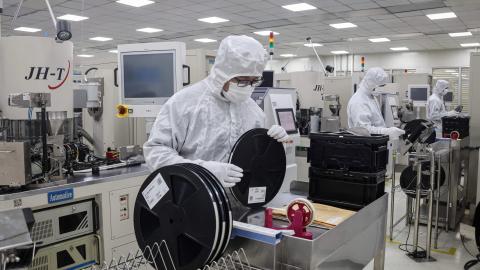
The chips in question are among the most complex machines ever designed by humans, and they are powering the AI revolution. Trump’s AI Action Plan compares the AI race to the 20th-century space race and describes it as an “industrial revolution, an information revolution, and a renaissance—all at once.” That’s why Nvidia’s chips matter so much.
The question of whether U.S. chips should go to China was at the heart of the fierce debate surrounding the GAIN AI Act, a piece of legislation introduced by Republican Sen. Jim Banks and advocated for by Republican Rep. Brian Mast and recently under consideration in the annual defense authorization bill. White House officials reportedly lobbied Congress against the provision, and some interest groups opposed the bill due to concerns about overregulation.
The bill would have modeled AI chip exports off U.S. arms sales by giving Congress a monthlong review period for chip sales to China and other countries of concern. Moreover, the Commerce Department would have needed to certify that the sale wouldn’t negatively impact U.S. competitors.
These policies are not protectionism, as some have argued, but rather an acknowledgment that demand for advanced AI chips has periodically and frequently outpaced supply—and part of that demand is coming from Beijing’s needs.
Ultimately, Nvidia’s private interests prevailed against national security concerns, and the GAIN AI Act was not included in the defense bill. That’s unfortunate for the United States because the provision would have protected its most critical technological advantages.
It’s impossible to talk about AI without accounting for China. The CCP has identified AI as a critical technology that it plans to leverage across its military and national security efforts, and Chinese President Xi Jinping called on the party in April to “win superiority in the field of AI.” Both Washington and Beijing view the AI race as a zero-sum game, which is why Trump’s AI Action Plan begins with a stark warning: It is “imperative that the United States and its allies win this race.”
This context might explain Huang’s recent damage control. “As I have long said,” Huang clarified in a statement on Nov. 5, “China is nanoseconds behind America in AI. It’s vital that America wins by racing ahead and winning developers worldwide.” In what race, though, does a runner win by equipping an opponent? In what war has a nation ever gained decisive advantage by arming its adversary?
As new generations of chips come into being, demand could outpace supply—as is the case with Nvidia’s Blackwell line now. An alarming report from the Institute for Progress recently warned that selling AI chips to China under these conditions would disadvantage U.S. companies and help Beijing close the AI gap.
Exporting advanced AI chips to China would plug a gaping hole in China’s tech stack. China already has globally competitive frontier AI models such as DeepSeek and cloud service providers such as Tencent, Huawei, and Alibaba. With Nvidia’s superior chips, these Chinese competitors could offer comparable products at cheaper, state-subsidized prices and box out U.S. companies from foreign markets. White House officials such as David Sacks have publicly stated their concern for this outcome, which the GAIN AI Act would prevent.
The policies in the legislation also address real national security concerns. China uses U.S. chips to strengthen its People’s Liberation Army (PLA), which has already acquired Nvidia chips illicitly. The CCP has long advanced a military-civil fusion strategy that militarizes commercial innovation, so it shouldn’t surprise companies such as Nvidia that the PLA benefits from breakthroughs of Chinese AI models.
Nvidia’s chips qualitatively outclass Huawei’s chips. Selling this superior technology to an adversary violates a core tenant of Trump’s AI policy: to deny “foreign adversaries access” to “advanced AI compute.” Equipping the CCP also clashes with the president’s America First Trade Policy memorandum, which calls on the U.S. government “to maintain, obtain, and enhance our Nation’s technological edge.”
Which takes us back to Huang.
In a July interview, CNN’s Fareed Zakaria asked Huang if it matters whether the United States or China wins the AI race. He responded: “In the end, I don’t think it does.” That casual dismissal of legitimate national security considerations suggests that Nvidia is less focused on U.S. interests and more concerned about self-interest, particularly given its outsized reliance on a small number of U.S. hyperscalers, likely including Alphabet, Amazon, Meta, Microsoft, OpenAI, and Oracle.
Several of these companies are reportedly looking for alternative chip suppliers, and others are developing their own chips. It isn’t difficult to understand why. Nvidia enjoys essentially a monopoly with AI chips, but that could change if its customers find or develop alternative chips. When Nvidia recently shed half a trillion dollars in valuation, Huang wryly boasted that “nobody in history has ever lost $500 billion in a few weeks.” The company has even more to lose without a fallback plan to secure reliable customers overseas, particularly in markets such as China’s.
This context explains Huang’s disagreement with Trump’s AI policy and Nvidia’s opposition to the GAIN AI Act. China’s market offers steady revenue for Nvidia, even if it loses its dominant market position at home. Nvidia is entitled under U.S. laws to advocate for this position, but it is the responsibility of policymakers to put the national interest ahead of corporate interests. The U.S. Constitution protects Huang’s right to call being a “China hawk” a “badge of shame,” as he recently did, but the Constitution also charges elected officials to provide for the common defense.