








With no end in sight to Russia’s war in Ukraine and a large US military buildup taking shape around Iran, another region that usually receives less attention is appearing in the headlines: the Arctic.
The Arctic region encompasses eight countries: the US, Canada, Denmark (because of Greenland), Norway, Sweden, Finland, Iceland and Russia. It is widely believed to hold vast energy reserves, including oil, gas and rare earth minerals. The region is also growing in economic importance as melting sea ice opens new shipping lanes.
As the Arctic’s global significance grows, so does interest from both Arctic and non-Arctic countries — especially in an era defined by great power competition.
A recent example was President Donald Trump’s push to acquire Greenland for the US. Washington already has a decades-old defense agreement with Denmark that provides very broad defense access and basing rights in Greenland. Nevertheless, Trump and his administration argued that outright US ownership was necessary to secure the Arctic region adequately.
Few dispute Greenland’s importance to America’s security. However, some of the rhetoric surrounding the proposal was reminiscent of the language Russia has used about Ukraine. Domestic political blowback in the US, combined with diplomatic engagement from NATO Secretary-General Mark Rutte, led Trump to soften some of his more aggressive tones regarding Greenland.
Yet the episode had a broader effect: it helped awaken NATO allies to the importance of the Arctic.
At the NATO defense ministerial meeting last week, the alliance announced the launch of a new security initiative in the High North called Operation Arctic Sentry. This follows two other recent efforts — Eastern Sentry, focused on Eastern Europe, and Baltic Sentry, focused on the Baltic Sea region. Arctic Sentry is designed to concentrate allied attention and resources on the High North in a way NATO has not done in the past.
Countries have already begun contributing ships, aircraft and personnel. The UK recently announced that it would double the number of troops it maintains in Norway over the next three years and Denmark has committed F-35 fighter jets to the mission.
A sharper NATO focus on the Arctic is welcome. For decades, the alliance placed little formal emphasis on the region. For years, one could not find the word “Arctic” or any reference to the High North in NATO’s top-level strategy documents.
That began to change in 2022 after Russia’s full-scale invasion of Ukraine. NATO adopted a new “Strategic Concept” at its Madrid summit in June 2022, outlining the alliance’s approach to future threats. For the first time, the document referenced the High North.
Summit language began to shift in 2021, when NATO leaders mentioned the “High North” in their Brussels summit communique and, by 2023, the Vilnius summit communique included an explicit reference to the Arctic.
Historically, NATO has been internally divided over its role in the region. Norway, which during the Cold War was one of only two NATO members bordering the Soviet Union (the other being Turkiye), long advocated for a stronger alliance presence in the High North. Canada, by contrast, often resisted expanding NATO’s role, viewing Arctic security primarily as a matter for sovereign states rather than for the alliance as an institution.
Three major factors explain the shift we are seeing today.
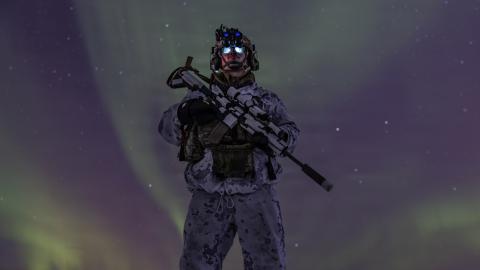
First is Russia — and, increasingly, China. Although NATO as an institution paid limited attention to the Arctic after the Cold War, Russia did not. Moscow has reopened Soviet-era bases, constructed new military facilities and invested heavily in Arctic-capable forces. Specialized brigades trained for Arctic warfare have been modernized. Russia’s Northern Fleet, headquartered above the Arctic Circle, accounts for about two-thirds of the Russian navy.
China has also shown growing interest. While not a traditional Arctic military actor, Beijing has labeled itself a “near-Arctic state” — despite its closest point to the Arctic Circle being some 1,500 km away — and expanded its cooperation with Russia. Chinese investments in infrastructure, shipping and scientific research signal long-term strategic ambitions. It is only natural that NATO countries in Europe are closely watching what Beijing is doing in the Arctic.
Second, NATO enlargement has fundamentally altered the alliance’s Arctic profile. Before 2022, five of the eight Arctic states were NATO members. With Finland’s accession in 2023 and Sweden’s in 2024, seven of the eight Arctic states — every Arctic country except Russia — are now under the NATO umbrella. This reality makes it inconceivable that the alliance would not take the region more seriously.
Finally, Trump deserves some credit. Whatever ultimately motivated his push on Greenland, the debate forced European allies to confront Arctic security more directly. The proposal created diplomatic friction but it also spurred greater European investment and attention. In strategic terms, that renewed focus strengthens deterrence and enhances transatlantic security.
Global interest in the Arctic will only intensify in the coming years. As ice recedes and access expands, Arctic and non-Arctic states alike will devote more resources to securing their national interests. Military activity, commercial shipping, scientific research and competition over energy and minerals will all increase.
For now, military tensions in the Arctic remain relatively low. That must remain the objective. But recent events elsewhere have shown how quickly supposedly stable environments can become volatile.
A safe and secure Arctic benefits everyone. It enables reliable shipping routes, supports economic development, facilitates scientific research and ensures access to energy and critical minerals. NATO’s growing role in the High North is not about militarizing the region unnecessarily, it is about preventing instability before it takes root. The alliance can help ensure that the Arctic remains a zone of stability.