








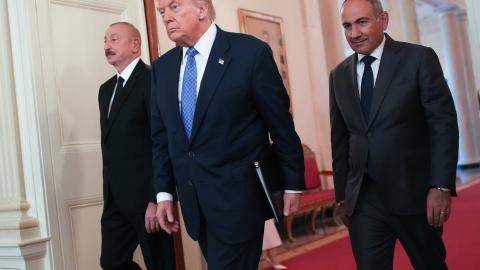
It has been more than five months since the historic meeting at the White House, in which US President Donald Trump hosted Azerbaijani President Ilham Aliyev and Armenian Prime Minister Nikol Pashinyan for a breakthrough peace agreement that, once finalized, could bring an end to the longest-running conflict in the South Caucasus.
The fighting between Armenia and Azerbaijan began during the final years of the Soviet Union, when Armenian-backed forces invaded Azerbaijan and occupied a sizable portion of its territory. That occupation lasted nearly three decades, until Azerbaijan regained control of those lands during two short conflicts in 2020 and 2023.
After decades of violence, both sides now appear genuinely ready for peace. Yet, until Trump returned to the Oval Office, they had been unable to find a viable way forward. That changed in August, when the leaders of Azerbaijan and Armenia, alongside Trump, signed an agreement committing to ratify a peace treaty and normalize relations. At the time, the ratification process was expected to take about 12 months. Now, nearly halfway through that timeline, little tangible progress has been made and several core issues remain unresolved. Four key areas will determine whether this opportunity is realized.
The first test will be Pashinyan’s political stability as Armenia heads into parliamentary elections this June. While he has shown political courage in pursuing reconciliation with Azerbaijan, hard-line nationalist forces inside Armenia continue to challenge both his leadership and the legitimacy of the peace process. These groups are often emboldened by segments of the Armenian diaspora living thousands of kilometers away, far removed from the consequences of renewed conflict. The elections are likely to be contentious and political stability afterward will be essential if the peace process is to move forward.
Closely linked to this is the sensitive but critical issue of Armenia’s constitution. Azerbaijan has been clear that this matter must be addressed before Baku can ratify a final peace agreement. Armenia’s constitution contains an implied territorial claim against Azerbaijan through its reference to the 1990 declaration of independence. That declaration cites a 1989 joint statement by the Armenian Soviet Socialist Republic Supreme Council and ethnic Armenians living in the neighboring Azerbaijan Soviet Socialist Republic, calling for the unification of Armenians in both territories and the extension of Armenian citizenship to ethnic Armenians residing in Azerbaijan.
For Azerbaijan, this is not a symbolic or semantic issue but a fundamental obstacle to peace. Aliyev has repeatedly stated that Armenia must amend its constitution to remove any territorial claims against Azerbaijan before a final agreement can be signed. Whether the political will exists in Yerevan to pursue such an amendment will largely depend on the outcome of June’s elections.
A third issue that urgently requires progress — though not necessarily full completion — is the Trump Route for International Peace and Prosperity. This initiative is intended to meet Azerbaijan’s long-standing demand for transit access between Azerbaijan proper and its exclave of Nakhchivan through Armenian territory. Armenia currently blocks this passage, despite committing to open such a route under the Russia-brokered November 2020 agreement that ended the Second Nagorno-Karabakh War.
Trump’s proposal would place the operation of this 42-km corridor in the hands of a private, international consortium backed by the US. While Armenia has formally agreed to the concept, no meaningful steps have been taken to implement it. No construction has begun and no roads or rail lines have been built or renovated. Aliyev has recently expressed concern over this lack of progress, warning that continued delays could undermine confidence in the broader peace deal. If construction inside Armenia does not begin in 2026, the credibility of the agreement could be seriously weakened.
The fourth challenge is pressure from Russia and Iran, particularly in the lead-up to Armenia’s elections. Neither Moscow nor Tehran welcomes Washington’s role in brokering the peace, as both view the South Caucasus as part of their traditional sphere of influence. The Trump route proposal is especially sensitive for both capitals.
Russia is wary of any US-backed presence — even one operated by the private sector — in a region where it currently patrols Armenia’s border with Iran. Tehran, meanwhile, relies on this same 42-km stretch as a key northbound trade route. A US-supported transit corridor could therefore intersect with Iranian commercial interests and Russian security responsibilities, creating friction neither country wants. It is thus in the interest of both Moscow and Tehran to preserve the status quo and quietly undermine efforts to establish a new transit route.
Despite these challenges, it is still possible for 2026 to become the year that peace finally takes hold between Armenia and Azerbaijan. Achieving this will require sustained international engagement and continued pressure on both sides to honor their commitments. Trump, having rightly received credit for brokering the agreement, now needs to see it through to completion to ensure the peace is durable rather than symbolic.
The potential benefits are significant. Armenia has missed out on nearly every major regional energy and transit project over the past three decades, leaving its economy isolated and in need of foreign investment. A peace agreement with Azerbaijan would likely open the door to normalization with Turkiye as well, creating new trade corridors that could transform the regional economy and bring long-overdue stability to the South Caucasus.
That outcome, however, will require focus and follow-through from the White House at a time when the US faces many competing global challenges. If Trump and his team remain engaged, the opportunity exists not only to end a decades-long conflict but to reshape a volatile region in a way that benefits all involved.