












Executive Summary
- Battlefield assessment: Last month Russian forces reportedly lost more Ukrainian territory than they gained. Kyiv hadn’t achieved this level of success since November 2023.
- Ukrainian drone diplomacy in the Middle East: Ukrainian President Volodymyr Zelenskyy conducted diplomatic outreach to the Gulf Arab states, offering Kyiv’s counter-drone expertise to the embattled region if they support Ukraine’s efforts at achieving a ceasefire with Russia.
1. Battlefield Assessment
Last week Russian and Ukrainian forces waged mid- to high-tempo combat operations, fighting an average of between one and two hundred engagements per day. At the strategic level, Russian formations remained on the offensive. The Kremlin’s offensive-minded approach—trading high casualty rates for incremental territorial gains—has led to more than 1.25 million Russian casualties in the war thus far.
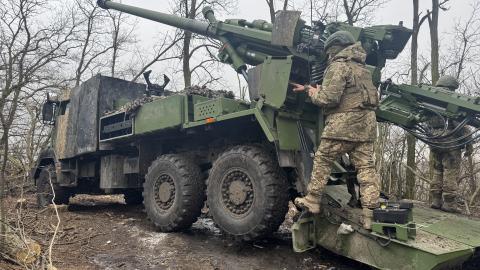
Pokrovsk, Kostiantynivka, Huliaipole, and Sloviansk saw particularly heavy clashes last week. Both sides used first-person-view drones to strike a broad target set, including heavy armor and personnel. Ukraine’s special forces and intelligence services continued to target the energy infrastructure that allows Moscow to fund its war.
Despite sustained Russian pressure, Ukrainian units conducted localized tactical pushes across multiple flashpoints. Ukrainian Air Assault Forces made gains on the front lines near Oleksandrivka, reportedly recapturing multiple settlements from Russian control.
Ukraine’s high command claimed that Kyiv recaptured more territory in February 2026 than it lost, though this assertion has yet to be independently verified. Some private intelligence assessments support Kyiv’s conclusion, and indicate that February marks the first month of the war since November 2023 in which Russian forces suffered a net loss of territory.
2. Ukraine Conducts Drone Diplomacy in the Middle East
Last week Kyiv sought to expand its diplomatic campaign to end the war, as Ukrainian President Volodymyr Zelenskyy offered to send Ukrainian drone and air-defense specialists to multiple countries in the Middle East in exchange for political support for a ceasefire in the Russia-Ukraine War.
Ukraine certainly has sufficient experience with drone warfare to advise and support [MM1]any prospective allies. Since Russia launched its full-scale invasion in 2022, Ukrainian forces have intercepted over 44,000 Shahed drones and derivatives. Ukraine faces Shahed attacks nearly every day.
As a result, Kyiv now fields the most combat-tested counter-drone architecture in Europe. Ukraine’s drone defenses include artificial intelligence–enabled acoustic detection networks such as Sky Fortress, the Wild Hornets group’s STING Shahed-hunting drone, and agile mobile air-defense teams.
President Zelenskyy’s Middle East diplomatic initiative underscores Ukraine’s confidence in the counter-drone and air defense capabilities it has forged through persistently defending against loitering munitions originally produced by Iran. Ukrainian officials now want to use their operational expertise—in layered air-defense integration, electronic warfare adaptation, and accelerated innovation cycles—as an exportable security asset that can be used to garner diplomatic support.
Ukraine’s approach is rooted in both military and diplomatic considerations. Militarily, Kyiv seeks to position itself as a credible provider of expertise to states facing similar drone threats. Diplomatically, Ukraine aims to show regional actors with ties to Moscow that it can offer tangible value that the Kremlin cannot provide. The objective driving Ukraine’s strategy is to apply indirect pressure: if Middle Eastern stakeholders view Ukraine as a net security contributor, they may be more willing to press Moscow to accept a ceasefire in its war with Kyiv.
Ukraine is attempting to translate battlefield innovation into strategic leverage. The outcome of its endeavors, however, will hinge less on Kyiv’s technical prowess and more on the skill of its diplomatic efforts.
3. What to Look for in the Coming Weeks
1. Last week Russia’s efforts to gain Ukrainian territory stalled. As a result, the Soviet-era reflexes of the Russian Federation may trigger the Kremlin to reshuffle the command of the highest levels of the Russian military.
2. As Iran continues to hit the Gulf Arab states with loitering munitions, these nations may turn to Ukraine for defense assistance in the drone-warfare realm.