









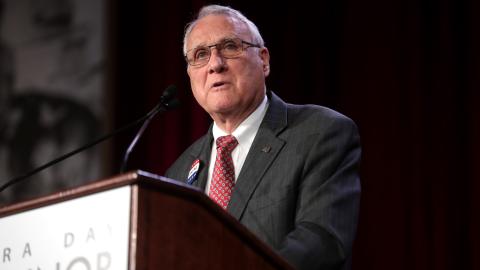
This essay is adapted from the author’s keynote address at the recent dedication of the new Kyl Institute for National Security at the University of Arizona in Tucson. Kyl announced on December 30 that “the time has come for me to withdraw from public life” after being diagnosed with “a neurological disease manifesting as dementia.”
Politics today is dyspeptic. Practitioners are commonly described as liars, blowhards, opportunists, or fanatics. Some deserve the knock. In fact, some are all of the above. But generalizing along these lines is not just a mistake; it’s cynical. It causes harm by disparaging democracy.
The country benefits by focusing attention on admirable examples of successful political leaders. That’s why the University of Arizona should be commended for naming its new Institute for National Security after Senator Jon Kyl. He has been an influential legislator and model public servant — a wise gentleman, diligent and accurate in his work, moderate in his speech and idealistic in his faithfulness to the Constitution.
Soon after the inception of President Reagan’s Strategic Defense Initiative, Kyl was one of America’s most persuasive advocates of defense against missiles of all ranges. He opposed the theory or doctrine of “mutual assured destruction,” describing it as “morally repugnant.” Mutual assured destruction was the intellectual foundation of the 1972 Anti-Ballistic Missile (ABM) Treaty, which banned defenses against long-range missiles. Kyl advocated that the United States abrogate that treaty.
In 1997, he said Americans generally did not realize that “if Syria, North Korea, or Russia launched a missile at one of our cities, we could not stop it.” They are outraged to learn that our policy has been based on a theory claiming that “we can have greater security if we remain vulnerable to missile attack.” He argued, “No one suggests that we would be more secure by renouncing defenses against strategic bombers or warships. It makes no more sense to conclude that we should remain without a defense against missiles.”
Kyl was instrumental in making the case that motivated President George W. Bush to withdraw from the ABM treaty in 2002. That withdrawal cleared the way for President Trump’s recent promise to build a “Golden Dome” national missile defense, based on Israel’s brilliantly successful Iron Dome program. It will protect against threats from Russia, China, Iran, North Korea, the Houthis in Yemen, and others.
National missile defense is hardly controversial now. Around 50 years ago, however, it was bitterly opposed in Congress and elsewhere. That’s when Jon Kyl began making his case. When America’s Golden Dome is deployed, Kyl should be acknowledged as a founding father.
Kyl likewise laid the foundation over many years for President Trump’s recent announcement in favor of a stunning, more-than-50-percent increase in the U.S. defense budget. As a senator and as a key voice on commissions that Congress created to deal with national defense and the U.S. strategic posture, he explained the need for larger defense investments.
President Reagan gave life to the phrase “peace through strength.” Kyl has ensured that it remained vital, and far more than a mere slogan.
Diplomacy is obviously a good thing. No sensible person disputes that it can help clarify actions, prevent misunderstandings, and resolve disputes. But diplomacy is not a cure-all for national security challenges. We sometimes face problems in the world that are not the result of error or misunderstanding and cannot be solved through dialogue.
While championing sensible diplomacy, Kyl has been outspoken on the limits of what diplomacy can achieve in the face of grave threats from aggressive adversaries such as the Soviet Union during the Cold War and Iran today.
In particular, Kyl has been astute in criticizing ill-conceived proposals for arms control agreements. Arms control, he said, did not prevent Iraq, Iran, North Korea, and other troublesome regimes from making strides toward nuclear capabilities “despite their treaty obligations, despite international inspections, and despite the widespread knowledge that they are pursuing such capabilities.” Kyl concluded, “We simply cannot rely on treaties to constrain regimes that do not respect their own domestic laws, let alone that weaker species known as international law.”
When President Clinton in 1999 signed the Comprehensive Nuclear Test Ban Treaty, Kyl took the lead in persuading fellow senators that a comprehensive test ban was not verifiable and would in time undermine confidence in the reliability of the U.S. nuclear deterrent. The Senate rejected the treaty.
One U.S. administration after another, however, chose to refrain from nuclear weapons testing anyway. The amazing fact is that the United States has not conducted a test explosion since 1992, a third of a century ago. To assure ourselves that our arsenal can perform, we have relied on computer simulations rather than actual tests. This is a controversial matter, and some experts believe we should resume testing.
This past October, President Trump suggested that the United States might resume explosive nuclear tests. His statement was not precise, but it is important to note that the United States has no legal obligation to refrain from such tests. It is owing to Kyl’s defeat of the comprehensive test ban treaty that the United States is free now to do what our leaders believe is necessary to ensure that our nuclear deterrent is safe and reliable.
Kyl understood the isolationist temptation. He noted that isolationism is attractive, at least in theory, to many Americans, who want to shun nasty, authoritarian, violent, corrupt, ideological extremists from the world’s hell holes. He laughed heartily at satirist P.J. O’Rourke’s observation to the effect that millions of Americans moved to this country from all over the world to get away from foreigners.
Isolationism for Americans simply is not possible, Kyl has said. In 1997, he remarked, “Our lives are influenced by world events whether we want to engage in the world or not. We can work to help shape world affairs or abdicate leadership, but we cannot prevent international affairs — and in particular the fate of our fellow democratic states — from profoundly affecting our people’s lives.” World events necessarily affect the physical security of Americans, our financial prosperity, our freedom to travel and study abroad and the vigor of our civil rights at home. Isolationism is not realistically an option, let alone a good option.
Kyl has explained why alliances are valuable, but also why our allies should not be allowed to veto actions that American leaders deem crucial for our national security. Allies can contribute to collective defense, share the burdens, impart to us wisdom from their own particular histories, and provide us their scientific and technological insights. Allies make forward defense possible, so we do not have to fall back on trying to protect our interests only at our own borders.
But alliances, Kyl has warned, should not unduly limit America’s freedom of action, imposing on us lowest-common-denominator security policies. Kyl supported President George W. Bush’s formation of coalitions of the willing after 9/11, at a time when some of our NATO allies were systematically opposing U.S. policies.
An ally that Kyl has particularly admired is Israel. He has praised the steadfastness with which it upholds its democratic principles despite the hostility of so many nearby enemies committed to its destruction. He has lauded the marvelous Israeli technology that has made possible the country’s formidable military and intelligence successes and helped improve U.S. capabilities. And he has supported Israel’s efforts to make peace, which Kyl believes requires a powerful Israeli military and a thriving Israeli economy so that Israel’s enemies will resign themselves to the reality that Israel is here to stay and cannot be destroyed, so there is no point any longer in even trying to annihilate it.
In support of these ideas, Kyl invented the Jerusalem Embassy law, enacted in 1996, that required the president to recognize Jerusalem as Israel’s capital and to move the U.S. embassy there. For more than 20 years, U.S. presidents waived the implementation of that law, but in 2018, President Trump recognized Jerusalem as Israel’s capital and moved the U.S. embassy there.
Another point about Israel warrants attention. In the late 1990s, Kyl teamed up with an Israeli member of Knesset, Uzi Landau, to create the bipartisan U.S.-Israeli Interparliamentary Commission. When the Israeli parliamentarians visited, Kyl arranged for them to receive a briefing on missile defense on board a U.S. Aegis cruiser. At the time, Israel had only one missile defense program — the Arrow — and was reluctant to even consider other programs. Kyl ensured that the main theme of the talks with the Israelis was that multilayered defenses were required for a serious missile defense capability. Landau later became the Chairman of the Board of Rafael, the Israeli defense company that went on to invent Iron Dome. Kyl nudged Israel in the right direction on this supremely important matter.
It is a sweet sorrow to pay tribute to a man who is still alive and who so fully deserves the tribute, but who is prevented by illness from being at the dedication of the Kyl Institute.
God bless Jon Kyl.