



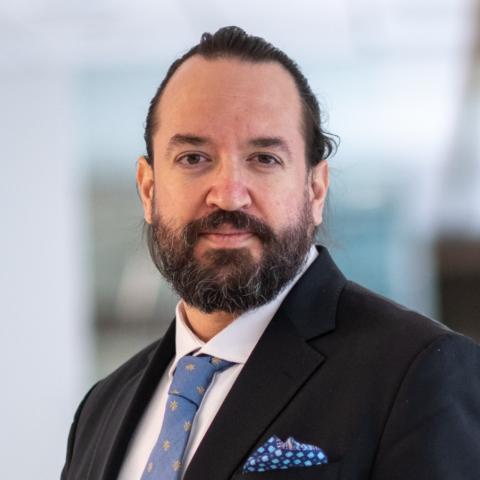




The following is an interview David Feith did with Bob Davis at The Wire China.
Q: Let's start with Trump 1.0 versus Trump 2.0. In Trump 1.0 it seemed clear that China was the main focus of both the national security and the trade objectives of the administration. This time it doesn't seem that way. What's different?
A: I think it's worth remembering that the Trump first term also had a lot going on - ISIS, Syria, leaving the Obama nuclear deal, and other episodes that weren't related to China. The world is a big place, and the president has interests other than Chinese trade agreements.
But President Trump's views about China in the firstterm were a major departure from the previousbipartisanyearsthatpreceded it. He wanted toresetthe terms of trade on China and impose significanttariffs. Those were dramatic enough shifts from what came beforethat they dominated policy making and a lot of market activity.
In 2026, those policies area a lot more mainstream. The president today still cares a lot about trade and tariffs, the fentanyl problem, and his diplomacy with Xi Jinping. But he doesn't subscribe to other China concerns that animate a lot of people in Washington on a bipartisan basis. That makes him a lot less hawkish on the spectrum of Washington and other democratic capitals today.
What do you make of the National Security Strategy? One canread it as a retreat to the Western Hemisphere, which is as lower growing part of the world, while letting go of China and the Asia-Pacific.
That's not how I read the text. It said things about thehomeland and our backyard that are completely unsurprising given what we've seen from the administration over the last year.
The language on the Indo-Pacific, China, Asia and Taiwan, was not about isolation or retrenchment. In the hierarchy of sections of strategic significance regionally, Asia was first after the Western hemisphere. The statements included maintaining the Indo-Pacific as free and open. That meanscertain things in plain English, and it also means certain things about our relationship with Japan, from where we took the 'free and open Indo-Pacific'concept back in 2017.
If you have the country's newest aircraft carrier and astrike force sitting off Venezuela, they're noting the South China Sea. Doesn't that mean that by definition you're going to have less emphasis on Asia?
We have challenges of scarcity and resources. We also have a combination of waste, inefficiency and misdirected spending in our defense budget, which is completely inadequate to the scale of the challenge that we face from China and others.
We have a share of GDP spending of 3 percent on defense. The Cold War average was 7.5 percent. If we think that we're going to maintain the peace and U.S. interests with that degree of spending, we are asking for terrible trouble. Senator Roger Wicker, the lead Republican on the Senate Armed Services Committee, wants to go to 5 percent of GDP spending over the course of a few years. The president has said he wants a $1.5 trillion defense plan, which would effectively get us there.
This isn't to say that there wouldn't be challenges in getting to that kind of spending, or that we don't have an enormous fiscal problem. But our defense spending should be around where the president has recently pegged it. We also need to dramatically change the way we spend those dollars so that it's more efficient.
What would you cut elsewhere to get to that level?
The president has staked out a very strong position in a complex debate. We have a solvency problem that is mostly driven by non-discretionary spending on our social programs. It's not driven by our defense budget, and it can't be solved by restraining the defense budget. If we continue to underspend on defense, we're going to invite problems in the world that are costlier in dollar terms and in blood than we imagine. There's no question that spending on deterrence is a cost saving compared to inviting in revisionist, authoritarian aggression.
Let me turn to a Washington Post op-ed you wrote in October. You wrote, "Nine months into the second Trump term, Washington is not adopting a Cold War posture toward Beijing. The second Trump administration has taken a soft line on issues from TikTok to semiconductor export controls to Taiwan."
You blamed an upsurge in what you called American 'self-loathing.'To me, that sounded like blaming the left. Is that how you see it?
That wasn't the point. I am concerned with an upswing in American self- loathing, wherever it's found in our politics. The more familiar, longer-tenured forms are on the left. But newer, novel and very concerning forms are on parts of the right too.
Some of it is wokery. Some of it is other forces, including a war-weariness that is an understandable consequence of our last 25 years of foreign policy. These are important 12 arts of our 12 politics that we need to reckon with.
The president sees correctly that our largest problems in national security are from foreign adversaries. But he thinks the deal his administration arranged is good and sufficient. He is less alarmed by the power over the U.S. political space that Tik Tok gives the Chinese Communist Party than some of us are.
We have to make national security policies in recognition of the fact that these are the currents of our politics. They will inevitably shape the decisions made on international security policies.
There are various reasons why the second Trump administration has gone the way it has on TikTok and on semiconductors, which relate to those dynamics.
The president was publicly critical of TikTok in his first term. In August of 2020, he signed an order to ban TikTok and a bunch of other Chinese social media and payment apps. I thought his comments then very correctly and very effectively captured how these apps are a problem from national security, data security, and cybersecurity points of view. That August 2020 ban, however, failed in the courts on a legal technicality, so the ban fell apart by 2021.
I don't think we heard from President Trump about TikTok again until early 2024 when he came out against the then-pending legislation in the Congress to create a different legal mechanism to get either a divestiture into non-Chinese control or a ban. lhe president said then that he opposed the legislation because banningTikTok would help Mark Zuckerberg, and Mark Zuckerberg is a bad guy.
At the time there were other influential voices in our politics and media who said we shouldn't pass the TikTok law because it would give American regulators too much power over the media. You wouldn't want future Justice Departments to be able to act overzealously - for example, to go after Elon Musk, owner of X, for some minority foreign investment in that media asset.
I think we should take very seriously the concerns about giving the U.S. government too much power over the media. But these concerns weren't persuasive to me on the subject of TikTok.
We have a long and completely constitutional tradition of restricting foreign ownership of U.S. media going back more than 100 years. The 2024 law said TikTok needs to be properly divested from foreign, in this case, Chinese control. That is consistent with that long U.S. legal and policy tradition. The law addressed an important national security threat, which is that Chinese influence over the TikTok platform. The U.S. government cannot mitigate that threat as long as there's a relationship between the TikTok platform in the U.S., and engineers and a company in China. And the Supreme Court had the same view of the constitutionality, by nine-to-zero, when they looked at the law that eventually passed.
Part of what was playing out on the TikTok issue was a question of what one sees as the core threat to the United States. If your basic orientation is that the most important threats we face are from determined and capable adversaries abroad, that would incline you to support
TikTok's divestment from Chinese state influence, and to ensure that a pl/atform as important to the American information and political spaces as TikTok would not be subject to online influence from an adversary.
But if your basic view of the world is that the greatest threats we face are from within, from the U.S. government itself and the deep state, and that maybe all this concern about the Chinese government is overblown, then you're much more likely to oppose the TikTok divestment law and its strong implementation.
That wasn't the only reason we got the outcome that we got on TikTok, but it influenced how things played out in 2025 as the second Trump administration came in and went through its implementation.
[Trump held up enforcement of the law for months. Under the sale he eventually approved, which closed on Jan. 22, 2026, a new U.S. entity owns a majority interest in TikTok in the U.S, but China's ByteDance retains a 19.9 percent stake. The core algorithm continues to be owned by ByteDance in Beijing and is licensed to the U.S. entity, which relies on source code from ByteDance.]
Don't you think Trump's view was that business is business, and this was a good deal? He hasn't been that concerned about the data issue.
I think that describes President Trump's personal view.
The president sees correctly that our largest problems in national security are from foreign adversaries. But he thinks the deal his administration arranged is good and sufficient. He is less alarmed by the power over the U.S. political space that TikTok gives the Chinese Communist Party than some of us are. He has more faith in the details of the divesture that have been negotiated than, I fear, is justified.
You have also written about export controls and have opposed selling Nvidia's H200 chips to China. Trump has approved selling those chips to China under some bizarre conditions where the chip is shipped from Taiwan to the U.S. and only then to China, so the U.S. can collect a 25 percent tariff on the sale. What's your view about how that has been resolved
I think it's a big mistake. Softening our export control policy will be a major contribution to China's AI progress in both commercial terms and in strategic military terms. The United States and our allies have major advantages over China in AI hardware - in the compute represented by U.S.-designed chips, and in the ability to manufacture those advanced chips. These advantages can be exploited through the sort of export controls that we built in the first Trump administration and that were expanded in the Biden administration.
There's enormous importance to keeping these controls in place partly because China has a lot of other advantages in AI, including their ability to power AI processes, and their talent pool. The administration's reversals on export controls give away one of the most important advantages we have.
Now, the details matter. Details of the licensing regime that were published by the administration are complex, and we'll need some time to see how they play out and how they affect the volume of compute that actually flows into China.
The administration isn't pursuing unrestricted flows of H200 chips into China. They have put up various gates, which is good. But, in principle, U.S. and allied export controls serve our national economic interests.
How would you judge the export controls that have been in place - the ones that started in the first Trump administration and were expanded, as you say, under Biden. They have been compared to Swiss cheese, with the Chinese able to go around them.
They're a lot more like Swiss cheese than would have been ideal. They were more limited in their general scope and weaker in their enforcement than they should have been. But by and large they were still very effective, and they have served us well.
The controls that were broader, tougher and not undermined by enforcement loopholes were the best. Extreme ultraviolet lithography technology from the Netherlands had the broadest and toughest control. That was the most effective. [ASML of the Netherlands is the sole manufacturer of EUV lithography machines, which are used to make the world's most advanced computer chips. The U.S. has so far successfully pressed the company and the Dutch government not to sell EUV machines to Chinese firms.]
The first Trump administration made this an issue. There's no question that it has prevented China from indigenizing production of the most advanced chips. As they seek to innovate with lesser lithography technology, they are hugely disadvantaged.
Other controls that were less categorical and tried tobe more surgical were a lot less effective. Controlsthat said you can't sell certain chip-making tools tocertainfabs inChina, but youcouldsendthemtofabsthat wereacrossthe street - those werea lotless effective than we needed.
Returning to the difference between Trump 1.0 and Trump 2.0, it seems to me that Trump's worldview is that countries with large, persistent trade surpluses are ripping off the U.S. That was Japan in the 1980s, and China now, because it has the largest trade surplus. But he wasn't the most hawkish person on China in Trump 1.0.
The dynamic that President Trump has established between himself and his senior team on China is indeed very different in the second term than it was in the first. In the first term, perhaps less than consciously, the president generated an environment where he elicited from his team a broad, diverse, aggressive mix of proposals for competitive and tough policy on China.
"Before Trump, there was an optimistic view that we could converge with China and establish China as a ‘responsible stakeholder’ in a U.S-led liberal international order… President Trump shattered these inherited ideas."
You had folks at the State Department, the National Security Council, Commerce Department, the Pentagon, the Justice Department, the U.S. Trade Representative and elsewhere generating ideas. There was a permissive environment for all sorts of tough ideas because the President had come in and shattered the inherited wisdom of a much more cautious approach to China.
Before Trump, there was an optimistic view that we could converge with China and establish China as a ‘responsible stakeholder’ in a U.S-led liberal international order. The U.S. was cautious and diplomatic. We didn’t speak unkindly about China or criticize their system or slam their human rights too much.
President Trump shattered these inherited ideas. Across his first administration we understood ourselves to be working on ideas of how to remake policy toward China. We would run these ideas through the president because the authority is his. We had proposals for sanctions and export controls and arm sales and law enforcement crackdowns
He would calibrate the magnitude of the action and the timing in his own way, often as a function of the trade negotiations with China, in which he was always especially interested. We had all kinds of initiatives that were proposed, and then held until something shifted in the trade talks.
Then, of course, Covid, was a major exogenous factor that caused a major shift. The president felt betrayed in certain ways by Beijing. He recognized that Covid was going to dwarf the economic effects of the Phase One trade deal.
The more finely calibrated weighing of policy versus market effects was going to be drowned out Covid anyway. So, beginning in March 2020, he gave the administration quite a bit more aggressive guidance to generate options and pursue initiatives.
To an outside observer, it looked like, ‘Release the hawks.’ All the things you were trying to do he gave the OK to.
Crucially, by mid-2020, there were three-plus years of accumulated policy designs available to him when the time came to use them.
The second term, so far, is a very different environment. The president does not seem to be encouraging his team to generate broad ideas that seek to compete and change the terms of our relationship with China across the economic, trade, technology, diplomatic, military, and human rights domains in the way we did in the first term.
He has a team around him that is much more focused on pursuing only those things he specifically prescribes. That helps explain why we’ve seen a narrower, tighter focus on trade, tariffs, fentanyl, and Xi Jinping diplomacy. These animate the president.
We have seen instances where senior officials have raised with the president good, hawkish measures to pursue vis-a-vis China, andthepresidenthasseeminglybattedthemdown. Over the summer, in a public televised cabinet meeting, Agriculture Secretary Brooke Rollins spoke about how she had begun toroll out an effort to restrict Chinese purchases of U.S.farmland.She had done it at the public event that included a few other Cabinet Secretaries and a few governors.
The farmland issue is one of the main China issues that the America First Policy Institute think tank, which Rollins had led during the Biden years, focused on. So, this was an up-themiddle, politically salient, and seemingly uncontroversial hawkish China policy about inbound investment restrictions. But the president kind of cut her off when she was presenting it and suggested something of a lack of interest and even discomfort with that proposal. We haven’t seen the administration move on investment policy in a particularly hawkish direction.
We published the American First investment policy in February 2025. It reflected a desire to strengthen not just the rules on Chinese investment into the United States, including in farmland, technology, and greenfield investments, but also a desire to strengthen outbound controls on what U.S. investors, venture capital firms and private equity firms could spend in China. This is not just about AI and quantum computing, which the Biden administration had begun to control, but also biotech and other key areas. But so far, the investment memo signed by the president hasn’t translated into much implementation.
There are two main factors behind this.
In the first term, remember, the Trump administration took important measures on financial decoupling, including a blacklist to prevent U.S. public investment to flow into Chinese military company stocks, a restriction on federal pension funds investing in Chinese markets, including into the stocks of Chinese defense companies, and support for the Holding Foreign Companies Accountable Act , passed in December 2020, which tries to enforce our audit transparency rules on Accountable Act, which was signed into law December 18, Chinese listed companies in New York.
But that was all after Covid. Before that, the president had spent the previous three years seeking a Phase One trade deal that included major measures to deepen Wall Street’s integration with China.
The second reason we’re seeing less financial decoupling in the second term is the general posture of restraint given how things have played out with the trade war and rare earths.
Shortly after you joined the second Trump administration as technology chief at the NSC you were attacked by Laura Loomer and then dismissed. How did that feel? And to what do you attribute the way it played out?
One explanation of her opposition to you is that your father [Douglas Feith, a former undersecretary of Defense in the George W. Bush administration] was viewed as a neocon. The other is that you were positioned at the NSC to restrict computer chip sales to the Middle East, and that could have screwed up a separate cryptocurrency deal pushed by the families of President Trump and his negotiator Steve Witkoff.
I was happy to join the second administration and work on the technology and national security piece of the President’s agenda, and build on the first-term measures around technology control and recognizing China as a competitor. There were a wide range of technology and national security policy issues that the President and his team were setting up to work on, including AI, semiconductors, biotech, and the quantum supply chain. The personnel picture of the entire NSC changed within the first roughly 100 days. As you know, a few colleagues of mine were part of that story.
Were you like, ‘Are you kidding me?‘
I’m not interested much in the personal feelings of it. We all go into these political jobs to serve at the pleasure of the president. These are not entitlements. There were personnel changes up and down the NSC. My preference obviously would have been to continue work on these issues and support what the administration was going to do on them.
It certainly didn’t go as expected. But it’s also the case that the president should have the team that he wants, and he takes input from a lot of different places.
Do you think [your removal] was due to your involvement in areas that could have affected crypto?
We don’t know, but that’s not my belief. [At that point, Feith waved his hand in a way to suggest he didn’t believe that was the cause of his dismissal.]
Let’s talk about rare earths. Have you been surprised at how effective it has been as a tool for the Chinese? Why do you think the U.S. didn’t strike back by using the chokeholds it has on the Chinese economy and technology?
It’s a good question. I wish we would have.
What are you expecting from a Trump-Xi Jinping meeting?
The Chinese side will likely push for a broader agenda and a broader range of asks than what we saw in Busan a few months ago, when the President and Xi Jinping had a brief meeting.
The rare earths case is very important, not only for the question of what the terms of this truce are. Will China follow through on its promises of continued exports? Will we follow through in pulling off what what Treasury Secretary Bessent has referred to as ‘warp Jinping before a ,speed’ for rare earths?
There are a set of things that we need to be doing on critical vulnerabilities, including rare earths, that I fear we are not sufficiently focused on. Other vulnerabilities that are at least as important as rare earths include pharmaceuticals and legacy, or so-called foundational, semiconductors . We seem to be seeing the administration not pursue policy measures we would need if we’re really going to try to rid ourselves of those vulnerabilities, on any time frame that’s realistic.
"We know that he has a fairly confident and ambitious sense of his ability to achieve things in the U.S. national interest through personal diplomacy with people like Xi Jinping and Vladimir Putin."
The administration’s caution on these issues has many explanations, some of which relate to the kind of quasi-detente that we’re in with China because of the rare earths, and some of which relate to the complexity of the issues. What does it mean to significantly change our pharmaceutical supply chains? Do we have to design tariffs for drugs for the first time and rules-of-origin for pharmaceuticals? [Rules of origin refer to requirements to produce a certain percentage of a product in the U.S.]
It would be heartening to see more activity on this from the administration. It has put out some signals recently, like with their Section 301 investigation on legacy chips and their Section 232 investigations on chips and on pharmaceuticals, which suggest the plan is to not take action for a while. I think that runs the risk of leaving major China-related vulnerabilities. [Section 301 and section 232 are provisions of U.S. trade law aimed at protecting U.S. industries. They require detailed and lengthy proceedings before tariffs or other punitive measures can be imposed.]
Let’s talk about Taiwan. What’s your sense of the administration’s view on Taiwan and about what the Taiwanese should do? And what should they read into Trump’s actions regarding Venezuela?
It’s too soon to draw too many conclusions about where this administration will go with Taiwan. The signs we have today are in some cases quite positive. We had a trade deal announced, which wasn’t inevitable. It reflects the administration’s strategic recognition of the importance of our trade with Taiwan, especially in semiconductors. We haven’t seen the administration approach Taiwan as an economic or semiconductor problem, but as an economic and semiconductor major partner.
Similarly, the defense sales progress has been real. We didn’t see the arms package emerge last summer, just like we didn’t see the trade deal emerge in November, but they both have now come and we’re only in the first year.
Still, the president obviously doesn’t speak about Taiwan the way that many Republicans have before him, or in the specific way of committing to Taiwan’s defense in the event of a Chinese military assault that Joe Biden did. That’s also not a surprise. It’s consistent with where the president has been for a long time. For decades, strategic ambiguity has been the default U.S. position on whether to come to Taiwan’s defense.
I also think the president has importantly signaled that the U.S. has a major interest in Taiwan and that China’s threats to Taiwan are a threat to U.S. interests, and are an affront to whoever sits in the Oval Office.
An interesting dynamic emerged during the 2024 campaign. When the candidate Trump was asked about Taiwan, he answered in ways that were read to be quite negative. He emphasized that Taiwan had stolen the U.S. semiconductor industry and rejected the opportunity to follow Joe Biden’s commitment to Taiwan, saying that he wanted to preserve his room for negotiation.
What was overlooked was that he regularly mentioned Taiwan on the campaign trail, and in his rallies and speeches, in a more macro and positive context. He would say that Joe Biden’s weak and infirm condition was causing all these problems, including that all these bad things that were happening in foreign policy and national security. The litany included Russia’s full-scale invasion of Ukraine, Iran and its proxies marauding across the Middle East, and China bearing down on Taiwan. It was an interesting, extemporized reflection of the president’s view that the China threat to Taiwan was obviously an expression of China’s view toward the United States, and toward the occupant of the Oval Office.
Since becoming president last year, those comments have translated into statements saying Xi Jinping wouldn’t dare move on Taiwan while Trump is president. It’s the same point.
Now that doesn’t guarantee that Xi Jinping won’t, obviously. And, of course, there are important things we need to do to strengthen our deterrent posture, our defense budgeting, our defense relationships with the most important allies in this regard, starting with Japan. Most of the decisions are ahead of us, which is why I say that it’s too soon to tell. But the record of the last year has a lot to recommend it.
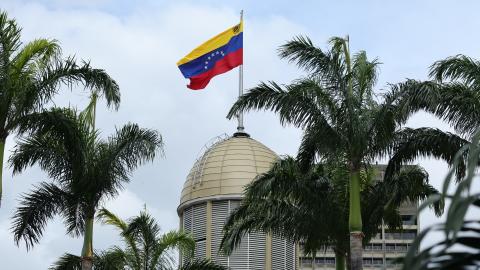
On Venezuela, if the suggestion is that the recent operation to grab Maduro makes it easier for Xi Jinping, to move on Taiwan and try to decapitate the Taiwanese government, that’s complete nonsense. The argument that Mann’s The China Fantasy Xi Jinping and Vladimir Putin need excuses from us to carry out their aggression is not consistent with the record.
By contrast, the administration’s backing up of its threats of military force by surgically and successfully applying force strengthens our standing and deterrent posture quite a bit.
The decisions Xi Jinping will have to make have to do with the balance of forces across and around the Taiwan Strait, and where the U.S. is with our important allies on the issue of Taiwan. The U.S. strike against the Iranian nuclear program after Israel’s operations and the Venezuela move are, in general, very helpful to the credibility of U.S. commitments around the world. And the defeat of Russian air defenses used in Iran, and Chinese air defenses and other systems in Venezuela, is also useful in terms of deterrence to China vis-a-vis Taiwan.
I had a conversation with Trump’s former national security adviser Robert O’Brien , where he talked about what has been called a ‘reverse Kissinger’ — Trump trying to wean Russia away from China. It also seems he is trying to peel Xi from Putin. Do you think that is animating Trump’s policies with both leaders in a fundamental way?
I don’t pretend to have any particular insight into the President’s thinking on Russia or Europe.
We know the President takes personal diplomacy very seriously. We know that he has a fairly confident and ambitious sense of his ability to achieve things in the U.S. national interest through personal diplomacy with people like Xi Jinping and Vladimir Putin.
There are arguments that this view underestimates the role of ideology in the behavior of Xi and Putin and their deep national interests in undermining us and preparing for conflict with us. I’m generally less confident in the ability of any American president to achieve breakthroughs through personal charm or personal diplomacy with capable and committed foes.