







Has Saudi Arabia truly abandoned moderation and embraced Islamism – or even antisemitism – as some have recently alleged? The short answer is no, and the reality defies the overheated media narrative that has circulated since a Saudi-Emirati rift burst into public view in December. That fissure, which had simmered beneath the surface for years and is due to many policy differences as well as economic competition, became overt and highly toxic following an attempted takeover of two southern Yemeni provinces by UAE-backed forces.
Social media commentary has since grown poisonous, and it is fair to say that both sides would benefit from lowering the temperature before the rupture becomes irreparable. It is in this charged environment that a narrative has emerged claiming that Saudi Arabia has “pivoted away from moderation,” “abandoned peace,” and begun embracing extremism – or even indulging antisemitism. None of these accusations withstands serious scrutiny.
It is true that Saudi Arabia was once part of the problem. Beginning in the 1960s, the Kingdom supported Islamist movements as a bulwark against leftist ideologies that threatened its rule. This trajectory intensified after 1979, when the seizure of the Grand Mosque in Mecca by millenarian zealots and the Iranian Revolution challenged the Saudi regime’s legitimacy. Rather than confronting reactionary forces within its society, the Saudi leadership chose to appease them, doubling down on its own intolerant strain of Islam, commonly known as Wahhabism.
Much of the Kingdom’s poor international reputation over subsequent decades – religious police, funding of mosques abroad, and draconian social laws, particularly affecting women – can be traced to this period. Efforts to placate extremists contributed to a social environment that produced a disproportionate number of al-Qaeda and other jihadist terrorists.
It is precisely this post-1979 trajectory that the current Saudi leadership has sought to reverse. Under Crown Prince Mohammed bin Salman (MbS), the Kingdom has embarked on a rapid transformation aimed at turning Saudi Arabia into something it had never truly been: a normal society. MbS is convinced that Saudi Arabia cannot modernize or diversify its economy away from oil dependence without embracing tolerance and openness. Anyone who has visited the Kingdom in the past eight years can readily observe the changes: the expanding role of women and youth, the disappearance of the religious police, the opening of the country to international tourism, a dramatic expansion of entertainment and recreation, and tentative steps toward permitting alcohol consumption. This transformation – driven by hardheaded self-interest – remains incomplete, but its speed and scope are remarkable.
Has Saudi Arabia now been so angered by the Gaza conflict and so irritated by its Emirati neighbors that it is prepared to abandon this transformation and instead embrace the Muslim Brotherhood and other Islamist movements – the forces of intolerance and, in some cases, violent extremism? That would be deeply implausible for a country that outlawed the Muslim Brotherhood in 2014, views Islamist politics as an existential threat to the monarchy, has been repeatedly targeted by al-Qaeda and ISIS, and is acutely aware of the damage its earlier reputation inflicted on its international standing and modernization prospects. If such ideologies once found a hospitable environment in Saudi Arabia, they no longer do – except perhaps among a small number of extremists now behind bars. Saudi leaders have been explicit: they do not engage Hamas; they arrest its members, and they seek the disarmament of both Hamas and Hezbollah.
Cautious regional engagement
Saudi Arabia has long adopted a pragmatic approach to Islamist political movements in an exceptionally volatile region. Where alternatives are worse, and pragmatic cooperation is possible, it has been willing to engage cautiously. In Sudan, for example, the Sudanese Armed Forces include figures linked to the former Islamist regime of Omar al-Bashir, yet they retain a degree of national legitimacy. The alternative, in Saudi eyes, is the Rapid Support Forces – widely viewed as genocidal actors responsible for horrific atrocities and one of the world’s worst humanitarian catastrophes, with foreign backing.
In Syria, the government of Ahmed al-Sharaa has roots in al-Qaeda, and some hardline Islamists regrettably remain influential. Yet al-Sharaa’s government has joined the anti-ISIS coalition and cooperates with the United States on counterterrorism, mitigating its grim origins. From Riyadh’s perspective, attempting to transform al-Sharaa into a nationalist leader is preferable to the chaos that would invite Iranian proxies and jihadi groups to fill the vacuum – a view Washington has increasingly come to share.
Claims have also emerged that Saudi Arabia has strengthened ties with regional backers of Islamist movements, particularly Qatar, Turkey, and Pakistan, at the expense of more moderate partners. Yet there is no tangible evidence to support the notion that such engagement amounts to a turn toward extremism. Saudi-Qatari relations reached a nadir during the 2017 Saudi-led boycott of Doha, and both states have worked to rebuild ties since reconciliation in 2022. Saudi-Turkish relations similarly hit rock bottom following the 2018 killing of journalist Jamal Khashoggi in Istanbul. Today, Saudi Arabia is cooperating with Turkey on investment and weapons manufacturing projects, but a military alliance is unlikely because Riyadh still sees Ankara as a rival. Yet Turkey is an unavoidable regional power, and most Arab states have pursued pragmatic engagement.
Saudi Arabia’s mutual defense agreement with Pakistan, signed after an Israeli airstrike on Qatar, reflects long-standing ties rather than a new strategic alignment. The Saudi-Pakistani defense relationship spans decades, though it is difficult to imagine either country intervening militarily on behalf of the other against Iran or India, respectively. The agreement is best understood as diplomatic signaling, not an operational blueprint.
The era of morality police
A hallmark of a normal society is the cultivation of tolerance at home and openness to foreigners of all faiths. Since 2021, Saudi Arabia’s Ministry of Education has systematically reformed school textbooks. The Israeli NGO Impact-SE, which closely monitors educational materials, has documented steady improvement in depictions of non-Muslims and the removal of most negative references to Israel. At the same time, Saudi Arabia – until recently closed to tourists – has invested heavily in a tourism sector that showcases the full breadth of its cultural heritage, including pre-Islamic sites once deemed taboo. Jewish and Christian sites have been opened to archaeological study, and the Kingdom has made clear that visitors of all faiths are welcome.
As custodian of Islam’s holiest sites, Saudi Arabia remains sensitive to its standing in the Muslim world, and public non-Muslim worship may take time to be permitted. Yet the era when Jews or Christians feared raids by morality police has ended. Private religious life among expatriate communities flourishes with the knowledge – and protection – of the authorities. While the occasional inflammatory Friday sermon still occurs, such incidents are far rarer and closely monitored.
Even as Saudi attitudes toward Judaism have evolved, views of Israel remain more complex. In public discourse, the two are often conflated – unsurprising in a society with historically limited engagement with either and a media environment that once amplified antisemitic and anti-Israel narratives. Some residue of this persists, though arguably less than in much Arab media – one need only compare Saudi-owned broadcaster Al Arabiya with Qatar’s Al Jazeera.
Much recent criticism centers on a single article in the Saudi newspaper Al-Jazira. This privately owned outlet (unrelated to the Qatari network) is often mischaracterized in US media as a regime mouthpiece. Saudi media is not fully free and practices self-censorship, particularly regarding the royal family, state institutions, and Islam. That does not mean journalists never test boundaries, especially on emotionally charged issues like Gaza. At times, criticism of Israel veers into conspiratorial rhetoric. Saudi officials and journalists, however, often fail to appreciate how sensitive such discourse is in the United States and Israel, and they do not view criticism of Israel as equivalent to hostility toward Jews.
Crucially, the Al-Jazira article and similar pieces must be understood as part of an ongoing Saudi-UAE media war. Each side has engaged in an unfortunate public campaign of maximalist messaging. For Saudi media, invoking the UAE–Israel relationship resonates powerfully in Arab and Muslim audiences; for pro-UAE voices, accusing Saudi Arabia of embracing Islamism and antisemitism is particularly effective in Washington and the West.
Such mudslinging should not be mistaken for a genuine shift in Saudi views of Israel or Jews since December. MbS understands that public opinion in Saudi Arabia – as in much of the Arab and Muslim world – remains deeply critical of Israeli policies toward Palestinians, sentiments intensified by the Gaza war. Reliable polling is scarce, but surveys by the Washington Institute for Near East Policy provide rare insight. In their most recent poll, both Hamas and Israel were deeply unpopular. Notably, 73 percent of respondents held negative views of Hamas, and over half agreed that Hamas should abandon calls for Israel’s destruction and accept a permanent two-state solution based on the 1967 borders – up from just 16 percent two years earlier. Meanwhile, support for the Abraham Accords declined from 21 percent in 2022 to 13 percent in 2025. Yet despite this hostile environment, MbS continued negotiations with the United States through the end of the Biden Administration that would have led to normalization with Israel.
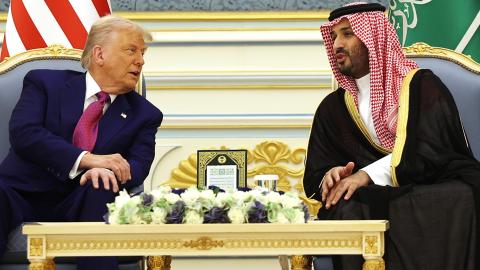
Even after October 7, Saudi Arabia never foreclosed normalization. As recently as his November 2025 White House meeting with President Trump, MbS reaffirmed his interest in joining the Abraham Accords. The price, however, was always clear: meaningful steps toward Palestinian statehood. Even before October 7, normalization without such assurances would have been unlikely.
In the Arab world, disentangling discourse about Israel from discourse about Jews is often difficult. The US Embassy in Riyadh has nonetheless made notable efforts. In January, it hosted its first Holocaust Remembrance Day commemoration, attended not only by foreign diplomats and Americans, but by more than a dozen Saudis, including several who had participated in a US-sponsored visit to Auschwitz the year before. Three rabbis were present. Saudi leaders have repeatedly met with Jewish figures, including a meeting between Defense Minister Prince Khalid bin Salman and Jewish leaders in Washington in late January. This month, a delegation of nearly 200 Jewish businesspeople visited the Kingdom, most for the first time. Such events would have been unthinkable in Saudi Arabia a decade or two ago – or in a country whose leadership had embraced antisemitism.
Ultimately, Saudi Arabia’s stance on Islamism, religious tolerance, and even peace with Israel is part of a deeper project of societal reinvention. As such, it is structural rather than tactical – and highly unlikely to be reversed for short-term political gain.