








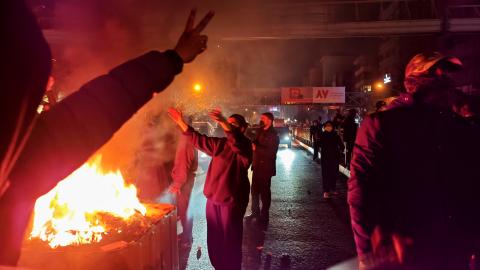
The ongoing mass demonstrations in Iran are the largest protests the country has seen in about half a decade. Although this current round of nationwide demonstrations began as a response to the economic crisis affecting market traders in the bazaars, it rapidly spread across the country as long-standing grievances over the lack of political reform and economic growth boiled over.
It is too early to tell what the outcome of these protests will be. The regime has proved resilient in the past and, although the situation does appear messy, it does not appear close to a total collapse. However, if the protests continue and outside intervention takes place, a wide range of outcomes is possible, from a rapid regime collapse as seen in Libya in 2011 to a gradual erosion of centralized control and de facto partition as seen in Syria.
While many policymakers view Iran primarily through the lens of the Middle East, the country’s northern flank cannot be ignored. The three South Caucasus countries — Georgia, Armenia and Azerbaijan — will be watching events closely with nervousness and anxiety. Iran has historically viewed the South Caucasus as an area of influence in competition with Turkiye and Russia. The region is geopolitically important, as some of the world’s most critical oil and gas transit pipelines run through it. Any spillover from Iran’s internal turmoil could therefore have broader geopolitical consequences for the South Caucasus.
Although none of the three countries has made public statements regarding the demonstrations, off-the-record conversations with regional officials suggest clear concern. While the three states maintain varying degrees of relations with Tehran, two shared issues stand out.
The first is the economic impact of sustained unrest inside Iran. As neighbors, all three countries engage in trade and economic activity with Iran, albeit to different degrees. Azerbaijan, as the only country that borders both Russia and Iran, plays a role as a transit country between the two allies and generates revenue from this arrangement.
Armenia has often viewed Iran as an economic lifeline since trade with its neighbors Turkiye and Azerbaijan was frozen following the Nagorno-Karabakh War in the 1990s. This remains the case today, with Armenia’s land borders with both Turkiye and Azerbaijan still closed. As a result, Iran continues to serve as one of Yerevan’s most important economic outlets.
Georgia’s trade with Iran is smaller than that of Armenia and Azerbaijan but it has been growing in recent years. As the Georgian government has grown more politically aligned with Moscow and more distant from its traditional European partners, it has increasingly sought economic opportunities elsewhere, including with Tehran. Trade between Georgia and Iran has risen year on year.
Notably, Georgia has faced criticism for allowing Russian cargo aircraft to transit its airspace en route to Iran, despite the fact that Russia continues to occupy portions of Georgian territory. This underscores how economic considerations are increasingly overriding long-standing political sensitivities.
Another economic factor shaping regional thinking is US President Donald Trump’s threat to impose a 25 percent tariff on any country doing business with Iran. While such a measure may not have a dramatic immediate impact on the economies of the South Caucasus, it would still create economic fallout that governments in the region would prefer to avoid, particularly at a time of broader regional uncertainty.
The second shared concern among the South Caucasus states is the humanitarian impact of a potential refugee crisis. If conditions in Iran deteriorate to levels seen in Libya or Syria in 2011, the countries of the South Caucasus could experience an influx of refugees fleeing instability and violence. Such a development would place serious strain on already-fragile economies and public services, and it is a scenario regional governments are keen to prevent.
For Armenia and Azerbaijan, the two South Caucasus countries that share a land border with Iran, additional concerns are at play. One major issue is the well-being of ethnic minority communities inside Iran. For Armenia, which has historically maintained close relations with Tehran, there is concern that a shift in the internal balance of power could undermine the status of Iran’s ethnic Armenian community.
For Azerbaijan, the issue is both more sensitive and more consequential. Since the Treaty of Turkmenchay in 1828 divided ethnic Azerbaijani lands between the Russian Empire and Persia, a latent grievance has existed in Azerbaijan regarding the treatment of ethnic Azerbaijanis in Iran. Some estimates place the number of ethnic Azerbaijanis living in northern Iran in the range of 15 million to 25 million. They continue to speak their own language and maintain cultural traditions more closely aligned with modern-day Azerbaijan than with Persian identity. Any major unrest in northern Iran could increase domestic pressure on authorities in Baku to respond, particularly if ethnic Azerbaijani communities are affected.
Another shared concern for Armenia and Azerbaijan is the potential impact of instability in Iran on the fragile peace process between the two countries. Although leaders in Yerevan and Baku pledged last August to ratify a peace agreement in the coming months, progress has been limited. A major crisis in Iran could easily divert political attention and diplomatic momentum away from completing this process.
Overall, the countries of the South Caucasus would strongly prefer stability and security over chaos and uncertainty. Yet recent history has shown that mass protests and sudden political shifts can rapidly reshape the region. Only a few weeks into 2026, the year is already shaping up to be one of significant geopolitical consequence. How events in Iran ultimately affect the South Caucasus and the wider region remains to be seen but, at present, the outlook is far from reassuring.