











In a surprising move at this time of year, a tanker from Russia’s Arctic LNG 2 project on Wednesday traveled along the Northern Sea Route to markets in Asia even as winter conditions were beginning to set in. Russia transporting liquefied natural gas to Asian markets, particularly China, along its northern coast is hardly unusual. What stands out here is the timing.
Regular commercial traffic on the Northern Sea Route typically tapers off by November as ice conditions worsen, with navigation normally concentrated in the July-November period. Unusually favorable weather this year, combined with Russia’s desperation to generate revenue wherever possible from its energy exports, created conditions for this rare late-season voyage.
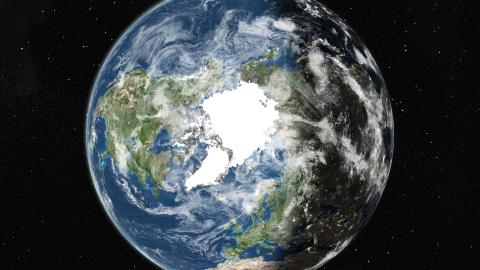
This move by Russia should serve as a reminder to international policymakers about the importance of the Arctic and great power competition. With established Arctic powers like the US, the European countries in the High North and Russia being joined by assertive non-Arctic states such as China, the region is being increasingly contested. The Arctic is rich in natural resources, hosting vast reserves of oil and gas. It is also a major source of global food supply through its fisheries and a crucial hub for scientific research aimed at understanding climate patterns and their worldwide impact.
The Arctic, however, is not immune to geopolitical shocks. The war in Ukraine has disrupted established patterns of governance and security cooperation. The Arctic Council — the primary intergovernmental body promoting collaboration among the eight Arctic states — has seen its high-level political activity largely paralyzed since Russia’s invasion of Ukraine. Cooperation with Moscow remains frozen, even though some project-level work among the other seven Arctic states has resumed in a limited format.
Meanwhile, NATO — traditionally cautious in its Arctic posture — has enlarged to include Finland and Sweden, fundamentally altering the regional security landscape. As a result, seven of the eight Arctic states now fall under NATO’s security umbrella.
In the past several weeks alone, three developments have underscored why the Arctic remains an area of strategic importance, even as global attention is focused on Ukraine, Gaza and Venezuela.
The first was the Trump administration’s October announcement that it will expedite the purchase and construction of a new class of icebreakers known as the Arctic Security Cutter. In President Donald Trump’s recent budget, more than $8.6 billion was earmarked to enlarge the Coast Guard’s polar icebreaker fleet as a whole — funding that includes both the troubled Polar Security Cutter program and the newly prioritized Arctic Security Cutters.
This effort builds on the work Trump began during his first administration to launch the Polar Security Cutter initiative. But after years of delays and significant cost overruns, much of the optimism surrounding that program has diminished. The Arctic Security Cutter program is now emerging as a more viable and immediate path to expanding US icebreaking capability.
As part of an agreement with Finland, the US will allow Finnish shipyards to build the first several Arctic Security Cutters, with additional vessels constructed in the US. This highlights the urgency the Trump administration places on America’s role in the Arctic, while demonstrating that the president can be flexible about his usual protectionist stance on domestic manufacturing. Many observers believed it would have been unthinkable for Trump to permit US Coast Guard vessels to be constructed overseas, even in a friendly nation such as Finland. But geopolitical realities appear to have influenced the White House’s approach.
Meanwhile, the EU on Monday took steps to advance its role in the Arctic region, calling on the European Council and the European Commission to develop a stronger and more coherent EU diplomatic strategy for the Arctic.
For the EU as an institution, the Arctic has long been a difficult region in which to operate. Many Arctic-related policy areas remain the competencies of individual member states, limiting the bloc’s ability to legislate or act effectively. In addition, a major Arctic power, Norway, is not a member of the EU and another key northern actor, the UK, left the bloc after Brexit. Greenland also left the European Economic Community in 1985 after gaining home rule from Denmark.
These bureaucratic and geographical constraints have relegated the EU to a secondary role in the region. Still, the European Parliament’s push this week signals that Brussels views the Arctic as a strategic priority.
Finally, there is Russia. In the context of the peace talks Trump is brokering between Russia and Ukraine, many were surprised by the emphasis placed on potential US-Russian economic cooperation, particularly in energy and trade. For Trump, part of the motivation for ending the war is to create new business opportunities for the US.
Some of the ideas reportedly discussed include renewed cooperation in Arctic energy projects — areas that carry implications for both Russia’s Arctic developments and US interests in Alaska. Although the policy consensus in Washington is that economic and trade overtures to Russia by the US are naive, it nonetheless appears to be a key factor in Trump’s negotiations.
After years of economic sanctions, Russia urgently needs foreign investment to develop its Arctic energy and transit infrastructure. As the world’s largest Arctic state, the region has long held a special place in Russian national identity. Successive leaders have promoted its Arctic role to bolster domestic support. But sanctions have forced Moscow to turn to China to fill the investment gap — strengthening Beijing’s Arctic ambitions in ways that likely make Russia uneasy.
If a comprehensive peace agreement between Ukraine and Russia emerges, policymakers should not be surprised if Arctic-related US-Russian commercial arrangements form part of the settlement.
With Trump moving to strengthen America’s presence in the region, Europe seeking a more coherent approach and Moscow continuing to prioritize the Arctic, the High North will remain an area of geopolitical importance. The question is whether it can remain a zone of peace and stability.