Caption
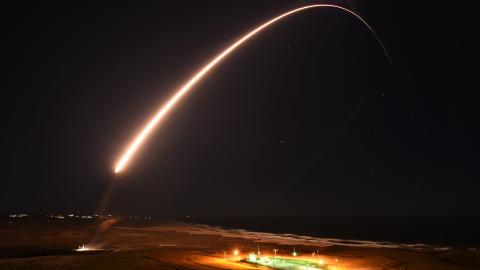
An Air Force Global Strike Command unarmed Minuteman III ICBM launches during an operation test on February 23, 2021, at Vandenberg Air Force Base in California. (US Space Force)


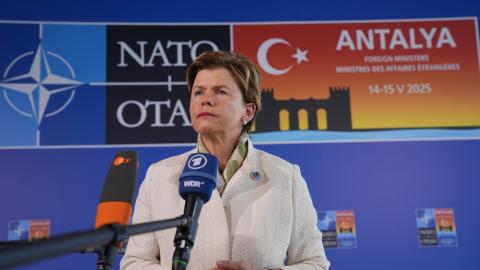
Since joining the North Atlantic Treaty Organization alongside Lithuania and Estonia over 20 years ago, Latvia has been a key part of the alliance’s Baltic Sea posture. Riga continues to invest heavily in security, expanding the size of its armed forces, procuring key capabilities like American-made High-Mobility Artillery Rocket Systems (HIMARS), and building out a Baltic defense line alongside Estonia and Lithuania.
Bordering the Baltic Sea, Russia, and Belarus, Latvia’s geographical importance is obvious. Additionally, Latvia has been a strong supporter of Ukraine in its war for survival. Since 2022, the country’s contributions to Ukraine are the fourth largest relative to gross domestic product. And Latvia will join the United Nations Security Council in January 2026 before taking on the UNSC’s rotational presidency in November.
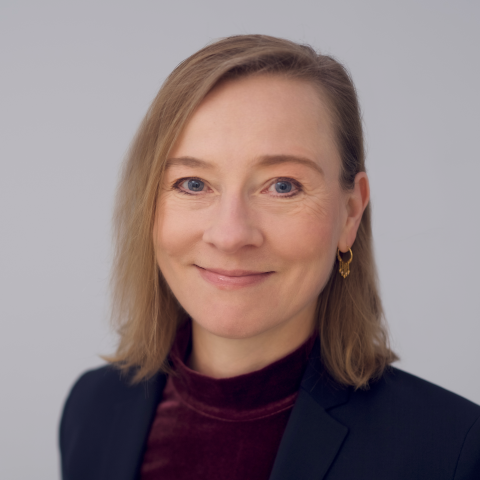
To discuss the future of Latvian foreign policy, Peter Rough will welcome Latvian Minister of Foreign Affairs Baiba Braže back to Hudson for a fireside chat.
Listen on Apple Podcasts and Spotify.
Peter Rough:
And with that, good afternoon and welcome to Hudson Institute. My name is Peter Rough. I’m a senior fellow here and direct our Center on Europe Eurasia. And it’s truly my pleasure and honor to welcome back, I’d say, a friend of Hudson’s. I’ll assign you that name even if you haven’t granted it, necessarily, but I’m sure you consider us a friend as well. Baiba Braze, who is the former minister of Latvia. Previously, we got to know each other when you were assistant secretary general for public diplomacy at NATO.
Baiba Braže:
Correct.
Peter Rough:
A longtime thought leader in foreign policy. Served a long time in the foreign ministry. And so it’s no surprise that you wanted to come to a think tank during your trip through Washington. Welcome to Hudson. It’s a real pleasure to have you here.
Baiba Braže:
Thank you so much. It’s good to be back.
Peter Rough:
So you’ve been on the road quite a bit of late.
Baiba Braže:
Yes.
Peter Rough:
I just discovered that you were in Ukraine recently. Maybe we’ll just start with a question there, which is, what were your impressions in Ukraine? What did you learn? What can you tell us here in the United States about the situation there?
Baiba Braže:
Yeah, I spent two and a half days in Ukraine last week, both in Kyiv but also going to Chernihiv, 70 kilometers from the front, speaking to a wide variety of groups. Of course, the officials, President Zelenskyy and defense people, foreign ministry, but also NGOs also, people on the ground in Chernihiv who really care, whether for children without parents, for injured soldiers, those that need rehabilitation.
And the overall assessment, yes, it’s not an easy situation in various aspects in Ukraine, but in the same time the will is there. They’re not going to capitulate or give up or give away their country or identity to Russia. So that iron will is there. And of course, that’s very important to know because, for us, the security defense priorities are pretty clear: make ourselves stronger, so investing 5 percent in defense, but also a lot in internal security, making sure internal, external works together. Support Ukraine and weakening Russia’s ability to fight the war, but also denying Russia money, technology, and international support because the peace can come only through the pressure on Russia. We don’t see, otherwise, any indications that they do want peace. So, for that, actually, takeaways from Ukraine very important. Very important.
Peter Rough:
So Latvia has clearly done its part in supporting Ukraine. No one can deny that. At the broader European level, what do you think needs to be done to ensure that pressure, as you just described it, can back that iron will that Ukraine already possesses to get to a strong point at the negotiating table if it isn’t there already?
Baiba Braže:
I think one is cognitive. I think that Europe, if you say, generically, “Europe,” or, “The European Union,” or whether, “European community,” has to recognize its strength. We are rich, we are strong, there is a lot of us. So, getting to, whether it’s 3.5 percent for defense or 5 percent for defense, making sure that we invest in those capabilities that we have them is something that is achievable. And I think there are too many inhibitions at a national level that, “Oh, can we do that?” And so on and so forth. Yes, we can do that. So recognizing Europe’s strength and then, of course, doing also practical work that needs to be done. And so it’s less about talking, more about doing. And of course, also working very closely together with the US at various levels. That’s why we have a delegation of MPs here to work with our partners in the Congress.
That’s why we have me here. That’s why we have regular visitors from the defense sector, technologies. And that goes for all Baltic States, Poland, and others. So, investing in the relationship with the US.
Peter Rough:
And at the military level, obviously, Ukraine has needs at the financing level as well. There’s been a lot of talk about shortfalls in the Ukrainian budget, which will really begin to bite in the coming months. Is there any update on where Europe might stand in helping support Ukraine financially?
Baiba Braže:
Well, Europe has been and still is the biggest supporters for Ukraine, both military needs but also all the other needs. In Latvia, we provide about 0.3 percent of GDP for military support. That’s more than we have committed in a binding way. And overall, throughout the country and throughout the population, it’s more than 1 percent of GDP. It’s massive. I don’t know anyone in Latvia who would not have supported Ukraine in one way or the other. But again, Ukraine itself is producing a lot. Let’s not forget that. Ukraine’s defense industry is doing well. For Ukraine itself, various capabilities. Obviously, they need certain US capabilities that only US has. That’s why, in NATO, we are also supporting all of us, currently 23 allies, I believe, out of 31. We are supporting the priority list for Ukraine, which allows Ukraine to buy US weapons in a quick, prioritized way.
So that part is also very important. Then of course, there is a wide international community supporting Ukraine in various different ways. The fact that Russia was not elected to OPCW Executive Council or International Maritime Organizations Council, or the International Civil Aviation Organization International Court of Justice, that shows that the international community is not fooled. They know what Russia is. It’s an aggressor. That it is violently, openly regressing against the UN Charter principles. So again, that sort of pressure on Russia is crucially important to be continued.
Peter Rough:
So the reparations loan debate remains a live issue and ongoing?
Baiba Braže:
Yeah. I avoided mentioning it because, again, that’s a part where you don’t need so much to talk about it, but to really find the ways, because political will is there. European Council, which combines the leaders of the EU, has been clear that the money is frozen, is not going back to Russia unless Russia pays compensations and reparations to Ukraine. Then, how to use that for practical support to Ukraine is the next step. And that’s where the Commission has come to with its proposal, which we, in general, support. Then there are practicalities because there are a lot of details in each one of those, and that needs to be worked out. And we still have time, before the European Council to, do that.
Peter Rough:
So no one’s fooled by the Russians in these elections to international bodies. But of course Latvia had a great triumph. People are impressed by Latvia. And you are less than a month away from joining the UN Security Council on a rotating basis. I think in November you’re due to even hold the gavel as the president of the United Nations Security Council. Prior to coming to Hudson, if I have it correct, you were over at the OAS, the Organization of American States. So, while we often look to Latvia to understand Russia and the Baltic security environment, you’re really going to be opening the aperture to look at global issues even in the Western hemisphere, which in the National Security Council . . . Sorry, National Security Strategy is going to be a focus for the National Security Council. It’s really a new element there. Tell us a little bit about how Latvia sees not just immediate neighborhood, but what are you going to be doing on the Security Council? How do you think of, say, the Western hemisphere now that that’s an area of priority and importance for you?
Baiba Braže:
Everything we do is at various levels. National, regional, European, transatlantic, and so on and so forth. So depending on the organization, depending on the security defense issue. And as I said, one very pressing issues that we have is of course the international recognition that we are in the world that is being torn apart by Russia’s aggression. And there, we have worked not only in the UN but also in other organizations in various constellations. But the UN Security Council will be very important to make sure that those issues that are important for Latvia, whether that’s on the classical, conventional threats, Russia’s behavior, the behavior of Russia in Ukraine, whether that’s on stolen children, whether that’s on prisoners of war, whether that’s on all types of other issues are actually brought to the Council and that there is that biggest stage of the world that hears the fact. Because for every issue, the UN staff brings their factual-based reports on what is happening on the ground.
So it’s not interpretations by one side or the other. It’s not interpretations by international media, but it’s fact-based reporting on the basis of which. Then the Council can decide or not on certain issues. The same with regard to issues related, for example, to maritime security. And that’s what I discussed today also at the OAS. Such as shadow fleet. Russia’s budget income very much comes through the exports of oil and gas. And the biggest part of that is moved through the Baltic Sea via this so called shadow fleet, or the ships that are aging, that are not secure, with crews that are not properly trained. No insurance and so on and so forth. And many of those ships change flags at will in a very quick way. Sometimes they are without a valid flag, such as the ones that was impounded by the feds.
So in that respect, also it presents cases for other regions in the world. And there the action can be variety. In our case, NATO has put a new operation, the Baltic Center into the Baltic Sea. So that has created additional sort of ability to understand and follow and actually constrain.
Peter Rough:
They’ve been pretty effective, I understand-
Baiba Braže:
They have been pretty effective, that there has been no new damage to the critical infrastructure since the operation is there. But it also gives additional information on what is happening with the shadow fleet, the presence, and so on and so forth. But then also diplomatically, through national efforts, through the efforts of External Action Service for example, we have approached countries of flags of convenience because, again, these shadow fleet ships very often change these flags. And the ease how it’s done enables the war efforts because the money goes back into Russia’s budget. So making sure that, again, that the nations recognize-
Baiba Braže:
. . . Russian budget. So making sure that again, the nations recognize that they have to do something about it. And then of course, also the sanctions or restrictive measures, as we call them in the EU, where all the ships that are presented that are found to be part of the shadow fleet can be put on the sanctioned ships list. So they’re not allowed to enter certain ports, the ecosystem and so on and so forth. So there are still measures that need to be applied, which will be part of the next round of sanctions, but that has brought down the ability of Russia to export the oil through these methods.
So again, also in the UN Security Council, we have seen the countries in other regions that are very interested in actually looking into this because DPRK is using quite a number of those ships to smuggle weapons to Russia, and then they go to the battlefield in Ukraine, obviously. So there is a wide interest from various corners in the world to look at these new and emerging threats also from the Security Council point of view.
Then on Western Hemisphere, yesterday also at the Kennedy Center I had met Pam Bondi. So we had a discussion on the organized crimes, the drugs, the smugglings, the enablement of certain forces to do that. Affects not only the US, it affects Europe very directly. It goes either directly into Europe through various methods, mostly by cargoes, but it also sometimes go to Western Africa and then into Europe.
Peter Rough:
The drugs now you’re referring to.
Baiba Braže:
Yeah. Drugs and substances and all types of stuff. So again, there’s a common interest on actually understanding, okay, we can’t fully stop it, but we can try to limit it. And there, the collaboration among various nations is crucially important. So, looking how to integrate, again, that is a sort of emerged threat and how to integrate the ability to deal with that through various efforts of various countries. At the end, we are all interconnected in that. So clearly cyber, AI, interference. So, there’s whole spectrum of issues that we would like to see brought up.
Peter Rough:
And when you are in the rotating presidency, does that, it’s a bit of a false comparison, but like a European Council rotating presidency, give you some agenda setting powers then that you intend to exercise?
Baiba Braže:
A month before you publish a program and that depends slightly, of course, what are the topicalities at the time, what other presidencies have brought in. So, we’ll publish our program next October. There’s always one high-level event and that will coincide with the time when the UN General Assembly sits. So those are the three months. So depending on the situation in the world, depending on the issues that need to be solved, it will surely be a security-related issue. And by then we’ll continue working very hard to achieve this long-lasting peace in Ukraine because that is a primary interest, I think, not only for Latvia, but for all the countries in Europe and beyond.
Peter Rough:
Okay. Well, let’s go back to Latvia, cross back from New York over the ocean to Riga, and go back to the five percent that you mentioned at the outset, because in the lead-up to The Hague Summit, some allies were really straightening their budget projections, and I’d say some were even uncomfortable. Madrid comes to mind, making the 5 percent declaration for fear of being able to hit certain thresholds and decide whether it’s necessary. Latvia could almost sit back because you knew you were going to hit 5 percent. You knew that you were on your way. I know it’s a very painful and difficult thing to do because you have domestic political constraints like anyone else but tell us a little bit about your attitude on defense.
The HIMARS purchase I think has been top on the news when people talk about Latvian defense thinking. This is of course the American artillery rocket system. Tell us a little bit about the 5 percent and what it means for you and how you think about regional defense in the Baltics particularly.
Baiba Braže:
Again, those principles of what you need to spend doesn’t come out of thin air. They come from the practicality of defense planning, which is in accordance again with NATO’s defense plans. NATO changed its military strategy in 2019 from out-of-area operations to defense of the allies and populations, which meant that the command structures, the defense plannings, the regional plans, the authorities of secure . . . I mean, the whole spectrum had to be changed. So these regional defense plans provide for certain capabilities for various allies. So we have the north, the centers, the south, the west. So all the allies have to invest in that and they’re quite demanding. They’re quite demanding. It’s not an easy task. So we took it very seriously.
And again, I can’t talk about details because it’s classified, but there are purchases, but there is also increase of armed force itself. There is the whole resilience issue around the cyber critical infrastructure, military mobility, the speed of enablement that is involved. So we are doing that as far as we are concerned, but we also want the others to take it as serious. And now that is not easy, we recognize that. What was helped in our case that our budget deficit is quite low, relatively low, the sixth lowest in the EU. And so there was some borrowing capacity which allowed us to increase at that expense so fast that we didn’t have to just go for budget cuts for other institutions, but we could also increase a certain borrowing capacity, which is much more difficult for others because if your budget deficit is already very high and the debt is at 70, 80 and 90 percent, it’s quite hard to make further decisions.
So that was the practical approach, both cutting expenditure, which gives the possibility of reform internally, but then also rational borrowing, so EU’s SAFE program and a few other steps through which we can get low-level loans for the quick purchases. But it’s hard because of course you can’t cut salaries of teachers. You need to increase them. You can’t cut health sector. You need to invest in it. So there is still the society demands normal lifestyle, so that’s what it is. And then the additional part has been obligatory military service, a conscription, which is going well, which is very popular actually. And in some parts, it’s oversubscribed.
There’s more requests than actually military needs. Reservist program, so twice a year, people serving wherever they are in any institution in the country, private or public sector, can go for three weeks into the reserve training. So they spend three weeks doing sort of preps, how to handle weapons, how to communicate, how to have basics in military medicine and so on and so forth. And then the other part is the National Guard, which is a part of the armed force, but it’s voluntary and it trains on the weekends. It also has a three-week obligatory preparation program. And then for the rest and during the weekends, you are appointed to a certain division, certain force, and that trains together with the armed force on a regular basis.
So it’s also that comprehensive approach of society, and also school programs for basic defense training. There is a so-called New Guards program because a lot of youngsters have interest in learning, orienteering in the forest, also handling weapons, basic weapons, and so on and so forth. So it’s a serious effort and that all obviously costs money, but it also brings back to the society great benefits because people have more sort of enablement of themselves. There is, okay, I know what to do if something arises.
Peter Rough:
Yeah. Right. Which reminds me of the opening days of the full-scale invasion when you had those videos from Kyiv where people were just grabbing weapons from the back of pickup trucks and kind of rushing ad hoc on ways to defend the capital. So a systematic approach to society-wide civil defense is obviously important. We’re here in Washington, so we have to talk about US-Latvian relations, of course. I believe this is your eighth visit to Washington since December, or to the United States.
Baiba Braže:
US.
Peter Rough:
US, I should say. Yeah. How do you think the arc of the Latvian-US relationship has evolved over those eight visits? How are things different than maybe back in December or how are things better than they might be or the same as they were back in December?
Baiba Braže:
I think I can say that all of the Baltic relationship with the US has been close, close, close, as close as possible throughout the history of the Baltic States, starting from the establishment of the Republics in 1918, when the US was on the ground, actually during the First World War and after the First World War, present with various activities through the Red Cross, through feeding the soldiers and so on and so forth. And throughout the strengthening of independence in the ‘20s and ‘30s, but also through the very clear stance of non-recognition of occupation of 1940 when the Soviet Union occupied us. And that served as literally the basis of restoration of independence in 1990. We have a lot of community here. There’s a lot of American investment in the Baltics, US soldiers on the ground, lots of practical collaboration through the National Guards, but also through the regular-
Baiba Braže:
. . . through the National Guards, but also through the regular army exercises, NATO membership, and so on and so forth. So that relationship is strong, non-problematic on both sides, because we don’t have a single sort of bilateral irritants in the relationship. And also, very open relationship in terms of having a lot of dialogues, lot of off-the-record conversations, on-the-record conversations, visits, and engagement. So we actually welcome the NDAA proposal that was published yesterday, the compromise proposal. Clearly also very favorable to the Baltic states. We think that reflects the strengths of the relationship.
Peter Rough:
Well, in the category of visits, my newest colleague at Hudson, Sophie May, is actually a Fulbright. She studied in Latvia, so I wanted to mention that and raise that knowledge—
Baiba Braže:
Where is she?
Peter Rough:
She’s sitting in the back, listening very attentively. And when I asked her before the event, “Can you make it? I know you’re busy.” She said, “I wouldn’t miss it for the world.” So Sophie’s our living embodiment of Latvia-US relations. Another colleague of mine or two colleagues in the back, Luke Coffee and Dan Coaches, have spoken a lot in meetings and written about the importance of non-recognition on the Baltic precedent for the Ukraine negotiations.
Baiba Braže:
Absolutely.
Peter Rough:
Where are the Ukraine negotiations? I was going to come up here and cite a clever line about how many times Secretary Rubio or Special Envoy Witkoff have met with the Ukrainians and Russians, but I’ve lost count; it’s such a busy period in diplomacy. What are you hearing on that front, and where do things stand?
Baiba Braže:
I think the US commitment of hosting these negotiations here in the US and Miami for more than three days and then going back and forth and constantly engaging, I think it’s very commendable. The non-recognition of occupied territories is crucially important, because ultimately what Russians would want is the US recognizing the incorporation of territories into Russia. So that is one thing that we have raised with colleagues here. And again, it’s up to the US to decide, but the way they have handled the issue in other historical cases is crucially important. And I think it’s also President Zelenskyy and the officials have been very clear, that for them, recognizing the legality of occupation is quite impossible, because it’s a democracy. They have strong opinions by people and by other parties and by armed force and others. So they have their constraints too. So I think it’s something that has to be recognized in that respect.
The negotiations are going, from what I understand, also we caught up last night on some of the issues with colleagues here and in Ukraine, on some points, quite rational, quite advanced, and then on some points it’s very difficult. And that difficulty is not on the Ukrainian side, that difficulty is on the Russian side. And this is where we are. I mean, there is an aggressor attacking an innocent victim, and it wants to achieve through peace negotiations what it cannot achieve on the battlefield. Because Russia this year has occupied less than 1 percent of Ukrainian territory. It has lost more than 280,000 soldiers. Overall, it’s close to 1.2 million killed and severely wounded Russians. Economy is not doing well. We see the spiral every time Russia cannibalizes its civilian economy. It’s not a productive economy. They don’t produce anything they can literally export except of oil and gas. So yes, more pressure on Russia is a key for success in the negotiations also on the outstanding issues.
Peter Rough:
Am I to read from that, the sticking points would be more on the territorial and security guarantees points of the negotiations, or am I over-interpreting your comment?
Baiba Braže:
There are issues that are really best dealt with in negotiations and not in-
Peter Rough:
There’s no one listening, man. You can—
Baiba Braže:
No, no, it’s true. I mean, and I welcome the fact that these points are not being published, that the substance is being close held, because that’s exactly for success that you need it. And it’s often the case in diplomatic and other negotiations that you can’t put everything out there in the open. Because then the commentary will take you away and the impressions of others will take you away from actually what is needed to achieve success. But it’s not going to be ideal. I mean, ideally, Ukraine will just kick Russians out from all the occupied territories, if you ask me what is just. But then again, Ukraine wants peace. Ukraine wants peace. Ceasefire has been on the table since March.
Peter Rough:
One way to guarantee peace in Europe or at large is the presence of American troops. That’s an argument we’ve heard from our European counterparts. Time and again you referenced the NDAA language, which caps the withdrawal of American troops from Europe. And I see one of your Lithuanian colleagues here, a tourist. The Baltics like to travel together very strongly to the US and deliver their message. Tell us about force posture in your region from the United States, which is an important issue. What are the Americans up to in your region, how important is it that they’re there, and what would you like to see go from here?
Baiba Braže:
So on the national security strategies that we covered a little bit when discussing earlier before the event, there have been, again, sort of loud commentary on certain elements, what has been said about Europe and what has been said on certain issues in Europe. But in the same time, there is a lot of rational positive stuff, that Europe has to be strong, that Europe has to take much more responsibility for investment in defense and security, that US needs Europe that is strong to handle both the global challenges such as China and Russia and others. So there is a lot of positive constructive stuff, but that as always doesn’t get the attention than some of the critical remarks. And then on the critical remarks, if you speak about the migration, I think all the Baltic states and Poland will agree what has been written, is that illegal migrations, that instrumentalization of the migrations, that the security of your borders is paramount.
We actually have built a fence on our Eastern border. We have the pushback policy of illegal migration, because Belarus is instrumentalizing illegal migration to push into our territory. So we see it as part of those threats that is not a conventional attack, but a significant security challenge that needs to be addressed as such, not just looked at it separately from everything else. So there is a lot of good alignment, we see international security strategy. And then also on the US troops in the Baltics, yes, we would like to see more troops in the Baltics because we do see that the deterrence in practice works. And those troops, US troops in the Baltics, they’re not sitting in barracks. They exercise together, for example, in Latvia, we have 14 other allies in Latvia with their militaries. So they engage in such exercises that they might not be able to do elsewhere.
And the facilities are great because like the new range of selonias that we are developing, it’s brigade size maneuvering. So with electronic warfare, with all the capabilities that you won’t find elsewhere in Europe, the same on various tech advantages, the same on drones, the same on integrating all the practical assistance that we are giving to Ukraine on the front, those experiences, bringing them back and integrating them in the training on the ground. So US loves exercising in the Baltics and I’ve spoken to quite a number of them. So they feel they’re—
Peter Rough:
Even in the winter?
Baiba Braže:
Yes.
Peter Rough:
Okay.
Baiba Braže:
They feel they’re advancing. They feel it’s for their own benefit. So more US troops, good.
Peter Rough:
And I believe your framework nation for the enhanced forward presence deployment is Canada.
Baiba Braže:
It’s great. They’re great.
Peter Rough:
Is it going well?
Baiba Braže:
Yes.
Peter Rough:
Okay.
Baiba Braže:
Super good.
Peter Rough:
So, ESP is working well for land forces, Baltic policing.
Baiba Braže:
We have a perfect match with Canadians also in various respects, and the fact that they have been able to integrate 13 other nations in the EFP, and again, working together and exercising real battle scenarios and also working now with Brunssum and others on the hybrid scenarios and a variety of other issues. Excellent.
Peter Rough:
Great. Well, we’ve already opened the aperture once for your security council seat and talked a little bit about issues beyond Russia. And of course we look to Latvia and Riga to learn a lot about the Russian Federation in Moscow, but that war effort is being backed pretty aggressively by the Chinese and by Beijing as well. Can you tell us a little bit about how you view China in Europe now and the role it’s playing in the war in Ukraine?
Baiba Braže:
So China is both in the NATO strategic concept, identified quite distinctly from Russia. It’s not identified as a threat to Euro-Atlantic security, but there’s a significant challenge, and where it’s behavior where there’s a behavior on not being transparent about the increase of its nuclear and other capabilities. Also, more assertive behavior in the region actually creates certain challenges for the allies, but also for the region. And in the EU, quite clearly, it’s a three pillar approach where China is a challenger, an economic challenger, but also a political security challenger. It’s a competitor for European companies, not only within the EU with its economic policies, but also in the, for example, Western hemisphere, where it’s subsidizing its companies and squeezing out Europeans from markets here. And also Americans. When we look at the data, for example, for Mercosur, China has replaced both the EU and the US very much in the markets there. But also it can be a cooperation partner in certain issues, and there have been in the UN, for a number of international . . .
Baiba Braže:
And they have been in the UN for a number of international conventions on preserving nature, diversity, maritime diversity, and some other issues where China has been a constructive corporation partner. So, that is the EU’s approach.
Having said that, our own trade with China, as for most of European countries, the trade balance is negative. And those Latin companies that have wanted to export into China have faced great difficulties in entering the market. And those have been variety of difficulties, the administrative practices, certification, and so on and so forth, which all is taking a long time. And that is quite a typical type of situation.
But that trade for us is not significant. It’s small. Our biggest partners clearly are in Europe and that’s how we want to maintain it. The increases in our trade go to the countries with which the EU has concluded free trade agreements, whether that’s Japan, Korea. Also, we look forward to Mercosur entering into force, the trade agreement between the EU and Mercosur. There is a great interest on our side.
Then on specific issues, I think the technological AI data challenge is huge. And that is what the NSS speaks also about the US, that the competition, the advances that China has made is so serious that there is a doubt if we can catch up with that or overcome and return to dominating position. So, from that respect, we fully understand the US technological companies that want to cooperate with Europe much more sort of closely. The chips, the supply chains, the rare earth metals, the practices on export controls that have been there, as the Experia example and the uniqueness of that company, I think, have opened a lot of eyes in Europe.
Peter Rough:
Because even if the trade values for certain countries are not all that significant, the areas that we do depend on are hugely important and can create shock waves.
Baiba Braže:
Yeah.
Peter Rough:
I don’t want to press you too far on this, but would you say on those kinds of tripartite definitions from partner to competitor to rival, that one outweighs the other? Or what’s the balance within that three part definition?
Baiba Braže:
Sometimes it’s quite strange. So, in my foreign ministry, we have all the tools for foreign policy concentrated in my ministry, which means in the EU, it’s understanding it’s a classical foreign defense policy, so CFP, CSDP. So, I sit on the foreign affairs council and also the trade council, so the trade is also an instrument that we have in the foreign ministry, but also development aids.
But then in other administrations in Europe, foreign policy and trade is completely separated. And then when I go to those two councils and sit on them, I have the feeling that some countries are not even consulting among different ministries because the ministers in the Foreign Affairs Council on China speak one way, and then in the trade, it’s entirely different.
So, I think more integration also at a national level on economic security, on really understanding the impact of various practices, of various technologies that China has, whether that’s on the cars, on the data gathering, on a variety of other issues, I think is very important.
But then also the trade flows. Yes, our tech companies also use certain rare earth metals, certain chips, and other stuff that they get from Germany. But then of course, where Germany gets it is also . . . so, there is that dependency. There is that systemic dependency. And that’s why that relationship has to be handled.
The way we approach is that we recognize the importance of China as a global force. We recognize the need for transparent, rules-based relationships. And we also recognize the needs and the understandings that China is enabling, for example, war in Russia, not by providing military equipment but certainly by providing dual use tech. And that enables Russia to continue producing missiles, to continue doing other stuff.
But again, to have that direct dialogue, to have that ability to work together on wider international issues is crucially important. And that’s why differentiation, how we perceive Russia and how Russia is defined in NATO and in the EU, but also at national level, differs very much from China, very much.
Peter Rough:
Well, ma’am, a final question. And that is, is there one thing that those of us who follow Europe and follow Latvia, but because we’re not Latvians, we might be missing about the country? I mean, Sophie will know. But the rest of us might not fully be totally anthropologically up to speed. What’s something we should know about Latvia that we might be missing that helps explain some of your strategic outlook or how you view the world?
Baiba Braže:
I think what you need to know about Latvia is that, from one hand, of course, we are one of the oldest sort of cultures, identities in Europe, one of the oldest Indo-European languages. So, it comes with a lot of sort of heritage.
But from other hand, we are one of the most modern nations, highly digitalized, internet speeds, everything. I sign cabinet documents on my phone. I haven’t been to a local government, I don’t remember for how many years, because there is no need to do that. You can do everything online. You have that access, transparency, declaration. We declare taxes. It takes about 10 minutes to fill our tax declaration. I mean, it’s quite a big country. It’s twice as big as Belgium by territory, 1.8 million. So, you don’t want your people sitting in lines somewhere in the local governments. You provide those services online so that they can access it as much as necessary.
And so, that is the mentality, that ability, transparency, speed, and quickness. I mean, what our drone companies are doing, and there is quite a bit of US investment in that, the autonomy is owned by Redwire from the US. Their capability to provide certain types of drones that enable Ukrainian self-defense, that enable quite a bit of US capability, and from what I understand, President Trump’s golf fields are also guarded by those drones, is quite significant. And so are other capabilities that we develop. It’s electronic warfare, jamming, all types of dual use stuff, one of the quant technology centers in Northern Europe.
Peter Rough:
Well, those golf courses are probably more precious to the president than some high ranking securities.
Baiba Braže:
Guarded by Latvian drones.
Peter Rough:
So, thank you for that. Thank you for being here. Thank you all for being here in person. And for those of you who joined us from home, from your offices, wherever you may be from Latvia. Please visit hudson.org for more of our program. Thanks so much for being with us and we look forward to seeing you at our next event.
Thank you for being here and please join me for a round of applause.


This certificate program is designed to provide policy professionals with a crash course in military tactics and operational realities.

Join Senior Fellow and Keystone Defense Initiative Director Dr. Rebeccah Heinrichs and Administrator of the National Nuclear Security Administration Brandon Williams for a discussion on the administration's priorities in strengthening the US nuclear enterprise.

Please join Acting Chairman of the Council of Economic Advisers Pierre Yared for a conversation with Senior Fellow Tom Duesterberg on the first year of the Trump administration’s economic agenda and the key factors shaping the US economy’s outlook.